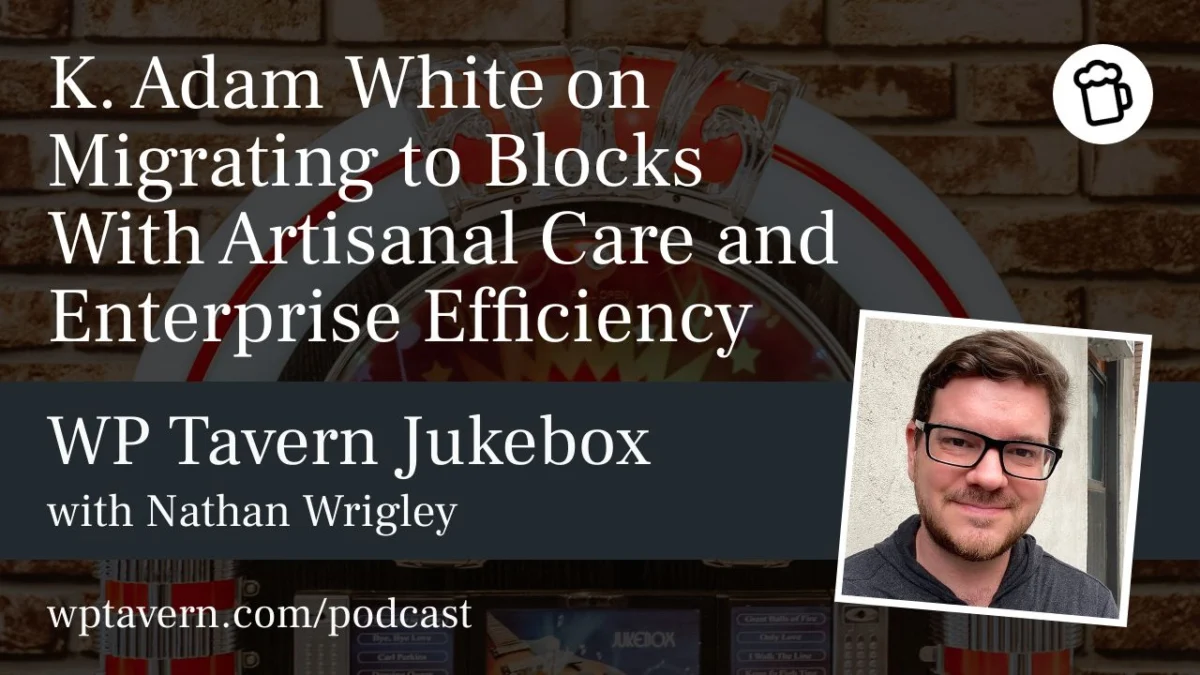
The evolving landscape of enterprise web development often requires balancing meticulous design precision with massive technical scale. At WordCamp US, K. Adam White, principal engineer at the enterprise WordPress consultancy Human Made, took to the stage to address one of the most critical hurdles facing organizations modernizing their web infrastructure: migrating thousands of legacy pages and posts into the WordPress block editor.
Speaking on the WP Tavern Jukebox Podcast with Nathan Wrigley from the corridors of WordCamp US, White discussed the intricacies of moving massive volumes of content from proprietary or legacy content management systems into WordPress. With nearly two decades of experience in the WordPress ecosystem—attending his first WordCamp in Boston in 2011 and contributing extensively to core development—White offered deep insights into how high-stakes enterprise migrations are executed without compromising brand integrity or visual fidelity.
The shift toward native block editing represents a fundamental change in how large organizations handle their digital presence. While smaller websites can easily transition using basic automated tools or the built-in content conversion features of the WordPress editor, enterprise migrations involving tens or hundreds of thousands of complex posts require a sophisticated blend of automation, auditing, and structured design frameworks.
Transitioning From Legacy Systems to the Block Editor
Human Made has been heavily invested in the block editor ecosystem since the early days of the Gutenberg plugin, consistently advocating for native WordPress blocks and full site editing over third-party page builders when building new projects from the ground up. For global brands and large enterprises moving away from legacy platforms like Sitecore, the editorial experience offered by WordPress serves as a primary driving force behind the migration.
However, moving massive amounts of legacy data presents distinct technical challenges. When content is migrated strictly as basic headings, paragraphs, and standard images, the resulting loss of layout and visual structure demands an unsustainable amount of manual cleanup from editorial teams. To solve this, Human Made focuses on a pattern-driven development approach, leveraging the modular capabilities of the block editor to map legacy data directly into pre-designed theme patterns.
White explained that rather than discarding layout data or forcing editors to manually reconstruct complex page structures, the consultancy utilizes automated migrators to read source databases and inject content directly into the structured HTML of predefined theme patterns. This ensures that when an editor opens a migrated page, the content loads seamlessly within the editor without triggering block validation errors, while maintaining exact visual consistency on the front end.
Leveraging Artificial Intelligence and Open Source Tooling
Managing the sheer volume and unpredictability of enterprise content archives requires advanced auditing capabilities. During the interview, White highlighted how the integration of modern artificial intelligence tools and automated agents has dramatically accelerated the migration workflow. By feeding legacy database exports—such as the complex dual-database structure utilized by Sitecore—alongside product documentation into AI systems, the Human Made engineering team can perform comprehensive cross-site audits rapidly.
Using these insights, developers build local databases in SQLite that allow teams to query source data, identify edge cases, and map out varied content types with unprecedented speed. Furthermore, Human Made has developed specialized open-source tools to streamline these processes. One such tool, an experimental plugin named rehydrator currently available on GitHub, enables developers to utilize theme patterns as templates during content importation, ensuring that structural styling remains firmly rooted in the theme rather than being duplicated across individual post contents.
Despite the power of modern automation, human oversight remains vital. White emphasized that engineering teams must conduct thorough spot checks and validate outputs category by category. By prioritizing migrations based on a careful balance between content scale and structural complexity, consultancies can ensure high reliability before content ever reaches client stakeholders for final review.
Editorial Control, Permissions, and Governance at Scale
When enterprise clients transition from rigid, highly restrictive content management systems to the flexible environment of WordPress, questions surrounding editorial permissions and governance invariably arise. Traditional enterprise platforms often provide hyper-granular access controls down to individual content nodes and text strings, allowing organizations to restrict user editing capabilities at a microscopic level.
WordPress, by contrast, traditionally relies on capability checks centered around post-level permissions. While features like block locking and partially synced patterns offer ways to protect brand guidelines and prevent unauthorized stylistic alterations, White noted that enterprise clients often choose to embrace a more flexible paradigm. Rather than relying on draconian restrictions that lock down every element of an interface, organizations frequently opt to adapt their internal editorial processes—implementing review steps, publication checklists, and workflow plugins—in exchange for the superior flexibility and user experience that the WordPress block editor provides.
Addressing gaps within the core WordPress publishing workflow remains an ongoing conversation within the broader community. White pointed out that out-of-the-box behavior regarding published posts—where subsequent edits immediately go live upon saving—frequently necessitates the addition of custom workflow solutions for enterprise clients who require robust editorial review cycles. Nevertheless, the overarching trajectory for enterprise adoption remains strong as organizations recognize the long-term viability and extensibility of the open-source platform.
Ultimately, modernizing digital infrastructure at an enterprise level requires an alignment between robust core architecture, carefully structured theme patterns, and intelligent migration workflows. By pairing artisanal attention to detail in design with industrial-scale automation, agencies like Human Made continue to bridge the gap between legacy enterprise complexity and the modern capabilities of WordPress.