
The modern web is undergoing a fundamental shift in its demographics, and human visitors are increasingly sharing cyberspace with automated entities. Recent data highlights this dramatic evolution, underscored by an extensive analysis from managed hosting provider Kinsta, which examined more than 10 billion web requests over a single year. During this period, researchers noted that AI-driven bot traffic surged by an astonishing 300 percent, cementing automated scripts and algorithms as a permanent, growing fixture of daily internet operations.
This massive influx of non-human traffic presents website administrators, developers, and business owners with a complex operational puzzle. As automated activity accelerates, experts emphasize that bot management must become a proactive priority rather than a reactive afterthought. Without early intervention, unmonitored automated traffic can degrade site performance, inflate infrastructure costs, and ultimately compromise the user experience for legitimate human visitors.
However, the solution is rarely as simple as throwing up a digital barricade to block all incoming automation. The digital ecosystem relies heavily on a wide variety of bots to function efficiently. Essential automated entities—such as search engine crawlers indexing content for discovery, uptime monitoring tools ensuring continuous availability, and legitimate third-party service integrations—provide undeniable value. Other bots may consume server resources without harboring malicious intent, walking a fine line between benign utility and resource exhaustion.
At the opposite end of the spectrum lie aggressive scrapers, credential-stuffing cyberattacks, and unauthorized AI data harvesters. These malicious or overly aggressive agents can create severe performance bottlenecks and security vulnerabilities, requiring swift and decisive action. The core challenge facing modern web managers is accurately diagnosing the nature of incoming traffic and deploying a measured, appropriate response that protects infrastructure without accidentally locking out legitimate utility.
It’s better to plan than to panic
When sudden traffic spikes or resource drains occur, the worst possible reaction is panic followed by a blanket block of all incoming connections. Industry professionals advocate for a calm, repeatable analytical process. Rather than resorting to emergency measures that could sever ties with search engines or customer monitoring tools, site managers should systematically evaluate what is happening beneath the hood of their web servers.

The first critical step involves distinguishing between a routine shift in bot behavior and an active, deliberate security attack. Before deploying countermeasures, administrators must gather intelligence on the specific patterns unfolding on their domains. If an analysis reveals a coordinated attack or an acute infrastructure failure, the immediate priority shifts to rapid site stabilization.
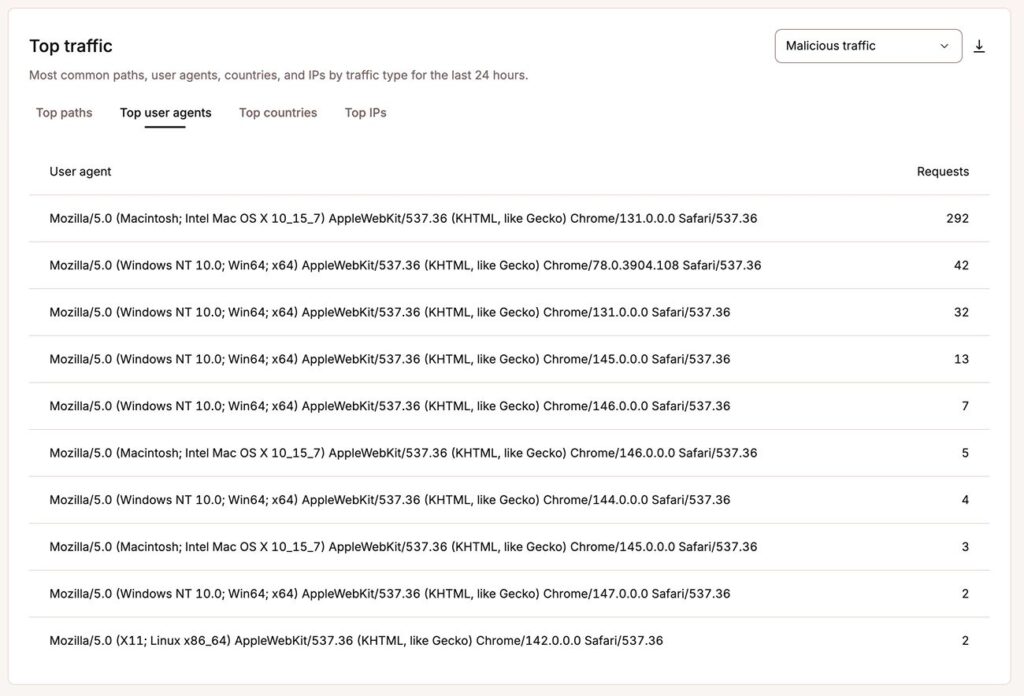
Yet, even when automated traffic is not causing immediate operational distress, adopting a proactive stance is vital. Establishing baseline visibility allows administrators to understand normal traffic flows before anomalies begin interfering with human audiences. Advanced telemetry tools, such as Kinsta’s bot traffic analytics, provide deep insights into how different categories of automated visitors interact with various sections of a website. These request breakdowns categorize traffic streams, allowing managers to inspect top traffic paths, user agents, geographic origins, and IP addresses.
Assessing site pressure and stability
A central factor in determining the severity of an automated traffic event is evaluating whether a website is currently under pressure. Administrators must monitor key performance indicators, such as unexpected spikes in server CPU utilization or memory consumption, database slowdowns, and surging error rates. Additionally, sudden bandwidth depletion or degraded page-load speeds for human users indicate that automated requests are straining available resources.
Identifying these warning signs early is essential. When a site is buckling under the weight of automated requests, legitimate visitors inevitably suffer from sluggish response times or service outages. Under such pressing circumstances, comprehensive investigations must take a backseat to immediate site stabilization.
Conversely, if a website is operating within normal performance thresholds, administrators have the luxury of time. They can bypass emergency containment and instead formulate a refined, long-term governance strategy for handling automated interactions.
Stabilizing the site under acute pressure
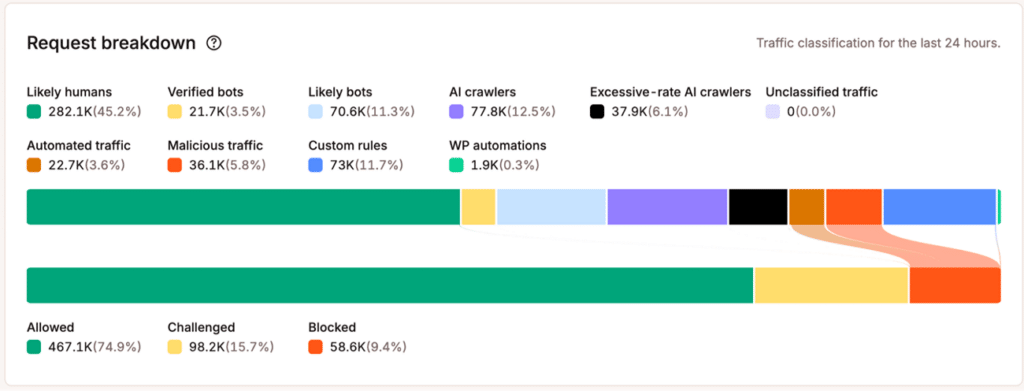
When a website is actively suffering from an influx of disruptive traffic, normal investigative procedures must be paused to restore functionality. Stabilizing the platform for human users takes precedence over identifying every individual bot behind the surge.
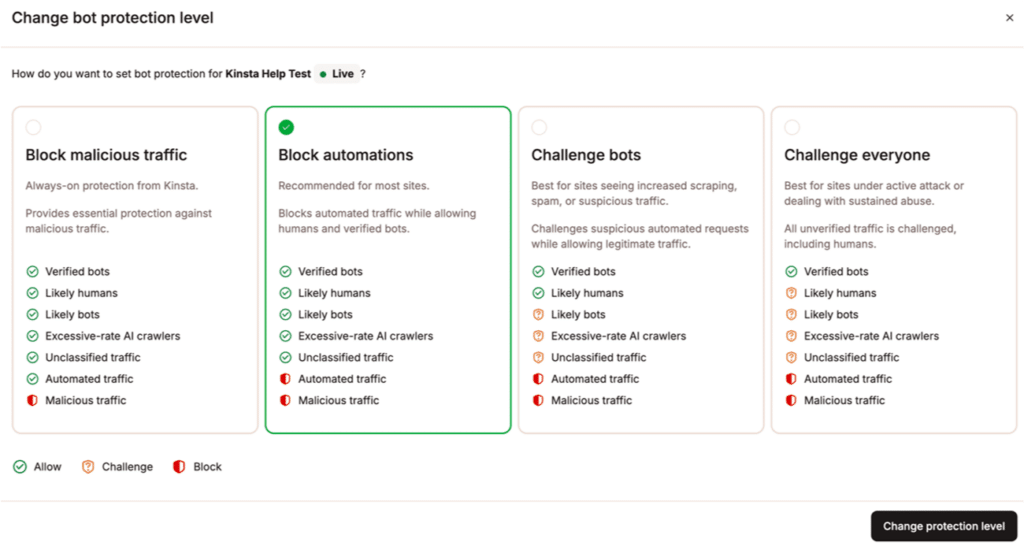
To regain control during an acute incident, administrators can leverage tiered defense mechanisms. Many hosting environments, including Kinsta’s built-in bot protection framework, offer adjustable security levels designed to mitigate heavy automated traffic quickly. While baseline security measures automatically intercept known malicious entities, elevated protection modes can be deployed temporarily to challenge or filter out unverified automated traffic.
Challenging all unverified bots or implementing broader verification screens may be more aggressive than what is required for routine, day-to-day operations. However, during an active crisis, these measures serve as an effective circuit breaker. They subdue the immediate pressure, bringing server loads back to manageable levels while the site owner develops a more nuanced, sustainable defense strategy.
Deciding what to allow, challenge, or block
Once immediate stability is secured, website managers can transition from emergency response to strategic planning. This involves formulating a clear policy to allow, challenge, or block distinct categories of automated traffic.
Allowing traffic ensures that beneficial crawlers, such as major search engine indexers and performance monitors, can access the site without friction. Challenging traffic typically involves presenting interactive verifications, such as JavaScript challenges or CAPTCHAs, forcing non-human visitors to prove they are operating on behalf of legitimate services or face rejection. Blocking, meanwhile, instantly denies access to malicious actors, aggressive scrapers, or unwanted resource consumers.
This decision-making framework relies on evaluating the source, intent, and resource cost of specific bots. Crucially, these rules do not need to be applied uniformly across an entire web domain. A site manager might choose to grant search engine crawlers full access to public blog archives while restricting or challenging their access to sensitive user account portals or transactional directories. Advanced control tools allow administrators to carve out granular exceptions based on specific IP addresses, URL paths, user agent strings, or countries of origin.
Responding to specific bot traffic scenarios
To understand how these principles apply in practice, it is helpful to examine common scenarios faced by website administrators, particularly those managing dynamic content management systems like WordPress.
Consider a scenario where a major search engine crawler generates a massive volume of requests, raising concerns about server load. Administrators must evaluate whether the crawler is indexing high-value content that drives organic traffic, whether the request rate aligns with standard web-crawling etiquette, and if the server infrastructure can absorb the load. Depending on the answers, a site manager might permit the activity while optimizing server-side caching, or selectively rate-limit the crawler during peak business hours.
AI crawlers present a more ambiguous challenge. Automated scraping bots deployed by artificial intelligence companies often generate substantial request volumes, but the immediate value they return to the website owner is frequently difficult to quantify. Administrators must weigh the resource costs of these AI scrapers against potential future visibility or referral traffic. Because different AI crawlers operate with varying degrees of transparency, web managers can utilize granular bot protection tools to establish distinct rules, permitting preferred discovery bots while restricting aggressive content harvesters.
Dynamic endpoints present yet another vulnerability. Automated visits to database-heavy endpoints—such as shopping cart checkouts, user login screens, search bars, and account dashboards—consume significantly more computing power than static, cached web pages. This phenomenon frequently impacts e-commerce platforms like WooCommerce. Although the bots visiting these pages may not be overtly malicious, their relentless interaction with dynamic scripts can drain server resources and disrupt customer transactions. In response, administrators often deploy targeted challenges or stricter rate limits specifically around transactional endpoints while leaving static content freely accessible.
Unidentified scrapers crawling thousands of URLs represent another common dilemma. When an anonymous bot aggressively harvests site data without offering any discernible benefit, further investigation is warranted. Even if the traffic is not overtly hostile, its resource-intensive nature justifies a balanced defensive posture, ranging from targeted user-agent blocks to behavioral challenges.
Monitoring results and adjusting the strategy
Implementing a bot management framework is not a set-and-forget task. After deploying new rules, administrators must continuously monitor key metrics to ensure the strategy operates as intended. This evaluation requires tracking server resource utilization, overall traffic analytics, search engine visibility, AI-driven referral traffic, and broader business Key Performance Indicators.
Continuous monitoring helps answer vital operational questions. Are legitimate human visitors experiencing any friction or false-positive blocks? Has search engine indexing slowed down unexpectedly? Are server resources returning to optimal levels? By analyzing these outcomes, site managers can fine-tune their exceptions, adjust protection thresholds, and maintain an equilibrium between security and accessibility.
The reality of the modern web
Automated traffic has firmly established itself as a permanent component of web operations. Because numerous bots perform vital functions that contribute to search visibility and site utility, adopting a rigid "block everything" mentality is neither realistic nor desirable for modern web properties.
Instead, sustainable website management requires a proactive, nuanced strategy that evaluates the economic and operational trade-offs of automated traffic across different sections of a domain. Tools providing advanced visibility and granular control allow administrators to navigate this shifting landscape, ensuring their digital platforms remain secure, responsive, and accessible to the human audiences they are built to serve.