By the end of a single afternoon, a developer can have a fully working WordPress plugin constructed with the assistance of artificial intelligence. It seamlessly routes form submissions to a client’s customer relationship management system and dispatches a confirmation email. When shown to the client, the response is overwhelmingly positive: Can this go live by Friday?
Yet, beneath the surface of this rapid deployment, critical operational questions linger. What happens when a user submits the exact same form twice, or if the CRM suddenly stops responding? Who has the authorization to change the plugin’s settings, especially when initial testing relied exclusively on a single administrator account? Before moving on to the next assignment, a colleague needs enough contextual understanding to troubleshoot the system while the original creator is away.
While that productive afternoon saves hours of initial coding time, it also leaves the agency with custom software that must now be supported and maintained indefinitely. As artificial intelligence makes software creation faster and more accessible than ever, the subsequent review and maintenance work can consume a significantly larger portion of the production schedule than teams initially anticipate. Industry discussions are increasingly focusing on where this extra workload lands, what it means for project estimates, and how optimized agency processes and hosting environments can help retain those hard-earned time savings.
Faster Production Changes the Workload
Some of the most immediate and useful artificial intelligence assistance happens long before a developer has code to show. Vague requirements are rapidly transformed into draft functions. Designers explore alternative layouts without manually building every single variation, and writers easily push past the intimidation of the blank page.
This acceleration can free up meaningful blocks of time. Developers who spend less of their morning writing generic boilerplate code or standard instructions suddenly have more room to investigate complex compatibility issues, provided the project schedule deliberately leaves that room open.
According to Google’s 2025 DORA research, more than 80 percent of respondents believed that artificial intelligence increased their overall productivity, and a positive relationship between AI adoption and delivery speed was widely reported. However, this productivity boost appeared alongside a negative statistical correlation with delivery stability. While these findings represent associations rather than direct causation, they clearly illustrate why focusing solely on faster output provides an incomplete view of modern software delivery.
Taking the CRM plugin example, a basic form submission can be made to appear inside a client’s account fairly quickly. However, complications arise immediately upon testing an email address that already exists within the CRM database. Should the plugin update that existing contact record, leave it entirely alone, or generate a brand-new entry? The underlying code must reflect the practical workflows of the sales team, including their specific expectations regarding duplicate submissions.
Sorting out these business logic details requires meaningful conversations with the client and thorough additional testing. Project managers must deliberately leave room for both activities within their initial estimates. If deadlines are aggressively moved forward by every single hour that artificial intelligence saves on initial coding, teams ultimately squeeze out the exact validation work that ensures a feature is genuinely ready for production.
The Work Moves into Review and Integration
Following a form submission through the perspective of a sales team member often reveals hidden gaps. While a new contact might successfully appear in the CRM, there is frequently no record indicating whether that individual has agreed to receive follow-up marketing emails. The plugin successfully transmits data without triggering a technical error, yet it omits critical compliance information that the internal team requires before they can utilize the leads.
Defining clear operational goals ahead of time helps establish what data must be captured across both WordPress and the CRM. Agencies can then verify the implementation against the realities of the live site. Existing agency conventions typically govern where settings must live, how credentials are securely stored, which system hooks are utilized, and how errors are officially logged. Following these established standards ensures that the next developer has far less guesswork to decipher when troubleshooting.
A standard website subscriber may never actually view a plugin’s settings page, yet they might still possess the capability to dispatch a request that alters those configurations. Thorough reviews of WordPress user roles must look beyond surface-level dashboard visibility. The underlying code must actively verify user permissions whenever information is read or modified. Data hygiene requires equal scrutiny: what information actually leaves the site, and do any private user details inadvertently end up in system error logs?

Artificial intelligence can assist in identifying potential security and functional gaps and drafting preliminary automated tests to check for them. By feeding specific requirements into the tool and asking it to critically examine underlying assumptions, teams can uncover blind spots. However, those behaviors must always be verified independently, as a test that merely repeats the implementation’s original assumptions offers very little genuine reassurance.
Before handing off a new feature, asking another developer to explain how it works and where they would investigate a potential failure serves as an invaluable stress test. Any hesitation or uncertainty highlights a clear opportunity to improve the code or documentation, ensuring the software is fully understood and owned by the broader team.
Easier Creation Gives Agencies More to Maintain
When a client requests the identical inquiry form on a secondary location’s website, the task initially appears to be a straightforward copy-and-paste job, with the minor caveat that incoming leads must be routed to a different regional sales representative. Duplicating the plugin and updating the assignment identifier makes both forms operational. However, a hidden maintenance debt is instantly created: when a bug involving duplicate contacts is eventually fixed in the original plugin, the developer must remember to apply the identical fix to the copy on the second site.
Internal utility scripts can similarly evolve into unexpected maintenance commitments. If an account manager relies on a custom CSV export script written by a developer to pull Friday afternoon’s unanswered inquiries from the CRM, and continues the practice week after week, the script transitions from a quick experiment into a relied-upon business process. Because it lives on a personal laptop under individual credentials, questions arise when authorization tokens expire during a well-deserved vacation. Another team member must know where the script is stored, how to supply a fresh token, and where to look when an export returns completely empty.
Effectively managing multiple WordPress sites requires rigorous record-keeping, noting specific plugin versions alongside direct links to code repositories and designated maintainers. Ad-hoc reporting scripts deserve the same formal tracking. For regional inquiry forms, maintaining a single, centralized plugin equipped with a configurable sales representative identifier eliminates redundant codebases, allowing bug fixes to be deployed universally without manual cross-comparisons.
Periodic reviews of internal experiments are equally vital. Establishing a calendar reminder to evaluate whether anyone is still actively utilizing custom reporting scripts ensures that obsolete tools can be retired rather than carried forward through endless updates.
A Working Demo Still Needs a Release Process
Client approval of a CRM integration after witnessing a single successful test submission is valuable feedback, but it provides zero insight into system resilience. It does not reveal how the software handles existing customers submitting duplicate forms, simultaneous requests arriving from multiple users, or sudden authentication rejections from the CRM API.
A repeatable release process provides a structured environment for those edge cases to surface long before live customers encounter them. Restoring integrations presents unique administrative challenges because external systems maintain their own state. While a WordPress site can be rolled back via backup, confirmation emails have already traversed the internet, and independent contact records remain active inside the CRM. Disaster recovery documentation must account for how teams identify and correct these external discrepancies.
Releases should always remain proportionate in scale to the underlying code changes, but a deployment process should never be skipped simply because artificial intelligence generated the code in a matter of minutes. Those few minutes of generation time offer virtually no predictability regarding what a feature might disrupt in production.
Operations Continue After Launch
Real-world operational failures often stem from external dependencies. If a client’s sales manager modifies the CRM configuration to make the company name a mandatory field, while the existing WordPress form only collects a name and email address, a critical breakdown occurs. Visitors submit inquiries, and WordPress dutifully logs them and displays standard thank-you messages, but the CRM rejects the incomplete payloads. The sales team remains completely unaware of the incoming leads.
Standard uptime monitors frequently fail to catch these logic-level failures. Even when web pages load successfully and front-end forms appear functional, custom plugins must actively report failed data transfers to their maintainers with descriptive error messages. This diagnostic trail gives developers the exact context needed to update form fields and field mappings without guesswork.
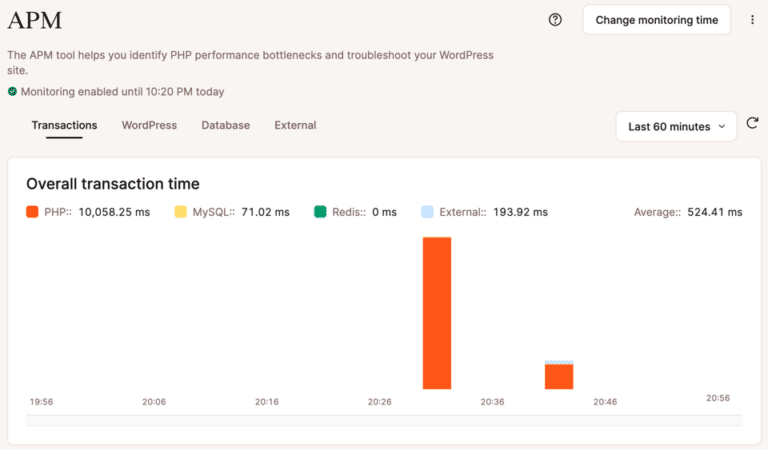
Monitoring performance metrics is equally critical. If a form that typically responds in under a second suddenly begins taking six seconds after an update, application performance monitoring tools allow teams to isolate slow PHP execution, database queries, or external API bottlenecks.
A clear distinction must also be maintained regarding artificial intelligence usage: employing an AI assistant to write custom PHP code does not automatically embed artificial intelligence into the live operational workflow. However, if the live plugin actively utilizes a machine learning model to evaluate and classify incoming sales leads, an entirely new layer of operational overhead is introduced. Teams must manage acceptable classification examples, catch erroneous sorting results, monitor API usage costs, and review provider model updates. A successful network response from an API does not guarantee that the automated classification makes logical business sense.
Faster Builds Change How Agencies Scope and Price Work
Clients naturally expect financial and temporal benefits when artificial intelligence accelerates production workflows. If an implementation requires less active effort, project estimates should reflect those efficiencies rather than artificially preserving hours no longer spent.
The challenge arises when the phrase "we can build this quickly" inadvertently transforms into an internal assumption that "everything about this project should be quick." Working functional drafts make ongoing review and technical support invisible to clients who judge progress solely by interactive demos.
Proposals must explicitly delineate these ongoing responsibilities. For custom CRM integrations, scopes should clearly outline setup, rigorous edge-case testing, error handling, and post-launch verification. If custom plugins rely on external artificial intelligence providers for lead processing, pricing models must account for ongoing usage fees, clarifying whether clients manage their own billing accounts or whether token consumption is factored into monthly retainers.
Equally important is establishing clear boundaries for future modifications. Altering a form to route data to an entirely different CRM platform requires evaluating new APIs and testing data integrity. Such requests must be quoted independently to prevent small adjustments from morphing into open-ended scope creep. Maintenance agreements must explicitly state whether custom codebases fall under standard support retainers so that both clients and internal developers share identical expectations when APIs inevitably change.
Give Teams a Consistent and Familiar Place to Operate
When clients report missing leads, responding developers need an operational environment that offers immediate familiarity. Constantly relearning disparate hosting panels, backup mechanisms, and logging interfaces for every individual client site slows down troubleshooting efforts unnecessarily.
Shared agency hosting platforms provide a cohesive operational foundation that streamlines daily tasks. Prior to deploying modifications to live CRM plugins, developers can utilize isolated staging environments to test repairs safely away from production traffic. Comprehensive pre-release planning allows teams to evaluate available backup and restore options, keeping the operational limits of database rollbacks transparent regarding external CRM states.
During active investigations, integrated application performance monitoring tools help isolate sluggish PHP processes, database queries, and external network calls, while centralized error logs supply crucial diagnostic context. User permission controls ensure that team members receive appropriate access levels without sharing administrative credentials, maintaining secure and consistent support routines across diverse client portfolios.
Build Faster, and Plan for What Comes After
A developer who constructs a complex CRM integration in a single afternoon provides their agency with an invaluable head start, offering clients a concrete artifact to review while leaving ample time to refine details before launch.
These ongoing operational responsibilities do not negate the time saved by artificial intelligence; rather, they must be integrated into project planning from the very beginning. By treating accelerated development as an opportunity to deliver exceptionally stable, well-documented software with clear ownership and repeatable release processes, agencies can successfully embrace modern productivity tools without accumulating unsustainable support commitments.