At the heart of the recent Dreamforce conference, Salesforce unveiled a transformative promise that marks a departure from traditional software interaction models: users should not have to navigate to Salesforce to complete their work. Instead, the power of the platform should migrate to where the work happens. Through the introduction of SIforce, Salesforce is extending its capabilities directly into the tools where users spend their time—from Claude and Slack to the familiar interfaces of Lightning. However, this shift in how business is conducted raises a critical, often overlooked question: how do brands show up when an AI agent is the one doing the interacting?
For the modern enterprise, the rise of the "agentic era" means that the entities representing a brand are no longer limited to human employees. They are increasingly AI agents, which operate on a different logic than the customers they serve. While humans are drawn to authenticity, narrative, and emotional resonance, agents require a diet of structured data, precise schemas, granular metadata, and contextual relationships to function effectively. To bridge this gap, businesses require a headless content platform that can simultaneously satisfy the needs of human consumers and the rigid, functional requirements of AI. This is the strategic imperative behind Salesforce’s acquisition of Contentful. By integrating Contentful’s composable content capabilities with the Salesforce ecosystem, the company is effectively providing a new foundation for the Agentic Enterprise.
Why content matters more in the agentic era
To understand the necessity of this union, one must first recognize that the history of the web has been defined by the "page." For decades, content was engineered for specific layouts, fixed channels, and defined screens. Developers and marketers built content for a human user to scroll, browse, and click. This paradigm is fundamentally at odds with the way AI agents operate.
Agents do not browse websites. They do not scroll through landing pages or parse visual hierarchies. Instead, they consume information through API calls, pulling the specific data they need at a precise moment to assemble an immediate, relevant response. Whether it is a quick answer in a Slack thread, a real-time resolution in a chat window, or an interaction on a surface that has yet to be invented, the agentic model is instantaneous and modular. If a brand’s content is "locked" inside a traditional page structure—trapped by CSS or baked into a rigid template—that content becomes invisible and unusable to an AI.
Every interaction an agent conducts on behalf of a brand is a critical "brand moment." From the nuance of a product description to the accuracy of a promotional offer, the quality of a help article, or the tone of a service chat, the agent serves as an extension of the corporate identity. When agents operate on context but deliver content, the outcome hinges on the structure of that content. If the underlying data is not governed, structured, and ready for deployment across any interface, the agent is forced to either fail to respond or, worse, generate an unapproved or inaccurate response. In this new era, context tells the agent who the customer is, while structured content tells the agent exactly what to say.
The content engine behind SIforce
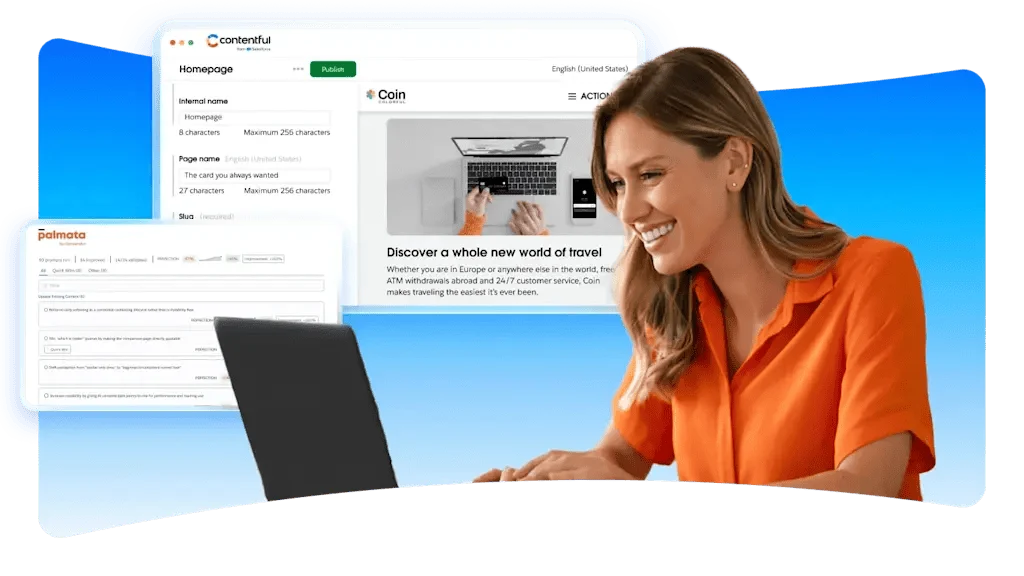
Salesforce acquired Contentful because it was purpose-built to solve this exact architectural challenge. As a composable content platform, Contentful allows organizations to break content down into structured building blocks that can be managed centrally and delivered anywhere via API. This separation of content from presentation is the essential ingredient for the agentic era. It ensures that the information consumed by an agent remains on-brand, governed, and consistent, regardless of the channel.
The scale of this requirement is significant. With more than 4,800 enterprise customers, Contentful currently processes roughly 180 billion API calls every month across a network of more than 20,000 apps and integrations. This massive footprint aligns perfectly with Salesforce’s broader platform strategy. By making the Salesforce platform available through APIs, CLI commands, and MCP tools, Salesforce has effectively enabled agents to utilize its entire functional suite. SIforce extends this logic further, bringing Salesforce’s workflows, data, and agents to any interface. By separating the capability from the screen, Salesforce allows its intelligence to permeate the entire digital workspace.
The architecture of the "Agentic Enterprise" relies on four distinct layers: Data 360 to provide the necessary context; Customer 360 to manage the work; Agentforce to serve as the digital workforce; and SIforce to define the interface. Contentful serves as the vital native content layer within this stack. Because this layer is the one that ultimately reaches the customer, its integrity is the deciding factor in whether the agentic experience succeeds or falls flat. Salesforce built its platform to come to the user; Contentful was built to ensure that content could follow the same trajectory.
Open by design
As businesses race to adopt AI, the importance of an open, flexible ecosystem cannot be overstated. Salesforce’s ability to meet users in Slack, Claude, and future platforms is entirely dependent on its connectivity. Contentful operates on the same principle of interoperability, and that commitment remains central to the vision of the combined entity.
Moving forward, Contentful will continue to be offered as a standalone product. This reinforces the core philosophy of headless solutions: the power to choose best-of-breed technologies to construct a bespoke stack that meets the unique requirements of a business. Salesforce intends to continue investing heavily in the Contentful roadmap, with a primary focus on increasing the speed and ease of use for content teams while adding features that drive tangible business outcomes.
The ecosystem remains firmly rooted in a developer-first, extensible architecture. Contentful’s strengths have always been derived from its API-first approach, and those 20,000+ integrations are a testament to the value of an open ecosystem. Contentful will continue to function within any technology stack, regardless of whether that stack includes Salesforce products.
What Salesforce adds to Contentful
The integration of Salesforce into the Contentful ecosystem is designed to provide greater reach and richer context for content without imposing limitations on the user. The goal is to move beyond the traditional model of static, channel-specific content—where a single campaign is pushed to a million people—toward a model of dynamic orchestration. In this new paradigm, the focus shifts to a million individual conversations, each one assembled in real-time for the specific person or agent on the other side of the interaction.
While the future holds vast opportunities for innovation, Salesforce is clear that these developments will not come at the expense of what has made Contentful a success. The platform remains committed to being open, flexible, and functional in any environment.
Looking ahead, the roadmap for the Agentic Enterprise is already in motion. Teams are working on new ways for agents to leverage content, new methods for content to reach customers, and improved developer tools to bridge the gap between AI and human-readable data. Salesforce has successfully established a model where its platform comes to the user, and with the integration of Contentful, it has ensured that the content reaches those same destinations. For organizations looking to navigate the transition to the agentic era, the path forward is increasingly clear: by ensuring that content is as portable and intelligent as the agents that use it, brands can ensure they remain relevant in an increasingly automated world.