While the echoes of Dreamforce still resonate throughout the technology sector, the momentum generated at Salesforce’s flagship event is already manifesting in tangible, real-world utility. Salesforce has officially begun the rollout of its Winter ’27 release for the Salesforce Platform, a substantial update that introduces a suite of features engineered to modernize how organizations build, secure, and scale their digital infrastructures. As the enterprise landscape pivots rapidly toward agentic workflows and AI-driven automation, this release serves as a critical bridge, providing developers and security teams with the tools necessary to maintain control and governance in an increasingly complex environment.
The Winter ’27 release arrives at a pivotal moment for businesses grappling with the integration of AI agents. By focusing on three primary pillars—accelerating development through headless architectures, enhancing agent governance, and fortifying the security perimeter—Salesforce is positioning its platform to handle the next generation of enterprise software demands.

Evolution of Developer Services and Agentic Architectures
The shift toward "headless" development has been a significant trend in recent years, but the Winter ’27 release takes this concept to a new level by addressing the fragmentation that often plagues multi-channel deployments. With the new Headless Experience Layer, developers are no longer burdened by the need to write redundant UI code for every individual channel. This enhancement allows a single widget definition to render natively across diverse surfaces, including Slack, Microsoft Teams, React environments, and Lightning Web Components. By utilizing the agentic-api-service translation layer, the feature removes a major cost and effort barrier that has historically hindered the deployment of rich, interactive agent experiences. This is a crucial step forward for organizations aiming to provide a consistent user experience regardless of where their customers interact with the brand.
Supporting this development is a newfound focus on the lifecycle of agent skills. As enterprises deploy an increasing number of agents across various ecosystems—including Agentforce, Slack, Data 360, and third-party models like Claude and ChatGPT—the challenge of managing and reusing "skills" has become a governance bottleneck. To solve this, Salesforce has introduced Agent Skills and Plugins, a unified registry that provides a governed pipeline for skill discovery and reuse. The system includes an automated verification pipeline that rigorously tests naming conventions, accuracy, and outcome quality before any skill is promoted to a production environment. This ensures that when a developer builds a reusable capability, it can be executed consistently and securely across the entire enterprise, eliminating the risks associated with ad-hoc development.
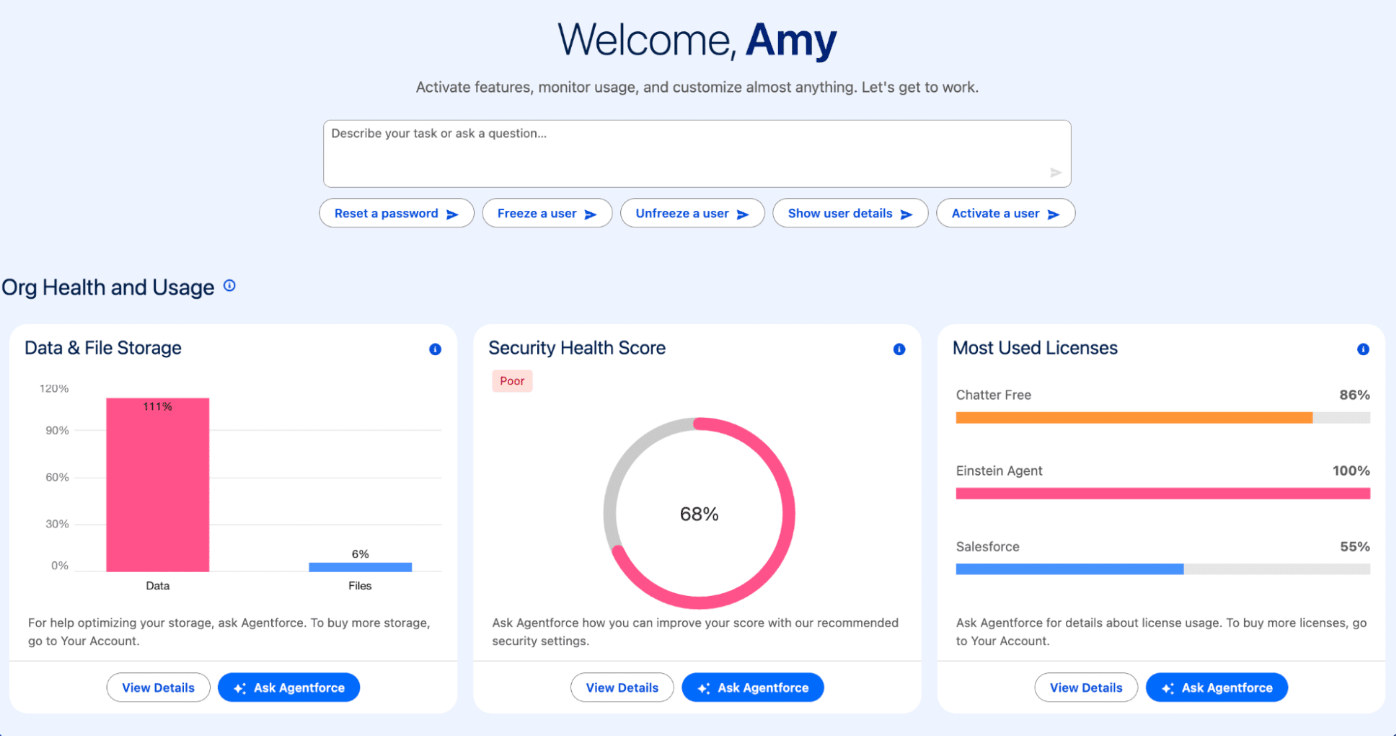
Administrative efficiency has also received a major upgrade through the integration of the Atlas Reasoning Engine into Salesforce Setup. Navigating the vast, often labyrinthine Salesforce Setup menu—which spans more than 1,000 pages—has long been a source of friction for admins. With the new Setup with Agentforce enhancements, administrators can now utilize natural language processing to manage sandbox environments, handle package deployments, enable features, and monitor overall org health. By turning complex, multi-step configurations into a simple, conversational interaction, the platform significantly reduces the risk of human error and dramatically slashes the time required for routine maintenance.
The developer experience is further bolstered by improvements to the headless development environment. Previously, developers building headless applications were often forced to break their workflow to manage external tools for tasks such as data masking, sandbox lifecycle management, or performance testing. With the latest updates, these capabilities are now extended to headless surfaces, allowing developers to provision environments and conduct validation without ever leaving their preferred toolchain or requiring a Salesforce UI session. This creates a cohesive, agent-native development environment that prioritizes speed and seamless integration.
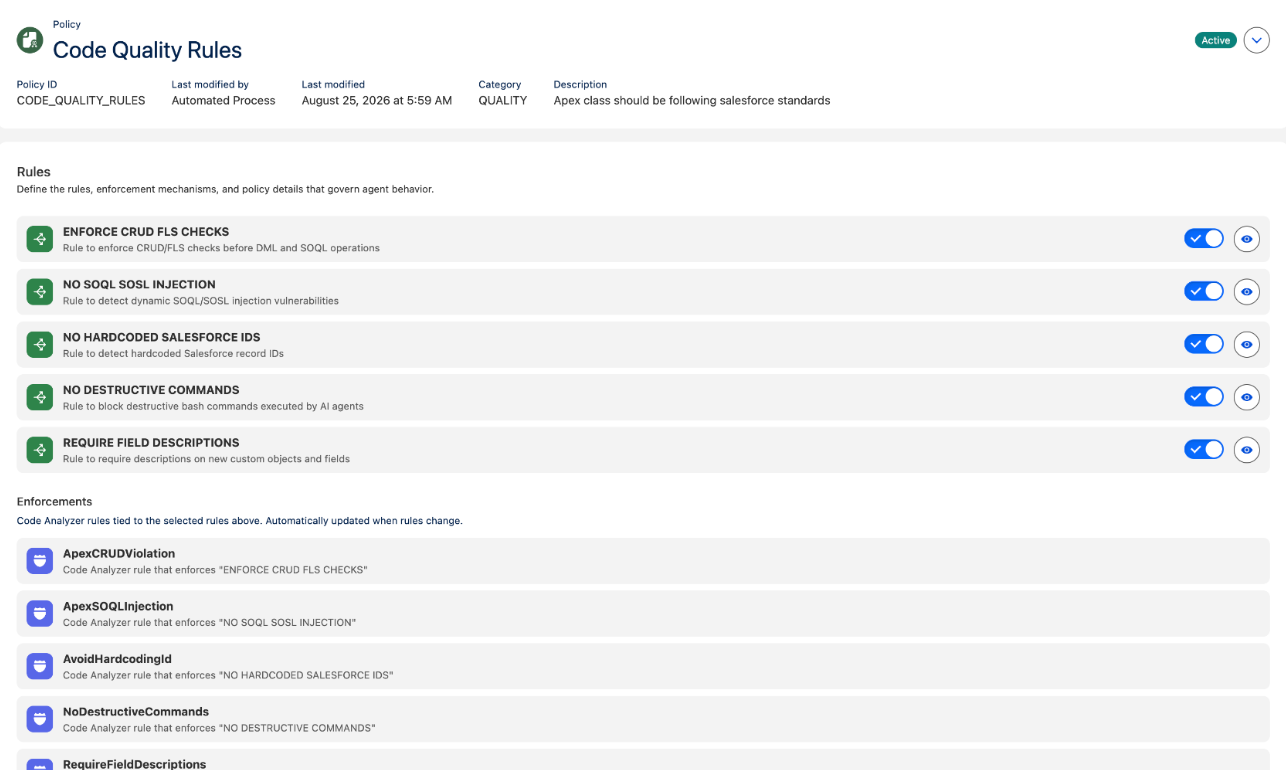
Finally, the introduction of the Agentic Developer Lifecycle addresses the growing tension between rapid innovation and corporate compliance. As coding agents become capable of generating code faster than traditional manual release processes can manage, enterprises face an emerging compliance risk. Salesforce has responded by updating its Lifecycle Center (the evolution of the former DevOps Center) to include robust policy enforcement, automated approval workflows, and comprehensive audit logging. By integrating these lifecycle automation features, organizations can now carry agent-generated code from initial planning through testing and final deployment while maintaining the rigorous compliance standards that modern enterprises demand.
Strengthening the Enterprise Perimeter with Salesforce Guardian
As the capabilities of AI agents expand, so too does the attack surface for the average enterprise. Salesforce Guardian, the platform’s security framework, has received significant updates in the Winter ’27 release to address these modern threats.

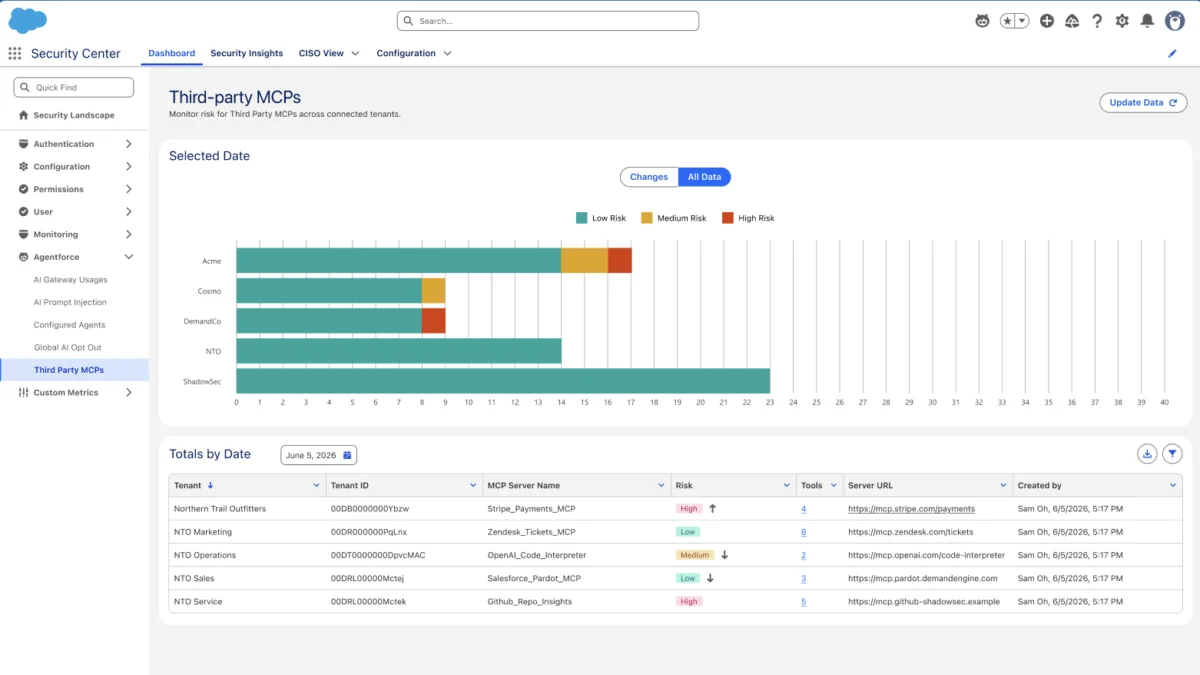
One of the most notable additions is the implementation of MCP Risk Scores within the Security Center. Third-party Model Context Protocol (MCP) servers, while powerful, can expose an organization to risks such as tool poisoning or "rug pull" attacks. To mitigate this, Security Center now automatically assigns a risk score—Low, Medium, or High—to every third-party MCP server. This score is determined at the moment of registration and is subject to continuous monitoring, allowing administrators to maintain a centralized, real-time view of their security posture. If a server is identified as high-risk, security teams can implement blocking policies instantly, removing the need for manual, reactive investigations.
Vendor sprawl remains a significant challenge for security teams, often resulting in fragmented visibility across the IT estate. To combat this, Salesforce has expanded its Security Mesh capabilities with new connectors for DigitSec and WithSecure. This integration unifies code scanning, pipeline security, and file threat detection into a single, standardized format, ensuring that teams can query and act on security signals that might otherwise be lost in the noise.
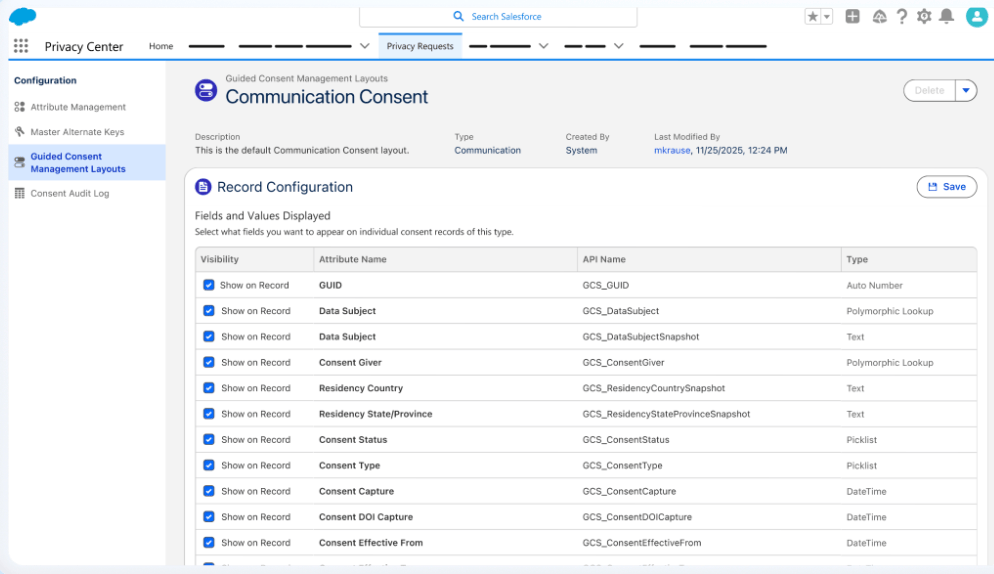
Privacy and regulatory compliance remain at the forefront of the platform’s design as well. The new Global Consent Manager in Privacy Center offers a solution for organizations that must govern opt-in and opt-out signals at a massive, enterprise scale. By utilizing an event-driven architecture, the manager synchronizes consent signals across various platforms and generates verified audit trails. This provides a single, audit-ready system of record that supports compliance with stringent global regulations like GDPR and CCPA.
For organizations operating in highly regulated industries such as healthcare, finance, and the public sector, the Winter ’27 release also brings a critical enhancement to data security: Platform Encryption for Archive and Backup. Historically, these organizations faced gaps in their security posture when archived or backed-up data fell outside the scope of standard encryption protocols. The new update extends native "Bring Your Own Key" (BYOK) and customer-managed encryption key capabilities to Salesforce Archive and Backup & Recover. This ensures that sensitive data remains encrypted throughout its entire lifecycle within the Salesforce Trust Layer, without requiring complex third-party key management solutions.

The release also introduces the Observability Center, currently in beta, which aims to bring transparency to what has traditionally been an "untouchable" aspect of AI: the agentic black box. As enterprises connect external agents via APIs or MCP, tracking their interactions and performance has been difficult. Observability Center provides near real-time session tracing, error detection, and performance monitoring across every interaction. By centralizing these insights, organizations can troubleshoot complex agentic deployments without the need for intensive engineering escalation, allowing them to move from pilot to production with significantly higher confidence.
These updates collectively represent a strategic shift in how the Salesforce Platform supports its users. By prioritizing the intersection of speed and security, the Winter ’27 release ensures that the promise of AI-driven enterprise transformation is matched by the practical, robust tooling necessary to make that transformation a stable and sustainable reality. As these features continue to reach general availability, they will undoubtedly set a new standard for how large-scale organizations build for the era of intelligent agents.