Artificial intelligence has fundamentally transformed how digital marketers approach Google Ads, offering unprecedented capabilities to target new and existing audiences. When paired with robust first-party data and comprehensive conversion tracking, machine learning algorithms can unlock growth opportunities that were once unimaginable. Yet, as advertising platforms become increasingly automated and intent-driven, industry experts are realizing a critical truth: what advertisers tell AI to exclude is just as important—and often more challenging—than what they instruct it to target.
For years, digital advertisers have relied on traditional methods like negative keywords and placement exclusions to prevent their ads from appearing for irrelevant or undesirable search queries. For instance, adding a term like "cheap" as a negative keyword has long been a standard tactic to stop ads from triggering when that specific word appears in a user search. However, in today’s sophisticated, intent-driven search landscape, these legacy tactics are simply no longer enough.

An advertiser can add every conceivable synonym of "cheap" to their negative keyword list, but that keyword filter will fail to detect a searcher who holds that exact budget-conscious mindset without actually typing the word. Consider a consumer who wants to purchase an inexpensive computer case; instead of typing out a modifier, that user might search exclusively for "laptop cases," leaving traditional negative keyword lists completely blind to their true intent. Because modern search engines interpret meaning rather than just matching strings, advertisers must learn to instruct the underlying AI explicitly about who they want to avoid, rather than just relying on blunt keyword restrictions.
Text Guidelines and Asset Optimization
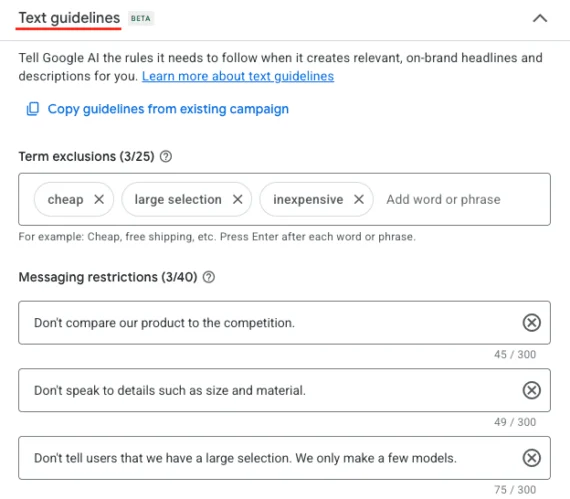
The clearest and most direct mechanism for establishing these necessary boundaries is through text guidelines and asset optimizations. These crucial controls are readily available within advanced campaign types such as Performance Max and AI Max Search campaigns. Because Google’s automated systems dynamically create ad copy and determine the exact landing pages where prospective buyers will ultimately arrive, the platform desperately requires clear guardrails. Without proper direction, algorithms can easily misrepresent a brand’s positioning. Text guidelines act as a vital compass, helping Google’s AI precisely understand which specific demographics to target and, equally important, which segments to actively avoid.
To illustrate how this works in practice, consider an advertiser selling premium laptop cases. The business model relies on offering a limited selection of exceptionally high-quality products rather than mass-market volume. Using text guidelines, the advertiser can inform the AI that their merchandise is not inexpensive and that the target audience consists of prospects who are genuinely willing to spend more money in exchange for superior craftsmanship and durability. By feeding these specific parameters into the system, the AI learns to bypass bargain hunters and direct its attention toward high-intent buyers who align with the brand’s pricing strategy.
Similarly, asset optimization features give marketers the ability to maintain tight creative control over their campaigns. Advertisers can turn off automated image and video enhancements within Performance Max campaigns while simultaneously utilizing text and URL exclusions across both Performance Max and AI Max campaigns. URL exclusions play an especially critical role by telling Google precisely which landing pages to avoid showing to certain audiences, such as ensuring that a high-end product line is never mistakenly paired with a clearance or discount landing page.
Automated Assets
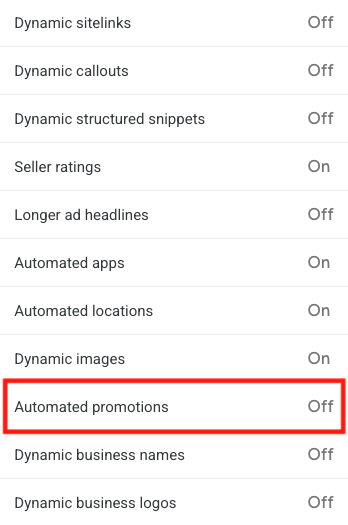
Tucked away deeply within the complex Google Ads interface lies a feature known as "account-level automated assets." While this setting can be difficult for busy marketers to locate, its potential impact on a brand’s public presentation is substantial. Google’s system is capable of dynamically populating an advertisement with automated sitelinks, callouts, images, and other supplementary elements without direct human intervention. Recently, automated promotions also went live within this framework, a capability that allows Google to automatically scrape a brand’s website and pull discounted items into live advertisements.
Within the user interface, navigating to advanced settings reveals the operational status of these account-level automated assets, displaying whether features like automated promotions are toggled on or off. Left unchecked, the system can automatically incorporate an advertiser’s corporate names and logos into placements, a process that risks inaccurate branding or unauthorized messaging unless those automated elements are explicitly switched to the "off" position. Advertisers who want to audit what the algorithm has done can easily review which assets the AI has independently added by clicking the assets link located in the left navigation panel and filtering the view with the specific parameter indicating assets added by Google AI.
Optimized Targeting and Audience Expansion
The challenge of managing algorithmic boundaries extends beyond creative assets and directly into campaign targeting structures. Standard search campaigns, by default, target Google Search Partners and its extensive Display Network unless advertisers actively intervene to turn those options off. In a similar fashion, Demand Gen and Video campaigns automatically apply optimized targeting and audience expansion features unless explicit instructions are given to restrict them.
While these automated expansion features are designed to sound helpful and growth-oriented, they frequently end up siphoning valuable advertising budgets away from a brand’s preferred, high-converting core audiences. Many experienced practitioners advise against turning on these expansive options immediately upon launch. Instead, the consensus is to let the campaigns run for a sufficient period to gather adequate, reliable conversion data first. In other words, the AI must be properly trained and anchored with real performance metrics before it is given the freedom to expand its reach into broader, unvetted territories.