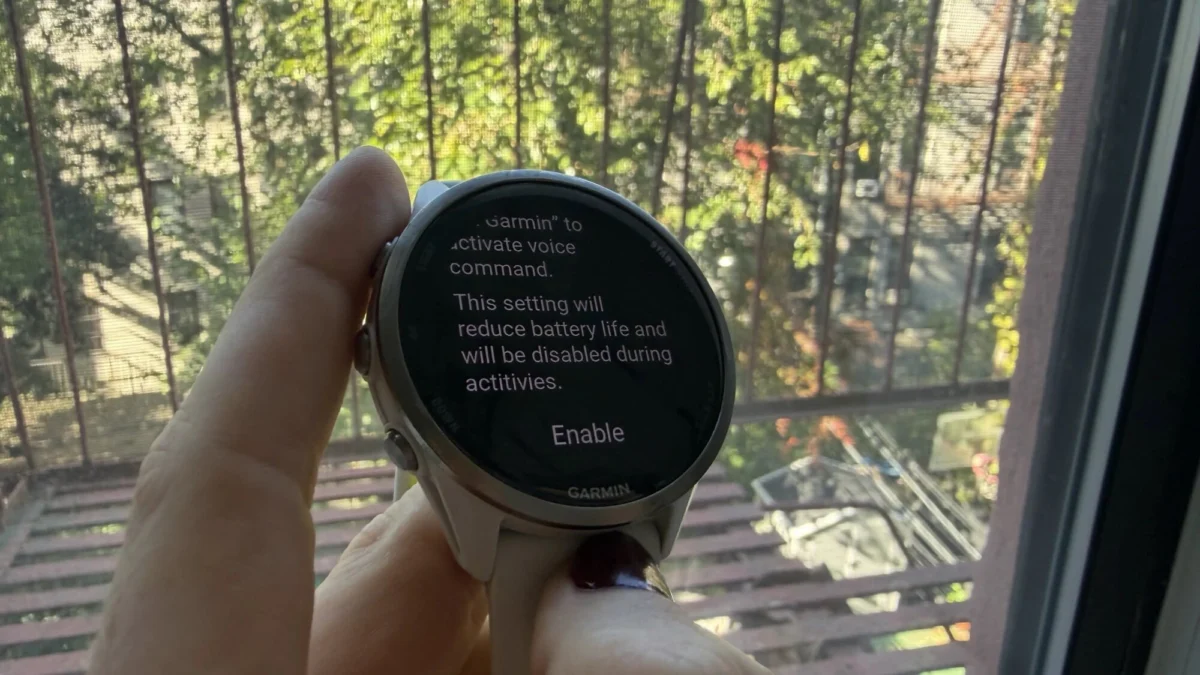
Garmin smartwatch users have taken to the company’s official support forums to voice a common and frustrating grievance regarding a recently introduced software update. The newly implemented "OK Garmin" hands-free voice feature, which rolled out as part of Garmin’s sweeping September software updates, appears to be heavily draining battery life across several of the brand’s premier wearable devices.
The update brought hands-free voice activation to a wide array of high-end models, including the Fenix 8, the Forerunner 570, the Forerunner 970, and the Venu 4, alongside several other devices in Garmin’s extensive ecosystem. While the capability was designed to offer modern, frictionless convenience, early adopters are finding that the background demands of the software come at a steep operational cost.
Garmin’s latest feature updates for select smartwatches
The software package that rolled out last month introduced a broad set of additions designed to enhance the utility and safety of Garmin’s hardware. Alongside the much-discussed "OK Garmin" hands-free voice command feature, the updates included all-day fall detection, a suite of new Quick Workouts, and updated Garmin Run Coach plans.

The voice feature itself operates similarly to other digital assistants found across the consumer technology landscape. Instead of requiring users to press a physical button or navigate a menu to trigger voice commands, users can simply say the wake phrase "OK Garmin" aloud. However, it quickly became apparent that this passive, always-listening state places a substantial burden on the device’s hardware resources.
According to user reports accumulating across Garmin’s online communities, the "OK Garmin" feature is the primary culprit behind a drastic reduction in projected device runtimes. Some owners have reported that turning on the feature causes their estimated battery life to plummet by roughly 35% to 50%. For devices that are typically celebrated for lasting weeks on a single charge, losing half of their operational longevity has proven to be a significant disruption for endurance athletes and everyday users alike.
Garmin has acknowledged that enabling these newly introduced settings naturally shortens battery life, though the manufacturer has not officially quantified the exact percentage drop in its public documentation. The technical tradeoff is fundamentally logical, as any smartwatch forced to listen continuously for an acoustic wake phrase must keep certain internal sensors and processors powered at a higher baseline level. Even so, surrendering several days or even weeks of runtime is a heavy price to pay for a feature that many users may only utilize sporadically.
Fortunately, the workaround to reclaim the lost efficiency is straightforward. Disabling the "OK Garmin" setting immediately restores battery life estimates, allowing users to return to the standard operational longevity expected from their hardware investments.
How to stop Garmin’s new feature from draining your watch’s battery

For owners who have noticed their watches discharging at an accelerated rate following the recent software update, the remedy requires navigating through the device settings menu. By heading to the system settings on the watch, selecting the voice options, and turning off the "OK Garmin" wake word, users can halt the background listening process. Additionally, the Phone Assistant wake word can be disabled from the same menu for those looking to maximize power savings.
Importantly, disabling these hands-free listening settings does not completely strip the watch of its voice capabilities. Users retain the ability to utilize voice commands by manually triggering them through the watch’s physical buttons when needed, preserving functionality without the constant power drain.
Industry observers note that these impacted runtime figures are largely based on system battery estimates provided by the watches rather than exhaustively tested, real-world conditions. It is also possible that a portion of the battery complaints flooding the forums following the update could stem from unrelated software quirks or background synchronization processes. Nonetheless, the sheer volume of user feedback points directly to the wake phrase feature as a major factor. For many devoted Garmin owners, trading away up to half of a device’s battery capacity simply to bypass pressing a button remains a difficult bargain to defend.