Organic search traffic is undergoing a quiet, structural transformation. Digital marketers and website publishers are increasingly confronting a confounding phenomenon: organic clicks are plummeting even as search engine rankings remain entirely stable. Pages that proudly hold top-three positions in traditional search engine results pages are seeing fewer visitors simply because a Google AI Overview now sits right above them, answering the user’s intent before anyone has a chance to scroll down the page.
To effectively combat this traffic erosion, digital teams must understand which of their specific search queries trigger an AI overview, whether Google chooses to cite them within that summary, and which competitors are being highlighted when their own brand is left out. While Google Search Console can help identify the impacted queries, discovering who holds visibility within the summaries requires a deeper investigation into the overviews themselves.
The economic reality of this shift is underscored by recent industry data. Two major studies help set realistic expectations for modern search engine optimization performance. A browsing study conducted by the Pew Research Center in March 2025, which analyzed the behavior of 900 United States adults, revealed stark differences in user engagement. On searches that featured an AI summary, users clicked a traditional organic result in just 8 percent of visits, compared to 15 percent on searches without an AI summary. Furthermore, only 1 percent of visits included a click on a link embedded directly inside the AI summary itself, and users ended their browsing session entirely on 26 percent of pages featuring a summary, compared with just 16 percent for standard pages.
Complementing these findings, an update released in December 2025 by Ahrefs—building upon its earlier April 2025 study—quantified the direct blow to click-through rates. According to the research, an AI Overview reduces the click-through rate of the very first organic result by approximately 58 percent, up significantly from a 34.5 percent reduction earlier in the year. Lower-ranking results experience slightly less severe drops, falling by about 51 percent at the second position and scaling down to roughly a 19 percent reduction at the tenth position. Consequently, digital analysts advise that when a high-ranking page suddenly loses traffic while maintaining its rank, the AI overview sitting directly above it should be examined long before questioning internal tracking systems.
Pinpointing these problematic queries begins within the Performance report of Google Search Console. Analysts look for a distinct pattern: impressions that remain steady or are increasing, average positions that hold firm or improve, but a click-through rate that is sharply declining. This shape indicates that users are still seeing the result and Google is still awarding a strong rank, but fewer individuals are actually clicking through to the site. If a query has lost clicks primarily because it also lost its underlying ranking position, that issue should be set aside as a traditional ranking problem rather than an AI overview casualty.
Exporting this list of queries usually reveals a clear pattern within a few dozen entries. Commercial priorities should take precedence during this review, focusing particularly on comparison queries, best-of lists, and how-to queries that sit close to a company’s core product or service offerings.
Once the queries are identified, the next phase involves understanding which pages Google already showcases within its generative artificial intelligence features. Following a rollout that concluded on August 31, 2026, every Google Search Console property now features a dedicated report specifically for generative AI capabilities. Introduced by Google earlier in the summer, this report tracks how often specific URLs from a given site appear within generative AI features like AI Overviews and AI Mode, providing granular breakdowns by page, country, device, and date.
While this report successfully highlights which pages Google already deems worthy of citation, it does not provide the full picture needed to counteract falling clicks. Because these same impressions are already integrated into the platform’s main Performance report, analysts are cautioned against combining the two datasets to avoid double-counting.
Search Console effectively points the way toward the problem, but reading the actual text of the overviews requires a different approach, as manual checking does not scale. Conducting a search in a private browser window reveals only a single version of an overview in one specific location on a given day. Because AI overviews frequently fluctuate between runs and differ significantly by geographic region, a single manual check cannot determine whether a specific view is typical.

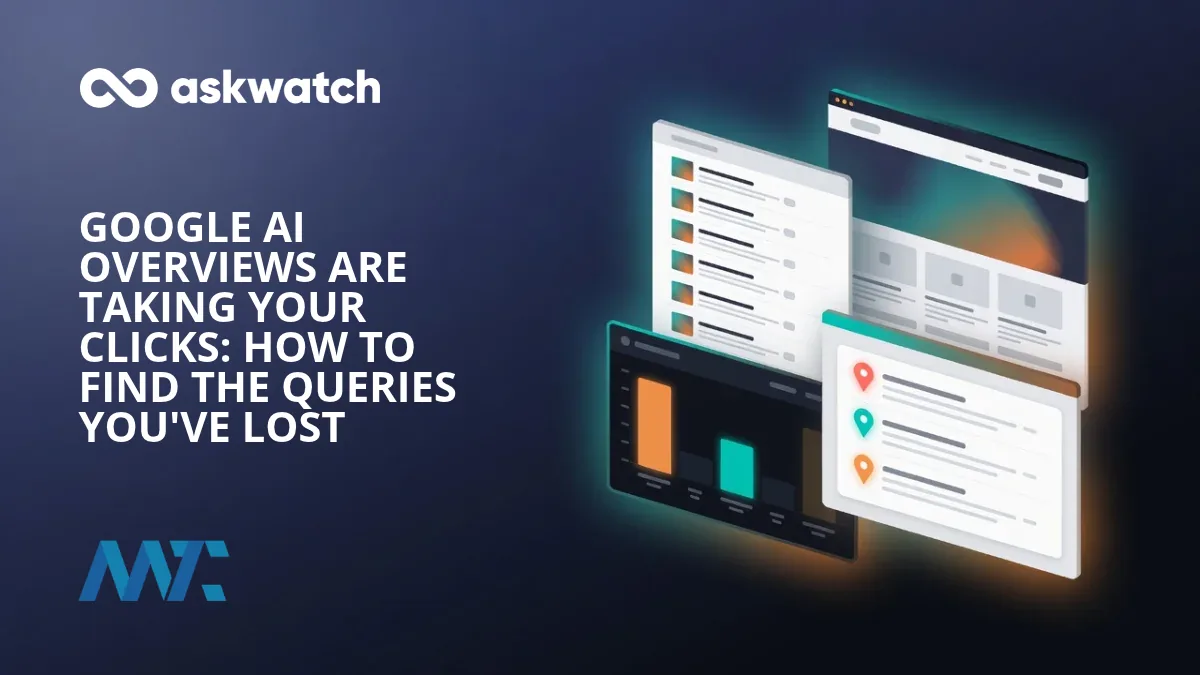
To solve this scaling issue, tools such as AskWatch’s free AI Overview checker automate the discovery process. By entering a domain, the system analyzes the website to comprehend its commercial offerings and competitive landscape. It then generates typical buyer searches—ranging from best-of lists and comparisons to category-specific how-tos, deliberately excluding brand names—runs them on Google, and evaluates every resulting AI overview to map out visibility patterns.
With this data compiled, priority queries can be sorted into distinct strategic groups. For queries where competitors are consistently cited instead of one’s own brand, a direct comparison between the cited pages and the underperforming site often reveals structural differences. These discrepancies typically fall into four distinct categories.
First, the cited answer is frequently easier for a language model to quote. Cited pages tend to answer the core question within the opening lines of a section, utilizing direct definitions, concise lists of options, or straightforward comparisons. Conversely, a page that builds up to an answer gradually over several paragraphs offers the underlying model far less quotable material to extract.
Second, the cited source is often an independent third party. When handling purchase intent queries, AI overviews heavily favor third-party reviews, comparison articles, and community forums. If the prevailing cited sources are independent listicles and review portals, simply optimizing an internal brand page will not suffice; the necessary work involves earning organic mentions within those trusted third-party publications with accurate and favorable information.
Third, the cited information is often newer or more granular. Pricing structures, detailed feature lists, and statistics have a tendency to go stale over time. If a competitor’s cited page incorporates current yearly data while an internal page relies on outdated metrics, updating the content becomes essential.
Fourth, technical barriers may prevent a page from being cited at all. AI overviews exclusively utilize pages that Google has indexed and explicitly permitted to appear within standard snippets. Ensuring that a target page is actively indexed, unhindered by restrictive robots.txt directives, and free of accidental nosnippet or max-snippet rules is a critical foundational step.
Implementing changes requires a measured approach, such as making a single modification per page, recording the date, and running subsequent evaluations after two to four weeks. Because overview outputs naturally vary across different runs, optimization success is measured by observing consistent patterns over multiple checks rather than relying on a single isolated result.
Ultimately, this shift necessitates a change in how internal performance is reported. A web page that maintains a first-place organic ranking and secures a citation within an AI overview is successfully fulfilling its purpose, even if its raw click-through metrics are diminished. Digital marketing teams are increasingly treating the status of being cited in an AI overview as a standalone success metric, evaluated alongside traditional rankings and clicks, to prevent teams from fruitlessly chasing click-through rates that modern page layouts no longer permit. While free tools offer a snapshot of current standing, ongoing tracking across Google AI Overviews, AI Mode, ChatGPT, Perplexity, Gemini, and Microsoft Copilot allows organizations to continuously monitor their brand visibility in an evolving search landscape.