Shopify and Vercel have announced a strategic collaboration aimed at reshaping how ecommerce storefronts are built for both human shoppers and autonomous artificial intelligence agents. The partnership brings together Shopify’s robust backend commerce infrastructure with Vercel’s advanced frontend application development capabilities, signaling a major shift in how web architecture must adapt to the growing presence of AI in retail.
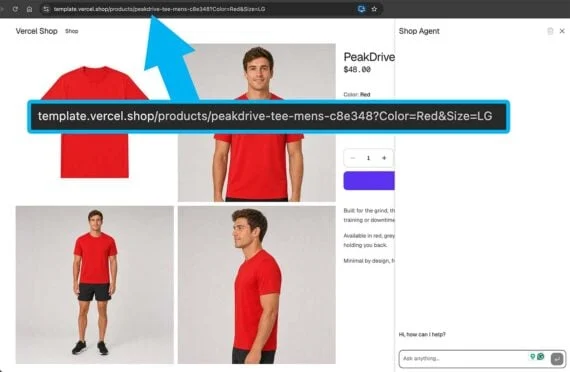
The collaboration was formally highlighted during a joint appearance at Vercel’s Ship 26 conference in San Francisco. Shopify CEO Tobi Lütke and Vercel CEO Guillermo Rauch took to the stage to discuss the future of agentic commerce. Their discussion centered on the release of Shopify’s rebuilt Hydrogen software development kit and Vercel’s new AI-enabled, open-source storefront template, known as Vercel Shop.
The integration of these technologies is designed to address a fundamental challenge in modern web development: creating custom ecommerce experiences that are visually engaging for human users while remaining entirely legible and functional for external AI agents acting on a consumer’s behalf. Hydrogen provides developers with a suite of reusable tools for building Shopify storefronts across various JavaScript frameworks, streamlining the complex process of connecting frontend designs to backend commerce systems. Meanwhile, Vercel Shop takes those foundational tools and packages them into a customizable, production-ready store template complete with agent-readable product information and built-in shopping assistants.
Cooperation Between Giants
This October announcement marks the latest milestone in a deepening relationship between the ecommerce platform and the application development provider. The partnership gained significant momentum following a joint initiative to rebuild Hydrogen, which rolled out earlier in the year. That technical overhaul allowed developers to utilize Shopify’s core storefront tools seamlessly across multiple JavaScript frameworks and runtimes, giving engineering teams unprecedented flexibility in how they architect digital storefronts.
To achieve this, the rebuilt Hydrogen SDK organizes common ecommerce functions into shared, modular tools. Developers can reuse these functions to handle core operations while retaining complete creative freedom over the shopper experience. This modular approach is crucial because building custom ecommerce storefronts has historically required extensive and complex integrations. Developers must connect the visual shopping experience to backend systems that handle inventory, pricing, catalog data, and real-time cart updates, ensuring that every purchase flows securely from the browser to the payment gateway.
The rebuilt Hydrogen SDK and the Vercel Shop template work in tandem to simplify this arduous development lifecycle. During their conference presentation, Lütke elaborated on the strategic reasoning behind Shopify’s open architecture, pointing out the immense difficulty involved in building secure and reliable checkout systems from scratch.
Lütke noted that checkouts are notoriously hard to get right and represent a piece of software that truly benefits from decades of iterative improvement. Emphasizing Shopify’s open philosophy, he noted that developers are invited to remix pieces of the checkout system as much as they want, leveraging the extensive infrastructure built by Shopify over the years to construct entirely custom applications on top of it.
By abstracting away the complexities of backend commerce, inventory management, and transaction processing, Shopify’s software enables developers to focus entirely on how shoppers find products and interact with the store. Engineering teams can build directly on shared commerce tools and extend the Vercel template to suit specific merchant branding and functional requirements.

This robust foundation naturally supports multiple, simultaneous shopping experiences. Traditional human visitors can browse the storefront or consult an integrated store assistant for guidance, while compatible outside agents can programmatically access product information, check stock variants, and execute shopping tasks directly on the merchant’s domain.
Empowering External AI Agents
As autonomous technology evolves, AI agents are increasingly shopping on behalf of human consumers, searching for specific items, evaluating options, and managing carts without human intervention. To operate efficiently, an AI shopping agent needs to locate products, verify specifications, and construct a cart quickly, without being forced to navigate cumbersome visual storefronts or parse human-centric web pages.
Vercel Shop addresses these operational requirements by structuring data in a way that AI agents can easily understand and manipulate. For instance, if an automated agent is searching for a specific black jacket in a particular size, the system does not require the agent to parse HTML code or process visual screenshots of the webpage to extract pricing and availability details. Instead, the product information and parameters are exposed in a clean, machine-readable format designed specifically for programmatic interaction.
This architecture allows external software agents to interact with a merchant’s catalog seamlessly, bridging the gap between automated shopping assistants and traditional online retail infrastructure. By eliminating the friction typically associated with web scraping and automated form-filling, the collaboration ensures that merchants using Shopify and Vercel are immediately prepared for the rising tide of agent-driven commerce.
Integrating the Store Assistant
In addition to supporting external AI agents, Vercel Shop features an integrated, AI-powered shopping assistant built directly into the store interface. Comparable to conversational retail tools like Walmart’s Sparky or Amazon’s Alexa for Shopping, this optional assistant helps human visitors navigate product catalogs, explore variants, inquire about store policies, and manage their shopping carts entirely through natural language chat.
The assistant is deeply integrated with the same underlying Shopify cart used by the visual storefront. This unified architecture ensures state synchronization across the user experience. For example, a shopper can manually add a jacket to their cart while browsing the visual catalog, and then use the chat assistant to change the item’s size or search for a matching hat. The cart updates dynamically to reflect these changes, regardless of whether the action was initiated by the human user or the AI assistant.
Under the hood, Shopify remains the ultimate authority, confirming real-time prices, stock availability, and permitted cart modifications. To maintain strict security and financial compliance, the assistant does not have the capability to place final orders or process payments directly. Instead, once the cart is finalized, shoppers complete their transactions through Shopify’s familiar, secure checkout flow.
The store assistant is disabled by default within the template, requiring developers to explicitly enable it and configure proper access to Vercel’s AI Gateway. This gives developers granular control over the guidance the assistant provides, how products are showcased in chat responses, and how the conversational interface aligns with the overall brand identity. Vercel’s own official merchandise store currently serves as a live, working example of the template and its integrated shopping assistant in action, demonstrating the practical application of this next-generation developer tooling.