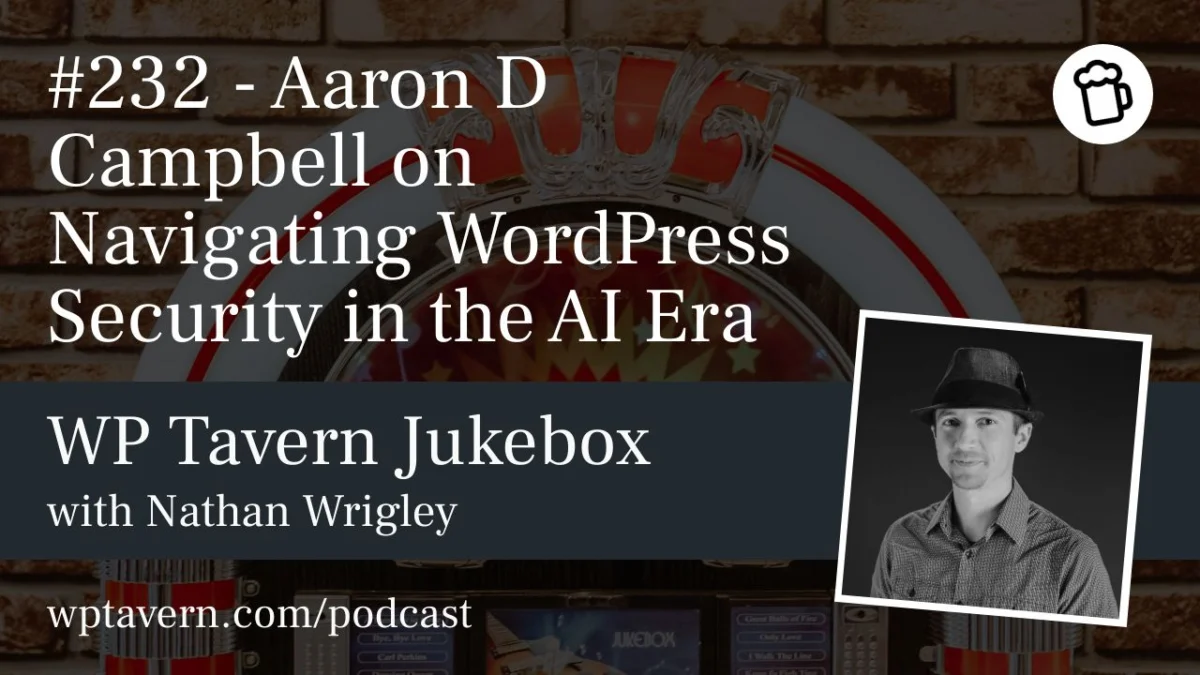
The landscape of web security is undergoing a seismic shift, and the WordPress ecosystem is sitting squarely at the center of this transformation. In a recent episode of the Jukebox Podcast from WP Tavern, host Nathan Wrigley sat down with Aaron D. Campbell—a veteran of the internet and WordPress space with over 25 years of experience—to discuss how artificial intelligence is radically reshaping the speed, scale, and complexity of cyber threats.
Recorded live from the corridors of WordCamp US, the conversation explored the evolution of security from a human-driven game of wits into an automated battle of computational power. Campbell, who has worked with leading agencies, spearheaded the WordPress Security Team, and held key roles at hosting giants like GoDaddy and Newfold, currently serves at Monarx. At Monarx, he focuses on automated malware detection and remediation, giving him a unique cross-platform vantage point on how modern threats propagate across the web.
The Paradigm Shift: From Human Ingenuity to AI Automation
For decades, digital security was defined by human limitations. Both attackers and defenders operated within the constraints of sleep schedules, manual code reviews, and human creativity. However, the advent of generative AI and autonomous agents has completely upended that dynamic.
According to Campbell, while the foundational cat-and-mouse nature of cybersecurity remains unchanged, the sheer speed, scale, and complexity of attacks have accelerated beyond what anyone could have predicted just a few years ago. AI-driven agents are now capable of executing operations 24 hours a day, testing millions of permutations simultaneously, and identifying potential exploits at a velocity that vastly outpaces human capability.
Perhaps even more alarming is the rise of complex, multi-layered attack chains. Campbell shared a striking example from a recent WordPress Core security report that he had to physically print out to comprehend. The document spanned eleven pages of intricate steps and instructions detailing a completely novel vulnerability. He noted that four years ago, software containing such an obscured path would have been considered entirely secure, as no human would have ever conceived of chaining those specific vulnerabilities together. Today, AI agents can orchestrate these complex sequences, write automated exploitation scripts, and launch attacks within fractions of the time it once took.
The Adversarial Landscape and the Economics of Hacking
The motivations behind these sophisticated attacks remain remarkably consistent, tracing back to a single primary driver: financial gain. As the most popular content management system on the web, powering tens of millions of websites globally, WordPress naturally presents a high-value target.
While individual sites may appear to hold little direct financial worth, attackers operate at a massive scale. Compromised websites are routinely weaponized for disparate monetization schemes, ranging from injected pay-per-click pharmaceutical advertisements to distributed computing nodes used to launch wider attacks. Because these malicious operations utilize vast arrays of separate IP addresses, tracing and blocking them becomes significantly more challenging for defenders.
Campbell noted that the adversaries themselves have also evolved. The days of small groups of hackers sitting together in a single room are largely a thing of the past. Today’s threat actors operate in distributed virtual networks, rapidly sharing information, novel malware variants, and newly discovered attack vectors across the globe.
Combating AI with AI: The Collaborative Defense
To counter this relentless, automated wave of attacks, the defensive community has had to adapt by adopting similar technological strategies. The modern security landscape requires defenders to deploy AI against AI, creating an ecosystem where automated systems are used to analyze code, triage vulnerability reports, and test remediation strategies at scale.
Crucially, Campbell emphasized that human oversight remains vital. While artificial intelligence handles the heavy lifting of logical processing and data parsing, human experts act as the decision-makers, guiding the software toward forward-thinking, sustainable solutions.
This cooperative approach extends far beyond individual companies. Just as adversaries collaborate across virtual spaces, the defensive community relies heavily on information sharing. Campbell highlighted the collaborative efforts of the WordPress Security Team, which works closely with major hosting providers, security firms, and infrastructure companies like Cloudflare. Through private communication channels, security teams share triage data and coordinate patches before vulnerabilities can be widely exploited, allowing millions of sites to be protected proactively.
Navigating the Shrinking Window of Vulnerability
One of the most concerning trends in modern web security is the rapidly narrowing window between when a vulnerability is discovered and when it is actively exploited. Historically, software maintainers and hosting providers had weeks or even days to review vulnerability disclosures and deploy patches.
Recent data compiled by Monarx in collaboration with Patchstack reveals that for major vulnerabilities, that window has shrunk to an average of just five hours. In extreme cases, such as the recent wp2shell WordPress exploit, massive spikes in automated exploitation were observed within thirty minutes of a patch and public disclosure going live.
This shrinking timeline validates the need for innovative, sometimes disruptive, defensive policies within the open-source community. Initiatives like "Protect the Shire"—a policy designed to introduce a brief, time-bound holding period before plugin updates are automatically pushed—aim to combat the rising tide of supply chain attacks. By slowing down the update mechanism temporarily, security teams can vet updates to ensure that malicious actors have not hijacked a plugin repository. While this creates a brief window of risk, Campbell noted that exceptions are readily made for urgent security vulnerabilities through coordinated efforts with the WordPress Security Team, striking a delicate balance between caution and rapid remediation.
Practical Advice for Everyday WordPress Users
For the average WordPress user who may not possess deep technical expertise in cybersecurity, Campbell emphasized the importance of leveraging the collective power of the experts. Because it is impossible for individual site owners to stay ahead of every emerging threat, users must strategically position themselves to benefit from automated protections and industry-wide collaboration.
First, users should ensure that automatic updates are enabled for WordPress Core, plugins, and themes. This allows site owners to passively benefit from the rapid patching cycles managed by the WordPress Security Team.
Second, users should carefully evaluate their hosting providers. Choosing a security-minded host that implements layered defenses—such as proactive file monitoring, web application firewalls (WAF), and automated malware remediation—ensures that robust safety measures are operating in the background.
Finally, Campbell stressed the importance of monitoring personal and professional credentials for data breaches. With AI systems increasingly leveraging massive archives of historical dark web data to test credential stuffing attacks across unrelated services, staying informed through monitoring tools like Have I Been Pwned is more critical than ever.
As the digital landscape continues to evolve, the battle between automated adversaries and proactive defenders remains an ongoing, complex journey. Through continuous innovation, open-source collaboration, and robust infrastructure-level security, the WordPress community continues to adapt to the realities of the artificial intelligence era.