
In late October 2026, the global web hosting and cybersecurity community faced one of the most severe infrastructure threats in recent memory. Dubbed "PHP2Shell," a pair of critical vulnerabilities targeting PHP’s internal memory handling threatened millions of websites worldwide. Official security patches were not immediately available when exploitation attempts first
materialized, forcing hosting providers and security teams into a high-stakes race against time. For managed hosting platforms like Kinsta, protecting hundreds of thousands of isolated environments required a synchronized multi-layered defense strategy, combining rapid emergency firewall deployment, custom PHP configuration tweaks, and a massive, automated rollout of runtime patches.
The crisis began unfolding on October 20, 2026, when the official PHP security team announced an upcoming critical security release scheduled for the following day. The advisory warned of two severe vulnerabilities bearing a CVSS 4.0 severity rating of 9.2. Later cataloged as CVE-2026-109618 and CVE-2026-109619, the flaws directly affected PHP’s internal memory management. Under specific conditions, these weaknesses could permit unauthenticated malicious actors to execute arbitrary code remotely on vulnerable servers.
For platforms powering WordPress and other PHP-based applications, the implications were profound. Unlike typical software bugs contained within a specific plugin or theme, PHP2Shell threatened the underlying programming language runtime itself. Application-level updates could not mitigate the risk; the core PHP environment required immediate remediation.

Before official patches were even released, bad actors began probing infrastructure worldwide. According to Laszlo Farkas, Director of Engineering at Kinsta, engineering teams observed suspicious incoming requests targeting the vulnerabilities during the early morning hours of October 21. Staff members immediately began manually checking targeted sites and closely monitoring platform traffic for any indicators of successful breaches, even as preliminary defensive measures were being put into place.
Preparing for PHP2Shell Before Patches Were Available
Because every website hosted on Kinsta—spanning both production and staging environments—operates behind Cloudflare, the engineering team possessed a centralized mechanism to enforce platform-wide protections. Rather than requiring individual site owners to configure manual defenses, Kinsta could deploy infrastructure-level rules instantly.
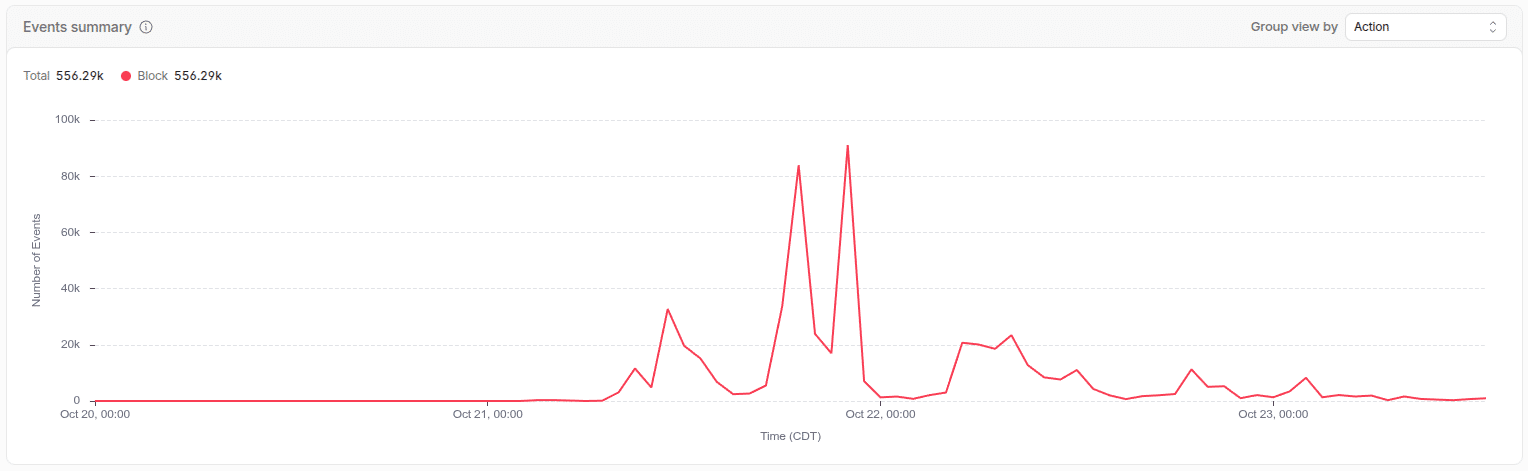
Ahead of the public disclosure, Cloudflare introduced emergency Web Application Firewall rules designed to intercept and neutralize known exploitation patterns. Kinsta’s engineering personnel closely tracked the WAF changelog, reviewing and activating the blocking rules as soon as they went live. Because the vulnerability targeted PHP directly rather than standard application layers, this platform-wide network shield proved vital. While attackers frequently altered their payloads to evade basic detection mechanisms, Cloudflare’s adaptive filtering and full transaction detection—which analyzes signals from both incoming HTTP requests and server responses—helped intercept malicious traffic. By October 23, these combined Cloudflare protections had successfully blocked more than 550,000 requests targeting the PHP2Shell vulnerabilities across Kinsta-hosted properties.
Alongside network-level blocking, Kinsta engineers implemented proactive PHP configuration modifications to minimize platform exposure. One key mitigation involved disabling PHP’s session upload progress feature via the session.upload_progress.enabled directive. Official security advisories identified this setting as a primary vector for certain exploitation paths, and turning it off effectively neutralized specific attack vectors while the platform awaited official vendor patches. This precautionary measure was later reinforced when the PHP development team officially recommended keeping session upload progress disabled until subsequent bug-fix releases were fully integrated.
Deploying PHP Patches Across Hundreds of Thousands of Containers
When the official PHP security releases—including versions 8.2.35, 8.3.36, 8.4.27, and 8.5.12—became available on October 21, the operational focus shifted immediately to infrastructure-wide deployment. However, supporting a diverse client base meant managing not only actively supported PHP branches, but also older, long-term-support versions requiring backported fixes from third-party maintainers such as Freexian.
As patched packages arrived progressively in Kinsta’s package mirrors, engineers rigorously validated each build to ensure platform stability before initiating automated rollouts. The deployment process moved rapidly across the hosting infrastructure. The first packages for PHP 8.5.12 arrived in the mirror at 14:24 UTC on October 21, with deployments beginning shortly thereafter and reaching tens of thousands of containers within hours. Subsequent waves brought patched packages for PHP versions 8.3, 7.4, 8.0, 8.1, 8.2, and 8.4 over the course of the following twenty-four hours.
By the early morning hours of October 22, only a minute fraction of the infrastructure—approximately 0.5% of total containers—required specialized manual attention. Engineers worked systematically through these remaining environments, and by 08:26 UTC, Kinsta confirmed 100% protection coverage across the entire platform, officially marking the incident resolved on public status dashboards.
Reflecting on the scale and speed of the operation, Farkas highlighted the efficiency of the platform’s automated deployment framework. Once an updated package undergoes validation and is confirmed to be stable, the infrastructure allows engineers to roll out changes across hundreds of thousands of containers within a matter of hours, entirely shielding customers from the complexities of manual patching or version management.

Monitoring Attacks and Verifying System Integrity
Deploying runtime updates was only part of the equation; verifying that no systems had been compromised prior to mitigation was equally critical. Throughout the incident, Kinsta engineers continued manual investigations of targeted environments and analyzed security telemetry in collaboration with vulnerability protection partners such as Patchstack. Participation in broader threat-intelligence sharing discussions with other major hosting providers further helped the team stay ahead of evolving attack tactics.
Ultimately, exhaustive reviews of platform logs and targeted spot-checks revealed no evidence of successful PHP2Shell-related breaches across any Kinsta-hosted website. While firewall metrics underscored the sheer volume of incoming scanning and exploitation attempts, the multi-layered defensive posture successfully prevented unauthorized access.
Customer Precautions and Industry-Wide Impact
The severity of the PHP2Shell vulnerabilities sent shockwaves far beyond standard web hosting providers, triggering precautionary responses from governments and organizations worldwide. National cyber security agencies in the Netherlands, Germany, France, Belgium, and Finland temporarily took select government web portals offline while applying emergency patches. In Japan, Prime Minister Sanae Takaichi issued public warnings urging website operators to update immediately or suspend operations if patches could not be applied right away.
This global atmosphere of caution naturally influenced Kinsta’s user base. Support teams experienced a surge in customer inquiries, and approximately 3,000 site owners proactively exercised an abundance of caution by suspending their own environments using MyKinsta’s management tools, enabling bot challenges, or requesting server-level traffic blocks.

Although Kinsta’s engineering leadership did not advise taking websites offline—given that Cloudflare’s emergency WAF rules were already actively shielding online properties—the team respected these precautionary decisions. Once the platform-wide patch rollout was successfully completed, Kinsta’s support and engineering personnel carefully reviewed the self-suspended environments. They systematically reactivated sites that had been taken offline exclusively due to PHP2Shell concerns, leaving unrelated maintenance suspensions untouched.
Ultimately, the PHP2Shell incident underscored the resilience of managed infrastructure. By combining proactive network-level filtering, temporary configuration hardening, and rapid automated container patching, the platform ensured that website owners remained fully protected without needing to navigate complex security updates on their own.