Most marketing and sales teams already operate in a state of software saturation, paying for more subscriptions than they have hours in the day to manage. Despite an abundance of specialized tools, foundational operational friction persists. Campaign reports continue to be assembled manually by stitching together disparate metrics, prospect research piles up behind looming deadlines, and invoices sit idly in vendor portals until someone finally remembers the password. While conversational chat assistants have successfully helped professionals draft emails and brainstorm ideas faster, the actual labor of execution remains firmly on human shoulders. Once a text draft is generated, a human still has to log into the relevant platform, paste the content, update the customer relationship management database, and execute follow-up actions.
The primary bottleneck in modern knowledge work is no longer a lack of ideas or copywriting capability. Instead, it is the hundreds of small, multi-step tasks spread across fragmented software applications that never quite communicate with each other seamlessly, combined with the sheer team capacity required to complete them week after week.
This operational challenge was recently underscored during a demonstration by Aaron Douglas, who showcased a fully orchestrated digital presence managed for himself and multiple corporate clients. By leveraging a new system, Douglas managed to eliminate mundane administrative tasks from his daily routine while maximizing marketing throughput. The core differentiator of this approach was not an autonomous artificial intelligence dictating creative direction or business outcomes, but rather a human orchestrating persistent digital workers to handle the heavy lifting. That underlying technology is Grok Bot, a new platform designed to fundamentally alter how professionals interact with digital automation.
Meet Grok Bot
Developed by xAI and operating on the account infrastructure of Cursor, Grok Bot introduces a new class of digital assistants known simply as Bots. Each Bot functions not merely as a chat interface, but as a dedicated teammate equipped with a distinct name, a specific job description, and a persistent memory that builds and refines itself over time.
Unlike traditional browser-based chatbots that provide static text responses, every Grok Bot operates on a persistent cloud computer equipped with its own dedicated browser, filesystem, and terminal. This architecture allows the Bot to execute complex workflows directly inside real software applications and websites, rather than simply handing a human user another draft to copy and paste. To ensure accessibility across diverse operational environments, the platform features desktop applications for macOS, Windows, and Linux, alongside native mobile applications for iPhone, iPad, and Android devices.
The system is a natural fit for marketing leaders, sales teams, operations personnel, and founders who constantly juggle a fragmented stack of business systems. Interacting with a Bot mirrors standard workplace communication; users message their digital teammates just as they would a human coworker. The Bot then processes the assignment independently, navigating software interfaces and executing tasks, and only returns to the user when it requires formal approval or explicit direction.
Delegate Outcomes, Not Prompts
The introduction of persistent AI teammates represents a fundamental shift in workplace productivity, moving organizations away from the traditional model of issuing isolated prompts toward a paradigm of delegating complete ownership of outcomes. For example, a Bot assigned to outbound sales development can independently research prospective accounts, score incoming contacts based on established criteria, and draft tailored outreach messages matching a specific brand voice overnight. By the time the human team logs in the following morning, a curated review list is already waiting for approval. This ensures that the business pipeline continues to move forward continuously while internal teams focus their limited energy on high-value conversations that ultimately close deals.
Because each Bot retains its own isolated memory, local file system, active browser sessions, and operational preferences, subsequent requests are processed significantly faster than initial tasks. Corrections and feedback provided by the human user are permanently integrated into the Bot’s operational methodology, ensuring that the quality of execution progressively improves rather than resetting with every new chat window or session.

Crucially, operational momentum continues even after the human user closes their laptop and logs off for the day. Because these Bots operate continuously in the cloud in parallel environments around the clock, recurring administrative obligations such as weekly performance reporting, competitive monitoring, and account health digests can be completed before a Monday morning status meeting rather than consumed during it.
At the same time, operational control remains firmly in human hands. Grok Bot is engineered to request explicit authorization before transmitting outbound messages, publishing content, or executing financial transactions. Furthermore, sensitive organizational actions can be routed through an automated internal review pipeline before execution. This dual approach enables lean teams to scale their overall output dramatically without sacrificing oversight over sensitive, customer-facing operations.
Capabilities That Move the Work Forward
The practical utility of any digital assistant is ultimately defined by the breadth of its access to third-party platforms and the analytical judgment it exercises between sequential tasks. Grok Bot is designed to bridge the gap between initial ideation and final execution, ensuring that workflows run from start to finish without stalling at intermediate suggestions.
Organizations adopting the platform typically begin by identifying a single, highly repetitive administrative task that consumes an excessive number of hours each week. Once a designated Bot demonstrates the ability to manage that specific responsibility reliably, the workflow is formalized into a routine, clearing the way to deploy additional Bots to adjacent operational lanes.
Getting Started with Grok Bot
Accessing the platform requires downloading the appropriate desktop client for macOS, Windows, or Linux, or the corresponding mobile application for iOS or Android, followed by authentication via an active Cursor account. Upon initial login, a primary Bot is automatically provisioned, and an underlying cloud computing environment is established in the background. Users can initiate the onboarding process by assigning a single primary job description in their first message, connecting any requested third-party applications, and delegating a tangible task for same-day review.
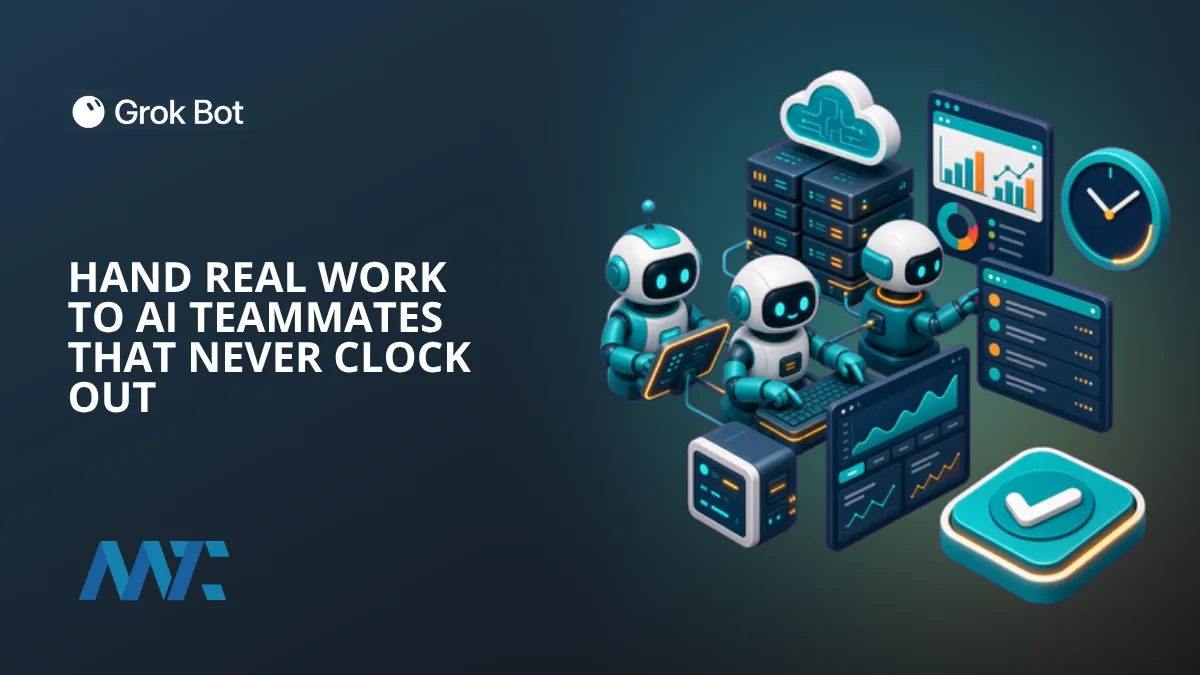
The practical efficacy of the platform is frequently demonstrated through its own operational deployment. In initial testing, the system successfully absorbed complex multi-step workflows encompassing research execution, content drafting, structural formatting, and visual asset production—such as generating a featured graphic through integrated design tools—before handing the finished package to a human editor for final proofing and publication.
Access to Grok Bot is bundled directly into paid individual Cursor plans as well as the Cursor Teams tier, utilizing a linked SuperGrok subscription. Additional deployment pathways include self-serve Grok Business seats and higher-tier subscriptions on the X platform. Resource utilization is pooled according to the specific plan tier and resets on a weekly basis, with higher subscription tiers providing expanded usage limits and priority access during periods of peak network demand. Enterprise organizations seeking organization-wide deployment can coordinate directly with sales representatives to provision access across internal teams, including personnel who may not yet possess an active individual software seat.