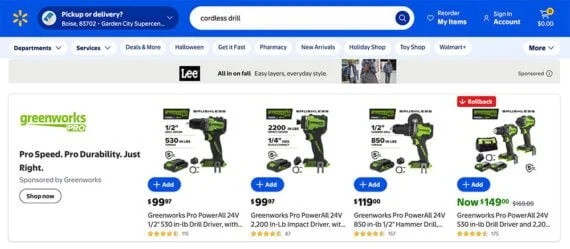
A recent routine search for "cordless drill" on Walmart’s digital storefront provided a vivid illustration of a quiet, high-stakes struggle playing out across many of the world’s leading enterprise ecommerce websites.
At the top of the search results page sat a Greenworks-sponsored brand module showcasing four distinct products. Immediately beneath that prominent banner, the next three individual product listings were also designated as sponsored content. For a shopper looking to browse the marketplace, a strictly organic search result did not appear until the seventh product position on the page.
Every single advertisement displayed in those top slots was entirely relevant to the query. That baseline relevance is what made the search experience interesting rather than outright frustrating. Yet, looking past the user interface, a fundamental question emerges: What mechanism decides which products occupy those prime digital real estate positions, and why?
For modern retailers aggressively building out profitable retail media networks, that question is rapidly becoming unavoidable. When advertising inventory heavily determines which products shoppers see first upon visiting a site, the operational and philosophical line where traditional merchandising ends and retail media begins starts to blur significantly.
2 Objectives
Within major retail organizations, merchants and media monetization teams often operate with competing reasons to place specific products in prominent positions. Traditional merchandising aims to optimize the customer journey by highlighting products that maximize long-term customer satisfaction, conversion rates, and gross margins. Conversely, retail media teams are tasked with maximizing advertising revenue by fulfilling high-paying placements promised to brand partners and advertisers.
Those two distinct objectives now routinely collide in some of the most valuable, high-traffic areas of an ecommerce site. The search results page serves as the most obvious battleground. The core site algorithm might rank products based on organic relevance, inventory levels, and historical sales signals, while sponsored products occupy the most visible top-tier positions based partly on an automated advertising auction.
Category pages present a strikingly similar dilemma. Ecommerce merchandisers would otherwise use these curated spaces to highlight top-selling items, seasonal goods, or exciting new arrivals to capture consumer interest. At the same time, the retail media framework makes those exact same high-value positions available to external brand advertisers looking for maximum visibility.
Retailers also need to be thoughtful about where and how they introduce advertising, noted Sherry Smith, president of retail media at Criteo, in response to email inquiries regarding the balance between ads and organic content. More inventory doesn’t necessarily mean more value, Smith explained, emphasizing that the primary focus should always remain on placements that perform effectively for advertisers, remain genuinely useful to everyday shoppers, and create true incremental value for the retailer once the total costs of running the advertising program are fully accounted for.
Governance
This delicate balancing act extends far beyond a simple layout or user experience question. In large, complex retail businesses, these two competing objectives usually belong to two entirely different internal departments governed by vastly different performance metrics and financial incentives.
The core merchandising team is typically measured on standard ecommerce metrics such as conversion rates, unit sell-through, and profit margins. Meanwhile, the retail media team is measured on total ad revenue growth, campaign performance, and advertiser retention rates. When both teams are given a stake in the exact same search results page, each possesses a completely rational incentive to claim the absolute best positions for their own goals.
The traditional merchant naturally wants the most visible spots reserved for the items most likely to convert browsing shoppers into buyers. On the other side of the aisle, the professionals selling retail media want those exact same prime placements allocated to the highest-paying brand partners.
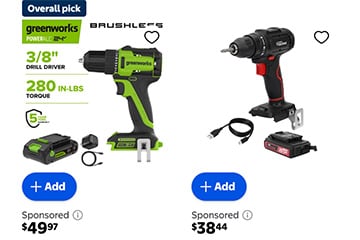
Left completely unresolved, the media side often holds a distinct structural advantage within corporate budgeting and reporting structures. Ad revenue is immediate, highly attributable, and remarkably easy to report upward to executive leadership. Meanwhile, the cost of a displaced organic product placement is diffuse, delayed, and notoriously difficult to measure in real time. A sponsored slot that generates heavy ad revenue this month while quietly depressing overall category conversion is recorded as a definitive win on the media team’s dashboard, yet remains a loss that almost nobody can quite prove on the merchandiser’s ledger.
That underlying corporate dynamic is precisely why determining where merchandising ends and media begins is fundamentally a governance decision. It forces leadership to address a critical question: Who ultimately owns the page, and by what transparent rules do the two internal sides share it?
Relevance
Fortunately, the two primary objectives do not inherently have to conflict with one another. A sponsored product can frequently be the exact item that the retailer would naturally want the shopper to discover and purchase anyway.
In the Walmart cordless drill example, the paid placements were entirely relevant to the underlying search intent, even though a commercial advertising auction helped determine which specific products appeared first on the screen.
The key is making sure media adds to the overall experience rather than getting in the way of it or simply replacing organic discovery, Smith noted. At the end of the day, relevance matters deeply, she added, explaining that if the advertising is genuinely useful to the shopper, it is much more likely to create sustainable value for every single party involved in the transaction.
Relevance, therefore, serves as the natural boundary line between the two distinct parts of the modern digital retail business.
When a paid placement and the automated merchandising algorithm independently choose the same product, there is no operational conflict whatsoever. Retail media revenue arrives smoothly without displacing any high-converting organic items.
Tension only truly grows when a paid placement gives a less useful or less popular product prominence over one that the retailer’s merchandising signals would otherwise heavily favor.
Rules for Sharing
As retailers take the governance question more seriously and increasingly recognize the long-term value of maintaining relevant, non-disruptive ads, many are beginning to converge on practical internal rules for sharing digital shelf space. Establishing clear thresholds for ad density, defining strict relevance scores before a sponsored ad can clear an auction, and protecting specific organic real estate for top-performing inventory are becoming standard practices among sophisticated operators.
Merchandising and Media
Retail media ultimately gives retailers another powerful way to create financial value from valuable digital assets they already possess, including their heavy digital traffic, proprietary shopper data, and the crucial micro-moments when consumers are actively looking to spend money on products.
That massive commercial opportunity is at its absolute greatest when advertising seamlessly adds to the core commerce business rather than simply occupying and monetizing the space that the retail business worked so hard to create.