Replacing complex JavaScript with modern CSS features often feels like an immediate victory during code reviews. Developers regularly swap out heavy ResizeObserver scripts for native container queries, watching the pull request diff turn mostly red as lines of JavaScript vanish. The change is often approved before lunch, celebrated as a triumph of modern web development and a major cleanup of the codebase.
However, a week later, unforeseen issues frequently emerge across the application. A dashboard card abruptly disappears, headings inexplicably grow larger on tablet devices, or interior comment spacing goes completely off. None of these bugs live within the specific lines of the new code; instead, they arrive alongside the newly introduced CSS, exposing a disconnect between local code simplicity and overall system complexity.
Gabriel Shoyombo explores this architectural friction, addressing what happens when business and presentation logic is split unevenly between CSS and modern JavaScript. The core dilemma centers on whether native CSS features genuinely reduce application weight or merely shift complexity into deeper layers of the browser rendering engine, stylesheet cascade, and surrounding layout structures.
Local Simplicity Versus System Complexity
Introducing a new CSS feature into an existing application functions similarly to welcoming a new tenant into a shared apartment. Even if the newcomer is quiet and tidy, they must still share the kitchen, utilities, and daily routines with everyone else already living there. In frontend architecture, CSS must coexist with JavaScript, component layouts, the CSS Cascade, and the browser rendering engine. The overall stability of the application depends less on the elegance of the individual feature and more on how harmoniously it interacts with existing systems.
This dynamic reignites ongoing debates within the frontend community regarding essential versus accidental complexity. Discussions across developer forums frequently highlight a recurring tension: writing fewer lines of code on paper does not automatically translate to reduced complexity in real-world production environments. Native features only successfully reduce complexity when they fully replace previous implementations without disrupting the surrounding system behavior.
The migration process itself often introduces vulnerabilities when legacy code is left behind. For instance, when a team transitions from a JavaScript ResizeObserver that toggles a utility class to a native CSS container query, the transition is rarely clean or absolute. The stylesheet rule for the container query is successfully added, but the original JavaScript observer often survives because it remains registered in an entirely separate file or module.

Similarly, dependent selector rules tied to old utility classes frequently persist because developers fail to search for every reference across the codebase. While the initial behavior appears identical because both implementations target the same breakpoint, subsequent design updates expose the hidden fracture. When a designer later requests a breakpoint adjustment, a developer updating only the container query inadvertently creates an unhandled intermediate state. The component displays conflicting layout traits, and tracing the origin of the bug requires engineers to understand and reconcile two separate owners of the same behavior.
Unintended Layout Shifts and the Cascade
The ripple effects of modern CSS extend far beyond layout containment and interactive breakpoints. Declaring modern layout rules can inadvertently alter block formatting contexts, fundamentally shifting how surrounding elements behave. For example, applying inline-size containment to allow child elements to query their parent width communicates much more to the browser than a simple size instruction.
Such declarations can abruptly halt margin collapsing between adjacent elements. A paragraph margin that previously merged seamlessly with a card header can suddenly become trapped, altering vertical spacing and expanding element dimensions without warning. Similarly, elements positioned near floated images can shift dramatically, moving entirely outside text-wrapping flows or collapsing entirely if their width was previously determined by their content.
These layout surprises intersect directly with the complexities of the CSS Cascade and modern selector capabilities. Advanced selectors and native nesting mechanisms allow developers to write shorter, more expressive stylesheets. However, concise selectors can inadvertently reach further than intended, matching elements outside their localized scope.
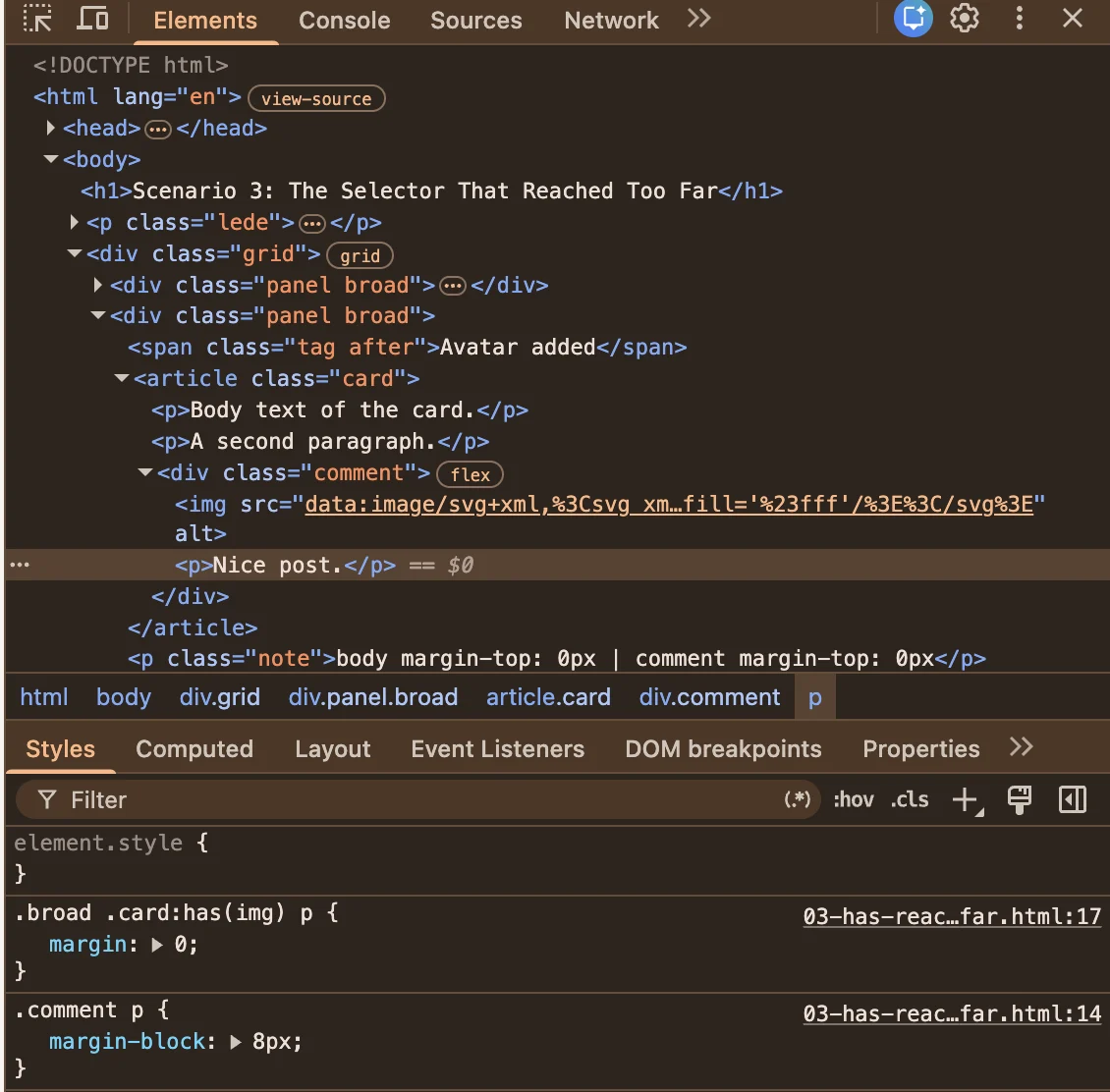
A selector designed to target paragraphs inside specific media cards can inadvertently strip margins from unrelated nested components, such as user comments, whenever structural conditions are met. Because these states change dynamically at runtime based on user interaction, reproducing and debugging these cascading side effects becomes exceptionally difficult.
Furthermore, stylesheet architecture and build processes play a critical role in how these rules resolve conflicts. In codebases combining traditional stylesheets with modern cascade layers or dynamic injection patterns, rule precedence relies heavily on origin, layer hierarchy, and load order. A layered component rule can easily lose specificity battles to unlayered legacy styles, reintroducing old specificity wars under a new syntax.

Performance Realities in Rendering Engines
A common justification for migrating logic from JavaScript to CSS is the assumption that native browser features are inherently faster. While offloading layout calculations to the browser engine eliminates explicit script execution overhead, it introduces new performance considerations that are rarely measured during code reviews.
Advanced conditional selectors require the browser to evaluate complex document relationships dynamically. Performance traces on large lists demonstrate that combining multiple layout-dependent rules can trigger widespread restyling across thousands of elements simultaneously, even when only a single row’s state changes. While modern rendering engines optimize these updates remarkably well, intersecting conditions can still introduce measurable overhead during rapid user interactions.
Similarly, migrating animations or transitions from script-driven transforms to layout-triggering properties like width, height, or positioning forces the browser to recalculate layout geometry on every single animation frame. The performance cost is dictated by the chosen property rather than the language used to write it, making profiling and measurement essential before declaring a migration successful.
Navigating these interconnected challenges requires a disciplined approach to frontend architecture. Rather than treating native CSS upgrades as simple drop-in replacements, engineering teams must evaluate how new features interact with existing component behaviors, cascade layers, layout contexts, and rendering performance. Thoroughly auditing legacy scripts, verifying selector boundaries, and measuring rendering impact ensure that modernizing a codebase genuinely simplifies the application rather than distributing complexity into harder-to-reach places.