Every website is at its absolute best the day it ships. The final branch merges successfully, the development server spins down, the production site goes live exactly as designed, and for a brief, fleeting moment, it is perfect. It is clean, sharp, fully responsive, and completely aligned with the immediate vision of its creators.
Experience shows, however, that it will never be this good again.
This decline does not happen because anything suddenly breaks or the code suffers a catastrophic failure. The site keeps working, rendering in browsers across devices just as it was programmed to do. But the market moves forward, business messaging shifts, a fierce competitor launches a surprise feature, and the careful creation built over months slowly stops matching the reality of the company it is meant to represent. A year later, it stands as a digital period piece—not strictly broken, but quietly and undeniably behind.
Every web development team, product manager, and designer knows this slow decay intimately. For decades, almost everyone in the industry has treated it as an immutable law of nature—an inevitable tax paid for launching a digital product into a fast-moving world.
Yet, a growing faction of developers argues that it does not have to be that way. Proponents of next-generation web platforms suggest a website should actually keep improving after launch instead of drifting away from its peak performance day. In this vision, a site could be quietly optimizing itself in the background while the human team that originally built it moves on to tackle entirely new product challenges.
Picture how that workflow might function in an ideal scenario. While the rest of the office sleeps, an intelligent agent catches that a design-system change made the previous week never successfully propagated to the pricing page, and it automatically fixes the discrepancy. Another automated agent finds a set of high-resolution images that were shipped completely uncompressed during a rushed late-night release and optimizes their file sizes without sacrificing visual fidelity. A third agent flags a subtle accessibility regression introduced by a newly deployed component, either resolving the issue independently or leaving a clean, actionable flag for a human engineer to check during morning standup.
The promise is waking up to a site that is measurably better than the one left behind the evening before, accompanied by a short, manageable list of the few high-level decisions the agents wanted human eyes on. For many developers, that is the version of web automation worth wanting.
However, the moment product architects take that theoretical promise seriously, they run into a profound psychological and operational roadblock that has almost nothing to do with underlying technology: almost nobody actually wants a website that changes entirely on its own.
Why "Just Make It Autonomous" Is the Wrong Goal
The most obvious move, once an engineering team has access to capable artificial intelligence agents, is to simply hand over the keys to the whole kingdom. Let the autonomous systems write, edit, optimize, and publish content, and then consciously get out of the way. It sounds like the natural technological endpoint for web development, and it is almost universally the first thing people picture when they hear the phrase "autonomous website."
It is also the exact thing almost no one wants once that reality is placed directly in front of them on a staging server.
Developers and platform architects are learning this lesson the hard way: by building the exact opposite approach first. While developing Fimo, an autonomous website platform designed to manage digital infrastructure, creators set out to make websites fully autonomous under the assumption that absolute self-management was the ultimate goal. They then watched closely to see how real-world users actually interacted with the technology.
What users did was hesitate. That hesitation did not stem from a deep distrust of the underlying agents or artificial intelligence capabilities. Rather, it exposed a fundamental organizational truth about the modern web: a website has no single owner. Different sections, pages, and components belong to different stakeholders across an organization, and each stakeholder demands a vastly different level of autonomy over their domain.
Consequently, the core engineering question was never simply whether to trust autonomous agents. The real challenge was figuring out where to draw the line, and for whom. Once product teams frame the challenge through that lens, the daily workload of maintaining a website splits cleanly into three distinct categories of effort.
Most of It Is a No-Brainer
To understand how website autonomy can actually function, it helps to start with the largest pile of maintenance work—a volume of tasks far larger than most outsiders or executives expect.

The vast majority of what keeps a modern website healthy, compliant, and functional is entirely rule-bound, highly repetitive, and completely devoid of creative joy. This category includes keeping accessibility standards compliant as individual pages shift and evolve, propagating a global design-system update across hundreds of subpages once a core token moves, and catching a broken meta tag, an unoptimized image asset, or a hyperlink that quietly rotted when a URL structure changed three sprints ago.
None of this is where any professional’s true talent or creative passion lives. No one is hired into a digital agency or tech company because of a legendary gift for spotting a missing alternative text attribute on a secondary graphic. This is the exact type of maintenance work that teams are actively relieved to hand off.
Furthermore, it is precisely the kind of work that software agents excel at executing, because it is defined strictly by clear, programmatic rules rather than subjective human taste. An agent that quietly keeps this foundational infrastructure correct across an entire enterprise site, working unattended in the background, does not represent a threat to anyone’s job security. Instead, it represents the tedious eighty percent of digital maintenance finally being taken care of without human friction.
Acknowledging just how much of the daily web maintenance load actually lives in this category is what ultimately transforms the concept of an autonomous site from a terrifying leap into a practical relief. Teams are not handing over creative judgment or brand identity; they are simply delegating digital chores.
Some of It You’d Never Hand Over
At the exact opposite end of the spectrum sits the critical work that professional designers, copywriters, and brand stewards would refuse to delegate at any price. It is a relatively small pile of tasks, but it represents the very reason those professionals were hired in the first place.
An automated agent can easily check a newly drafted web page against every rigid technical rule a company has established. It can effortlessly confirm that color contrast passes regulatory thresholds, heading hierarchies are structured correctly, design tokens are accurately applied, and the copy aligns with the corporate style guide.
What an automated system fundamentally cannot do is decide what a page should feel like emotionally, or determine whether the product being shipped is genuinely good in the subjective sense of human taste. That specific brand judgment is exactly what creative teams are paid for, and no amount of algorithmic capability will ever successfully move that responsibility off a human desk.
This is the exact domain that skeptics immediately point to when they voice resistance against website autonomy, and in many ways, they are entirely right to protect it. The critical mistake lies in assuming that an entire enterprise website is constructed out of this kind of high-level creative work. In reality, almost none of it is. Yet, that small, untouchable percentage matters infinitely more than all the rest combined, which explains why automating a website blindly feels fundamentally wrong to experienced creators.
And a Lot of It Depends on Who You Are
Between the mundane chores and the untouchable creative core lies a vast middle ground that no commercial software product can pre-package or settle for a team, because the boundary line runs through completely different places depending on who is looking at the task.
Consider one real-world scenario frequently encountered during web redesigns: changing the default theme of a landing page to dark mode for incoming visitors. An autonomous agent can execute this structural code change in a matter of seconds. The real debate centers on who holds the authority to decide that the change should happen at all.
For the lead designer who fiercely protects the company’s visual identity, a default theme is never just a simple settings toggle; it is a profound artistic statement about how the brand wishes to be perceived upon first impression. Consequently, that designer wants absolute control over the call.
For the front-end developer tasked with shipping code improvements, however, switching to dark mode is merely a one-line default configuration backed by clear usability metrics—precisely the kind of routine update they would happily let an automated agent apply so they can move on to complex engineering problems.
It is the exact same change, executed on the exact same website, yet the designer and the developer draw their respective lines of control in entirely opposite places.
This divergence occurs because the exact same task carries varying amounts of subjective judgment for different roles. For one professional, it represents a pivotal brand decision; for the other, it is just another technical chore. There is no universal default setting that any software product could ship out of the box that would satisfy both perspectives simultaneously, because the definition of the "right" boundary is a direct function of where an individual’s professional value lies, rather than an inherent property of the task itself.
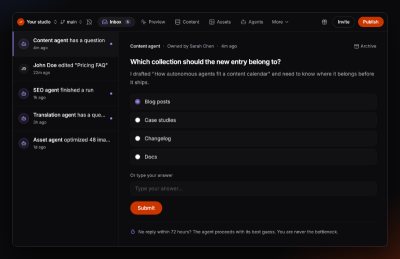
This realization is precisely why platform developers argue that control mechanisms must be granular—configured per task and per individual user—rather than relying on a blunt, site-wide toggle.
You Don’t Just Set the Autonomy: You Build the Agent
Once an organization accepts that the boundary line of control is deeply personal to each team member, a simple binary switch between "manual approval" and "automatic delegation" ceases to be functional. Because the exact placement of the line depends heavily on what a specific agent is designed to achieve, the true unit of modern software control becomes the agent itself.
This insight shapes how modern platforms approach workflow configuration. Rather than forcing users to choose from a rigid, fixed menu of predetermined system behaviors, platforms allow teams to compose their own specialized agents, deciding precisely what domains each entity is permitted to touch.
Users can build a custom agent from scratch or take an existing template close to their operational needs and shape it to match their internal comfort threshold. For instance, an engineering team might deploy an accessibility-focused agent and grant it full permission to run unattended, while keeping a content-generation agent tightly tethered to human review whenever brand-facing copy is involved.
Furthermore, these systems do not remain static after deployment. Advanced agents learn continuously from the tasks they execute and the explicit feedback provided by human supervisors, meaning the regulatory boundary established last month does not have to remain static. Tasks that required cautious human approval weeks prior can gradually shift toward automated delegation, not because teams lowered their professional standards, but because the software agents earned verifiable trust over time. The control line ceases to be a configuration set once during onboarding; it moves dynamically as trust accumulates, ultimately resulting in reduced operational overhead for human staff.
Start Narrow and Widen as You Trust It
Embracing website autonomy does not mean blindly flipping a production site into a fully autonomous state on day one. In practical deployment scenarios, the process moves in the exact opposite direction: teams delegate a tiny slice of responsibility, observe how the agent performs under real conditions, and gradually loosen the reins.
Modern platforms make this verification process transparent by logging every agent run, complete with historical records, system logs, and side-by-side visual comparisons of what changed before and after the script executed. Trust does not scale simply because users get used to the abstract idea of artificial intelligence; it grows because operators can visually inspect what happened and empirically evaluate the results. The first time an automated agent quietly fixes an obscure bug that would have otherwise slipped past human review, and the supervisor can trace the exact logic of the fix, the next wave of delegation becomes significantly easier to authorize.
Configurable deadlines also prevent teams from becoming operational bottlenecks for the workflows they have already chosen to delegate. If a human reviewer does not weigh in on a flagged update within a designated timeframe, the agent proceeds safely based on pre-established parameters. The terms of operation are set once by the team, removing human latency from the daily optimization cycle of the website.
The Frozen Site Is the Real Risk
The primary anxiety voiced by traditional web teams when discussing autonomy is the fear that an agent might autonomously alter a critical page without explicit human oversight. Industry veterans suggest inverting that perspective entirely: the true, active risk to any modern business is a corporate website that never changes at all.
A frozen, stagnant website does not remain safe simply because it remains untouched. Instead, it slowly falls behind market realities in a subtle, compounding decay that often goes completely unnoticed internally until the digital presence no longer accurately represents the active enterprise behind it.
The fundamental point of bringing autonomy into web infrastructure was never to remove human creators from their websites. Rather, the goal is to remove the slow, grinding decay that ruins great launches, allowing skilled professionals to invest their limited creative judgment into the handful of high-impact decisions that genuinely deserve their attention while routine maintenance takes care of itself.
By drawing the operational line where true human value resides, teams can safely let automated agents handle everything else on the other side—allowing that boundary to shift naturally forward as the software proves its reliability over time.