Every website experiences its fleeting moment of perfection on launch day. The final branch merges successfully, the deployment completes, and the site goes live precisely as envisioned by its creators. For a brief moment, everything is pristine. Yet, digital creators and developers know an unacknowledged truth: a website will almost never be that good again.
This decline is rarely the result of a catastrophic crash or a sudden technical failure. Instead, it is a slow, silent drift. The surrounding market shifts, messaging evolves, competitors launch new features, and the meticulously crafted digital presence gradually stops reflecting the modern reality of the company behind it. A year later, a website can easily feel like a period piece—not strictly broken, but quietly falling behind.
Every web development and product team is intimately familiar with this steady decay, and for decades, the industry has largely treated it as an immutable law of nature. Maintenance is viewed as a constant tax on human time, a treadmill of minor updates where keeping the lights on consumes the energy needed for true innovation.
However, the rapid advancement of artificial intelligence and autonomous agents suggests it does not have to be that way. Industry observers and platform builders argue that a website could theoretically continue improving long after its initial launch. Rather than drifting away from its peak day, a modern digital property could engage in continuous, quiet self-optimization while the human team behind it focuses on higher-level creative and strategic work.
Envisioning the ideal scenario paints a compelling picture. While the team sleeps, an autonomous agent detects that a recent design system modification failed to propagate correctly to the pricing page, and it automatically applies the fix. Another agent identifies a batch of uncompressed images shipped during a rushed product release and optimizes them for performance and bandwidth. A third agent flags an unexpected accessibility regression introduced by a newly deployed component, either resolving the issue independently or flagging it for human review. In this utopian vision, professionals wake up to a website that is measurably superior to the one they left the evening before, accompanied by a concise summary of only the critical decisions that required human intervention.
Yet, as developers and platform engineers begin taking this promise seriously, they quickly encounter an obstacle that has very little to do with raw technology: almost nobody actually wants a website that changes entirely on its own.
Why "Just Make It Autonomous" Is the Wrong Goal
The most obvious strategic move, once a development team has access to highly capable autonomous agents, is to hand over the keys to the entire digital property. The instinct is to let algorithms write, edit, optimize, and publish content autonomously, effectively removing humans from the routine operational loop. It sounds like the natural technological endpoint, and it is almost universally the first thing people picture when they hear the phrase "autonomous website."
It is also the exact configuration that almost nobody wants once they see it implemented in front of them in the real world.
This friction is something developers learn the hard way—by building the opposite first. While developing Fimo, an autonomous website platform designed to streamline digital operations, creators initially set out with the assumption that full autonomy was the ultimate destination. They built the system to run independently, and then watched how users actually interacted with it.
What users did was hesitate. That hesitation did not stem from a deep-seated distrust of artificial intelligence or autonomous agents. Rather, it highlighted a fundamental organizational reality: a modern website has no single owner. Different sections, features, and layers of a digital property belong to different stakeholders across an organization, and each stakeholder demands a vastly different threshold of autonomy. Consequently, the core architectural question was never simply whether to trust the agents. It was about determining exactly where to draw the line, and for whom.
Once the problem is framed through that lens, the daily workload of maintaining a website splits cleanly into distinct categories.
Most of the Work Is a No-Brainer
To understand how autonomy can actually serve human teams, it helps to examine the largest pile of digital maintenance tasks, which almost always proves to be much larger than people initially expect. The vast majority of what keeps a website healthy, compliant, and functional is rule-bound, repetitive, and entirely devoid of creative fulfillment.
Consider the daily operational burden: keeping accessibility standards compliant as dynamic pages change; propagating a design system update across hundreds of templates the moment a core token shifts; catching broken meta tags, uncompressed images, or internal links that rotted when a URL structure changed three sprints ago.
None of this routine maintenance is where human talent actually lives. No one is hired for their visionary design eye or their exceptional strategic insight when it comes to spotting a missing alternative text attribute on an obscure icon. In reality, this is the exact category of work that digital teams are actively relieved to hand off. Furthermore, it happens to be the precise domain where autonomous agents excel, because these tasks are defined by strict rules rather than subjective taste.
An agent that quietly and reliably maintains this operational layer across an entire multi-page website without human supervision does not pose a threat to anyone’s job security. Instead, it serves as the tedious eighty percent of digital maintenance finally being taken care of automatically.
Naming and quantifying how much of the routine maintenance load lives in this baseline pile is what ultimately shifts the entire concept of an autonomous site from a risky technological leap into a practical utility. Teams are not handing over subjective judgment; they are simply delegating their chores.
Some of the Work You Would Never Hand Over
At the opposite end of the spectrum sits the work that professionals would refuse to delegate at any price. This category represents a remarkably small fraction of the total effort required to run a digital property, but it is precisely the reason those professionals exist in the first place.
An artificial intelligence agent can evaluate a newly created web page against every established rule in a design system. It can programmatically confirm that color contrast ratios pass regulatory thresholds, heading orders follow a logical sequence, code tokens are accurate, and the written copy strictly adheres to a predefined style guide.
What an agent fundamentally cannot do is decide what the page should actually feel like, or evaluate whether the creative direction of a newly shipped feature is genuinely good in the subjective, artistic sense of the word. That human judgment is precisely what professionals are hired to provide, and no amount of algorithmic capability will ever successfully move that responsibility off their desks.
This is the exact domain that critics point to first when they express resistance toward full website autonomy, and they are entirely justified in protecting it. The critical mistake lies in assuming that an entire website is composed exclusively of this kind of high-stakes, subjective work. In practice, almost none of it is. Yet, that small fraction of creative work matters profoundly more than all the routine maintenance combined, which explains why the idea of automating everything feels so unsettling to creative teams.
The Line Depends Entirely on Who You Are
Between the routine chores of baseline maintenance and the untouchable realm of human creative judgment lies a vast middle ground. This is the territory where no commercial product can settle the boundaries automatically, because the operational line runs through entirely different places for different people.
Consider a concrete, real-world change: switching a website’s default theme to dark mode when visitors land on the page. An autonomous agent is fully capable of executing this adjustment across the codebase in a matter of seconds. The real debate centers on who holds the authority to decide that the change should happen in the first place.
For the brand designer who owns the visual identity of the organization, a default theme is never merely a technical setting. It represents a deliberate statement about how the brand wishes to be perceived upon first impression, and the designer naturally wants to retain absolute control over that aesthetic call. For the developer tasked with shipping the code change, however, it is often viewed as a simple one-line configuration with a clear, rational justification—precisely the kind of routine update they would gladly let an autonomous agent apply so they can move on to more complex architectural challenges.
The scenario reveals a deeper truth about digital operations. It is not a matter of one professional being overly cautious while another is reckless. Rather, the exact same operational task carries vastly different amounts of subjective judgment for different roles. For one person, it represents a core strategic decision; for another, it is simply another chore to clear off a ticket backlog. Because "right" is a direct function of where an individual’s professional value lies rather than an inherent property of the task itself, no single default setting shipped by a software vendor could ever satisfy everyone.
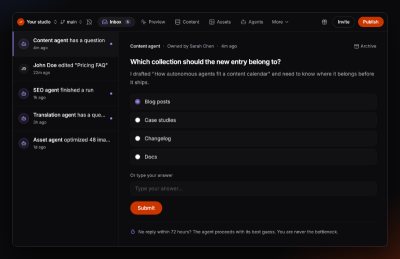
This fundamental reality is why operational control must be granular, operating on a per-task and per-person basis. It explains why platform developers ultimately abandoned the search for a universal settings toggle that would miraculously work for every organization. There is no single configuration; there is only the specific boundary each professional draws, and the availability of sophisticated tools required to draw that line with precision.
Building the Agent, Not Just Setting Autonomy
Once an industry accepts that the operational boundary is deeply personal and context-dependent, a binary toggle between manual approval and total delegation ceases to be sufficient. Because the exact placement of the line depends heavily on what a given agent is actually permitted to do, the true unit of control shifts from a static dashboard setting to the construction of the agent itself.
This realization shaped the evolution of platforms like Fimo, transforming how users interact with automation. Instead of choosing from a rigid menu of predefined behaviors, teams compose their own autonomous agents, explicitly defining what each individual agent is permitted to touch within the digital architecture.
Users can build custom agents from scratch or take an existing template tailored to their general requirements and shape it to match their exact risk tolerance. For instance, an organization might deploy an accessibility agent with broad permissions to run completely unattended, while keeping a content generation agent tightly restricted to ensure human eyes review anything facing the public brand.
Crucially, these agents are dynamic rather than static. They learn continuously from the tasks they execute and the direct feedback provided by human supervisors, meaning the operational boundary established last month does not have to remain the boundary forever. A task that required mandatory human approval weeks ago might safely be delegated to the agent over time—not because the team lowered its standards, but because the autonomous system consistently earned that trust. The operational line stops being a static configuration menu set once during onboarding and instead evolves dynamically in the direction of reduced administrative burden as trust accumulates.
Starting Narrow and Widening Trust
Embracing this philosophy does not mean flipping a switch to achieve total autonomy on the first day of deployment. In practice, the adoption curve moves in the exact opposite direction. Teams typically delegate a very narrow scope of responsibilities, carefully monitor how the agents perform, and progressively loosen restrictions as competence is proven.
Transparency is what makes this gradual expansion possible. Every execution run by an agent, along with its complete historical log and a detailed before-and-after comparison of the changes made, remains fully accessible for human inspection. Trust does not develop simply because individuals get used to the abstract idea of automation; it grows because supervisors can tangibly verify what happened and evaluate the quality of the work. The first time an autonomous agent quietly resolves a minor issue that would have otherwise slipped past the team, and the human supervisor can review the exact audit trail, taking the next step in delegation becomes significantly easier.
Furthermore, built-in system safeguards and deadlines prevent human supervisors from accidentally becoming operational bottlenecks on the very tasks they have already agreed to delegate. If a human reviewer fails to weigh in within a designated window, the agent proceeds according to pre-established parameters. The terms of engagement are defined once by the team, effectively removing humans as the friction point that the entire website deployment process has historically waited upon.
The Frozen Site as the Real Risk
When organizations first encounter the prospect of autonomous website management, the primary concern they voice is usually the fear that an algorithm might alter a page without explicit human awareness. Industry veterans, however, suggest inverting that perspective entirely: the genuine risk facing modern businesses is a website that never changes at all.
A frozen, stagnant digital property does not remain safe or pristine over time. It simply falls behind at a gradual, creeping pace—often in a manner so subtle that internal teams fail to notice until the live website represents an outdated version of the company that no longer reflects reality in the marketplace.
The fundamental objective of introducing autonomy into web development was never to sever the connection between creators and their digital properties. Rather, the true purpose is to eliminate systemic decay, freeing human professionals to invest their creative judgment into the small handful of critical decisions that genuinely deserve their attention while routine maintenance takes care of itself. By establishing operational boundaries where human value actually resides, letting autonomous agents handle everything else, and allowing those boundaries to shift as trust is earned, organizations can ensure their digital presence remains as dynamic and vibrant as the businesses behind them.