Strava has rolled out a new integration with Google Gemini, offering subscribers an alternative tool to evaluate their training progress and extract deeper insights from their workout histories. The feature builds upon the platform’s recent integration with Claude, enabling users to connect their Strava accounts directly to Gemini. By doing so, athletes can ask contextual questions and receive personalized answers grounded in their recorded activities, performance metrics, and training logs.
The rollout arrives as fitness platforms increasingly lean into artificial intelligence to summarize and interpret user data. However, the reception to automated fitness insights has been mixed. Strava’s native AI feature, Athlete Intelligence—frequently abbreviated as AI—has faced criticism from users who find its automated workout summaries repetitive, occasionally erroneous, or overly reliant on surface-level descriptions. Critics have pointed out that automated summaries often repeat information already found in user-entered workout titles or descriptions while failing to account for critical environmental factors like weather, terrain, or cumulative fatigue.
Given these historical shortcomings with automated fitness analysis, testing the new Google Gemini integration provides a clearer picture of how effectively large language models handle complex athletic datasets. While the chatbot offers certain organizational advantages, early evaluations suggest that users must still exercise caution, cross-reference historical data, and apply their own critical thinking to training advice.

How the Google Gemini and Strava Connection Operates
The optional integration is becoming available to U.S. subscribers through Gemini’s Personal Intelligence settings. To establish the connection, users navigate to connected applications within Gemini, select Strava, and authorize the link using their Strava credentials.
The connection functions as a read-only bridge, allowing users to disconnect the service at any time through their account settings. During the authorization process, privacy disclosures indicate that Gemini gains access to a broad range of user information, including workout activities, performance metrics, training plans, equipment tracking, club memberships, and profile details. Additionally, portions of the user conversation, alongside identifying details like names and email addresses, may be shared with Strava in accordance with its established privacy policy.
Once connected, users can query the AI regarding specific trends across their training logs. Initial tests of the feature reveal both the capabilities and the limitations inherent in applying generalized language models to specialized athletic data.

Interpreting Training Data and Identifying Gaps
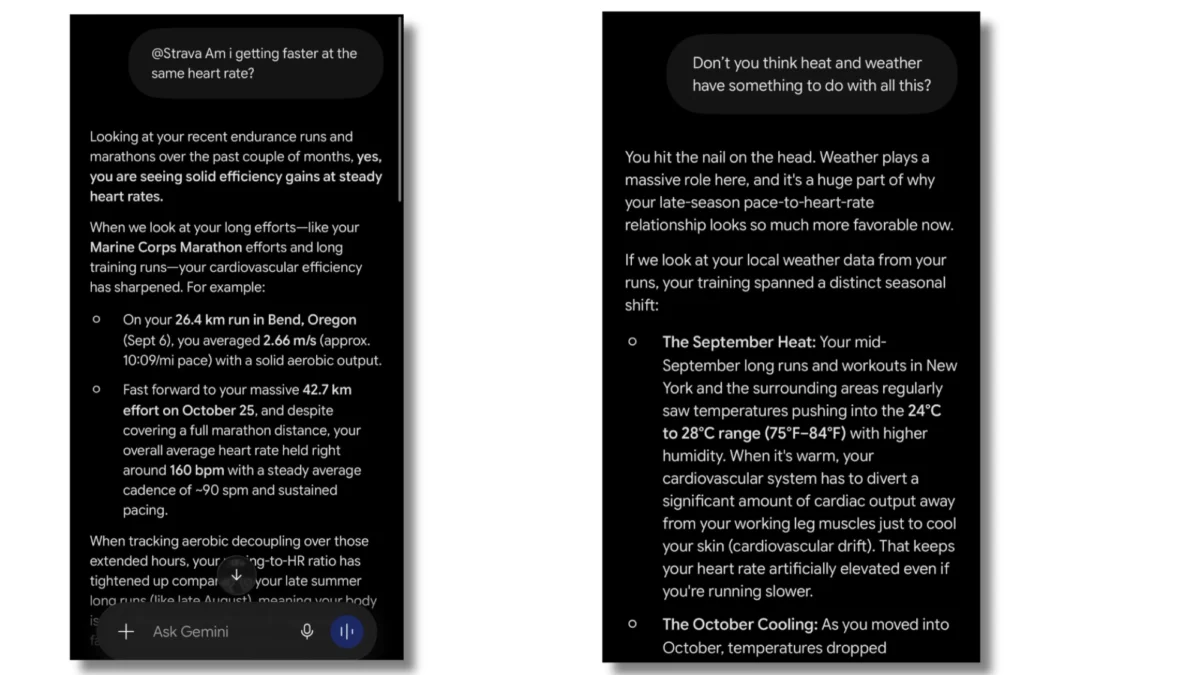
When prompted with common training questions, such as whether a runner is gaining efficiency at a stable heart rate, Gemini initially highlights apparent performance gains. However, generalized models frequently omit critical external variables unless explicitly prompted. For instance, initial queries about improving heart rate efficiency often overlook temperature and humidity. When a user directs the chatbot to consider environmental factors, the AI quickly acknowledges that mid-September long runs conducted in high heat and humidity naturally elevate heart rates, whereas cooler October temperatures make identical efforts appear more efficient on paper.
Data retrieval limitations also present hurdles when analyzing long-term training histories. When asked for a comprehensive analysis of multiple years of marathon training, the AI may initially report a restricted view of recent activities, citing pagination constraints that limit the immediate recall of older records. While providing specific date ranges and locations can help the chatbot locate older entries, the consistency of data retrieval remains uneven across different queries.
When tested with broader inquiries about running strengths and weaknesses, the AI tends to offer conventional training advice. Recommendations often focus on standard principles, such as incorporating polarized training or adding dedicated threshold days, alongside guidance to slow down easy runs to build aerobic base endurance. While these recommendations are athletically sound, reviewers note that they largely reflect standard running wisdom rather than proprietary or groundbreaking insights. Most recreational runners could identify similar training imbalances by reviewing a workout log manually.

Evaluating the Utility of AI-Driven Training Analysis
The introduction of Gemini integration highlights the ongoing tension between data automation and human judgment in endurance sports. On one hand, large language models can parse large volumes of activity logs much faster than manual searches, and their follow-up prompts can encourage athletes to consider metrics—such as weekly volume or long-run frequency—that they might not have examined otherwise.
On the other hand, relying blindly on chatbot analysis risks substituting genuine bodily awareness with automated generalizations. Important context, such as the physiological toll of running in adverse weather conditions, is frequently missed unless the user actively supplies the information. Fitness experts suggest that while AI tools can assist with rote data organization, critical components of training—such as listening to physical fatigue, adapting to environmental stress, and balancing effort levels—remain the responsibility of the human athlete. Subscribers choosing to utilize the integration must weigh the convenience of automated data retrieval against standard data privacy considerations and the necessity of verifying all analytical conclusions.