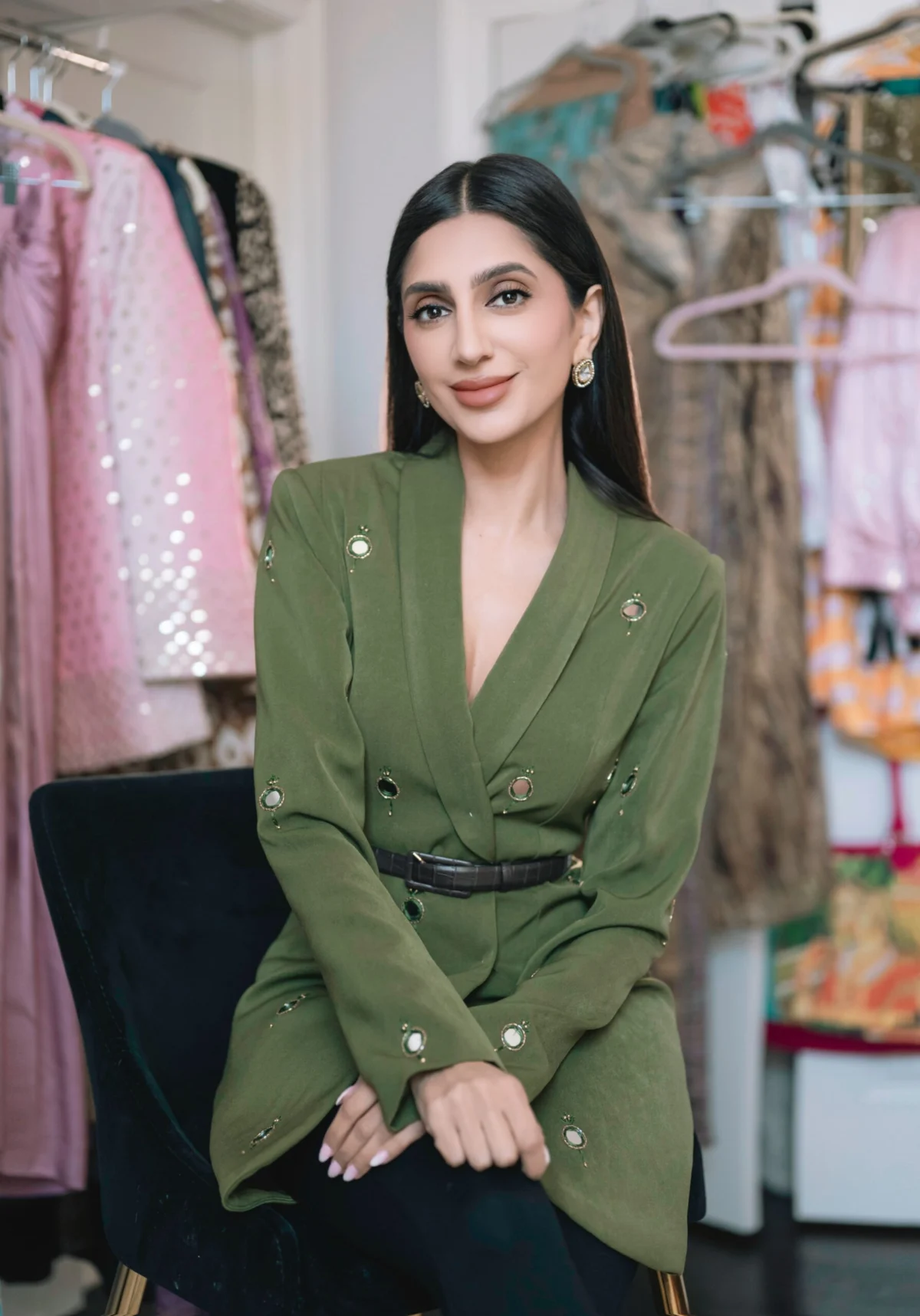
Growing up in Queens, New York, Megha Rao faced a challenge familiar to many children of immigrants: she could never quite find clothes that authentically represented her dual identity. Caught between traditional South Asian heritage and contemporary American streetwear, she decided to take matters into her own hands. What started as a personal creative outlet—experimenting by mixing her mother’s traditional saris with modern denim and leather—gradually evolved into something much larger.
First, she began crafting pieces for friends and family members who resonated with her unique aesthetic. Before long, that circle expanded into a dedicated community. Today, Rao is the founder of holiCHIC, a thriving cultural fusion fashion label. Reflecting on her entrepreneurial journey, she notes how the dream blossomed far beyond her initial expectations. From her roots in Queens to major retail floors like Nordstrom, people around the world are now wearing holiCHIC blazers, saris, dresses, and more, breaking traditional boundaries in the global fashion industry.
Before launching her venture into the mainstream retail market, Rao spent years navigating a completely different professional landscape. Working as a finance sales professional, she honed the commercial acumen and strategic discipline that would later help her sustain a business entirely on her own. For close to a decade, Rao bootstrapped holiCHIC, steadily building it into a profitable, seven-figure enterprise without any outside institutional backing.
As both a business owner and a loyal customer of Nordstrom, Rao frequently envisioned how well her brand’s vibrant designs would align with the upscale department store’s inventory. Driven by that persistent vision, she embarked on a campaign of relentless persistence, making months of cold calls to retail executives. Her efforts finally paid off in 2023 when she secured a high-profile pop-up shop opportunity at Nordstrom’s New York flagship location, strategically timed right before the celebration of Diwali.
The temporary retail activation proved to be a watershed moment for the brand. The pop-up shop was a massive commercial success, comfortably surpassing all of internal sales expectations over the course of those three intensive days. According to Rao, the stellar performance at the flagship location naturally opened doors to higher-level corporate discussions. The successful event led directly to a meeting with Nordstrom buyers, which soon culminated in an official online retail partnership, placing holiCHIC’s collections on one of the country’s premier digital shopping platforms.
Building upon that retail momentum and years of disciplined bootstrapping, holiCHIC reached another major financial milestone in May 2026 by securing its first major funding: a $1.5 million seed round. The injection of capital provided the brand with immediate runway, leading to a dramatic 47% increase in sales shortly after the investment closed. Rather than rushing into fundraising early in her entrepreneurial journey, Rao waited until the business had established undeniable traction. Reflecting on the experience, she often encourages other growing founders to carefully evaluate specific strategic questions before deciding to open their companies up to outside investment.
The first critical question Rao urges entrepreneurs to ask is whether their business possesses genuine, sustained momentum. Recalling her own mindset prior to the seed round, she admits that her biggest fear was whether her team would be able to keep up with the operational demands following the sudden surge in visibility brought on by the Nordstrom partnership. To answer this concern, Rao and her team dove deep into their analytics. The data revealed a surprisingly broad consumer base: a rapidly growing segment of customers who did not identify as South Asian were purchasing holiCHIC garments simply because they deeply appreciated the unique style, craftsmanship, and quality of the apparel.
Recognizing that consumer interest was expanding far beyond initial demographic boundaries, Rao knew she needed adequate financial resources secured to handle upcoming opportunities without straining cash flow. Her intuition regarding the brand’s momentum was soon validated when retail giant Amazon Fashion reached out to explore a partnership. Because Rao had already made the strategic decision to raise capital and fortify her operational infrastructure, she was well-positioned to entertain and manage these large-scale retail collaborations seamlessly.
The second major consideration Rao highlights for founders embarking on a fundraising journey involves choosing the right strategic partners. Describing her decade-long bootstrapping journey, she compares the experience to riding a roller coaster. In the early stages of self-funding, a founder might experience one phenomenal month of high revenue, only to be followed by an unexpected market lull that completely wipes out available profit. At the same time, maintaining total autonomy means that while a founder may listen to input from advisors, they ultimately retain absolute control to make the final call on every decision.
When it came to selecting financial backers for holiCHIC, Rao remained open to various structures but ultimately found an ideal fit through a single angel investor. After participating in just two exploratory meetings, the investor chose to write a check covering the entire $1.5 million seed round. For Rao, partnering with a single investor has proven to be the most advantageous path forward. She notes that while accepting capital from multiple venture funds or syndicates might have introduced a wider array of professional networks, it also would have required managing a multitude of competing opinions, expectations, and strategic directions.
Her chosen angel investor deeply understands the brand’s long-term vision and respects the deliberate, steady way the business was grown from the ground up, making the partnership a natural alignment of values.
The third vital question Rao stresses is determining precisely how the raised capital will be deployed. For holiCHIC, the primary motivation behind raising the seed round was to scale operations effectively rather than experimenting with speculative projects. Rao explicitly avoided taking on outside funding merely to test concepts and burn through investor cash on trial-and-error phases. Having already navigated and learned from her own early mistakes regarding product-market fit, shipping logistics, and supply chain adjustments, she felt her enterprise was fully prepared to put fresh capital to work across multiple established channels of the business.
With the seed funding secured, Rao laid out a clear roadmap for expanding holiCHIC’s market footprint. A significant portion of the capital is designated for enhanced marketing initiatives and a robust influencer partnership strategy. Furthermore, the brand is placing a heavy emphasis on digital platforms, specifically focusing on expanding its presence through Amazon Fashion and TikTok Shop. Recognizing broader consumer shopping habits, Rao identified an underserved demographic within her existing audience. Since their primary female clientele frequently attend formal events and celebrations accompanied by a partner, holiCHIC is simultaneously doubling down on its menswear line, focusing intently on perfecting the fit, tailoring, and contemporary style for men’s cultural fusion apparel.
Beyond expanding its domestic reach across the United States and Canada, holiCHIC has its sights firmly set on international growth. Rao envisions transforming the enterprise into a globally recognized fashion brand, with target markets in the United Kingdom, India, and the Middle East sitting squarely on her long-term strategic horizon. However, she remains grounded in prioritizing foundational growth first. She intends to evaluate the possibility of a subsequent funding round only after revenues multiply significantly from their current standing. Until that milestone is reached, Rao’s daily focus remains squarely locked on delivering consistent commercial results, expanding the brand’s physical and digital retail footprint, nurturing her growing team, and continuously refining holiCHIC’s diverse product lines.
For fellow entrepreneurs navigating the complexities of business growth and capital acquisition, Rao’s foundational philosophy remains clear and direct: founders should never raise money simply to find momentum; instead, they should raise money to fuel the momentum that is already proven and underway.