
On the surface, most content marketing courses look strikingly similar. They typically offer pre-recorded video modules covering roughly the same foundational topics, accompanied by standard action items and best-practice advice. Yet, the content marketing programs that actually succeed in helping professionals accelerate their careers and generate real revenue come down to a few critical differences. These include the real-world experience of the instructor, opportunities for personalized feedback, and the recency of the strategic advice, particularly regarding how courses adapt to an ever-changing digital landscape shaped by artificial intelligence.
Industry observers note that choosing the right educational resource requires looking past flashy marketing claims and evaluating programs against a rigorous set of criteria. To help marketers, entrepreneurs, and business owners navigate the crowded field of online education, a comprehensive evaluation framework has emerged, measuring programs against factors like instructor credibility, content formats covered, advice recency, individual support, community access, and pricing structures.
Content Marketing Course Evaluation Criteria
While most programs follow established industry standards, their actual effectiveness varies widely. To determine which option aligns best with specific professional needs, experts measure courses against several core benchmarks.
Instructor credibility is paramount, focusing on whether the instructor has actively used content marketing to grow a profitable business and whether they possess verifiable statistics to prove it. Furthermore, modern strategies demand more than just writing blog posts. Comprehensive programs must cover diverse formats including social media, email marketing, and personal branding. Advice recency is another vital factor, as the rapid rise of artificial intelligence has fundamentally altered content distribution and creation. Finally, access to individualized support, active peer communities, and transparent pricing models heavily influence the long-term value of any educational investment.
Several prominent content marketing courses and communities currently dominate the landscape, each offering a distinct approach to training modern marketers.

Copyblogger Academy
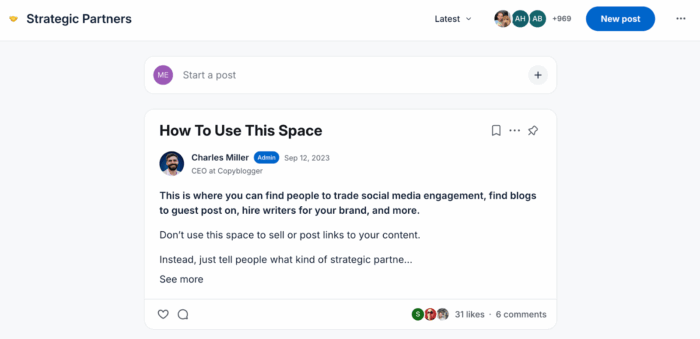
Copyblogger Academy operates as a combined course and community platform managed by digital entrepreneurs Tim Stoddart and Charles Miller, who built their respective enterprises primarily through content-driven strategies. Charles Miller has cultivated a substantial following on social platforms such as X and LinkedIn, leveraging personal branding to help numerous entrepreneurs scale their operations. Meanwhile, Tim Stoddart has founded and scaled multiple seven-figure companies through search engine optimization, including a prominent digital marketing agency and his current venture, Quantum Leads.
The platform offers six distinct courses covering copywriting, SEO content, email copywriting, and personal branding. Rather than relying solely on static video libraries, the Academy provides direct feedback loops where members can submit their work for critiques from the founders and peers. Additional features include collaborative community channels, monthly mini-courses, and active networking opportunities. The program offers an initial trial entry before transitioning into a standard monthly membership model.
HubSpot Content Marketing Course
HubSpot offers a free, comprehensive certification program designed to help marketers develop and execute overarching content marketing strategies. Taught primarily by Justin Champion, HubSpot’s Global Head of Surround Sound Growth, alongside industry veterans like Andy Crestodina and Matthew Howells-Barby, the program provides solid foundational training across traditional formats such as blogging, guest blogging, and video marketing.
Spanning multiple hours of video lessons and quizzes, the self-paced course delivers reliable best practices for brand building. However, analysts note several limitations. The curriculum omits crucial modern channels like email marketing and personal branding, which are essential for consultants, startup founders, and independent creators. Additionally, because the material is pre-recorded and self-paced, students receive no one-on-one instructor support, personalized feedback, or peer networking community.
Grow and Convert’s Customers From Content Course and Community
Created by agency founders Benji Hyam and Devesh Khanal, the Customers from Content program focuses heavily on driving tangible business conversions rather than vanity metrics like raw traffic. The curriculum is built upon the founders’ documented systems, which they have used to scale lead generation for numerous business-to-business and business-to-consumer brands.

The program is structured into five detailed modules featuring real client case studies, technical keyword research frameworks, and ROI tracking methodologies. A key differentiator for the program is its hosting inside an interactive discussion forum where the founders actively participate in comment threads and host monthly strategy calls. The curriculum continuously evolves as the creators refine their agency processes. The program is available for a one-time lifetime payment or through an installment plan, granting ongoing access to community resources and future updates.
Superpath
Superpath functions less like a traditional linear video course and more as a collaborative professional community designed for career advancement in content marketing. Founded by industry veteran Jimmy Daly, formerly of Animalz, the platform draws its primary value from a network of content leaders hailing from prominent technology and software companies.
Rather than a fixed syllabus, Superpath provides advanced graduate-level mini-courses, content teardowns, workflow templates, and live workshops. The curriculum heavily emphasizes long-form blogging and editorial strategy tailored for software-as-a-service businesses, though it generally avoids personal branding or social media video production. The community component features active peer discussions, AMA sessions, and career support networks. Superpath utilizes a tiered pricing model ranging from free community access to professional and advanced paid memberships.
Ahrefs’ Blogging for Beginners
Ahrefs offers a free, highly focused educational resource taught by its Chief Marketing Officer, Tim Soulo. The program is designed to guide marketers through building a blog from inception, scaling organic traffic, and converting readers into paying customers.
The curriculum provides a tactical, step-by-step playbook centered entirely on search engine optimization and organic search growth, supported by guest interviews with notable digital entrepreneurs. While the technical instruction regarding blog architecture and keyword targeting remains sound, industry analysts point out significant drawbacks. The core material was recorded several years ago and lacks critical updates regarding modern search engine shifts and artificial intelligence integration. Furthermore, the course is strictly limited to blogging, excluding other vital digital channels such as social media and email marketing, and offers no direct instructor feedback or interactive community outside of standard video comment sections.

Semrush Academy Content Marketing
Semrush provides specialized educational modules, notably featuring courses led by Brian Dean, the globally recognized search optimization expert who founded Backlinko and Exploding Topics before their acquisition by Semrush.
The instructional content delivers structured frameworks covering advanced blogging campaigns, link building, traffic generation, and conversion optimization. The lessons are praised for being concise, actionable, and supplemented by practical worksheets and real-world examples. However, similar to other legacy platforms, these courses were recorded prior to recent technological shifts, meaning they lack up-to-date case studies addressing the artificial intelligence landscape. The programs are offered free of charge as self-paced modules without dedicated community forums or individualized instructor support.
CXL Content Marketing Course
The CXL content research program offers a strategic overview focusing on the development and execution of overarching content initiatives. Taught by Derek Gleason, SEO and Content Lead at Shopify and former digital agency strategist for major corporate clients, the curriculum emphasizes high-level distribution frameworks and editorial management.
The material reflects modern enterprise publishing strategies derived from large-scale content libraries. While the instruction provides valuable insights into strategic planning and multi-channel distribution, it intentionally avoids granular tactical writing instruction. The course is offered as a self-paced paid product through individual purchase options or platform subscription models, though it does not include direct instructor interaction or a dedicated peer community.
Content Marketing Masterclass on Udemy
Udemy hosts an all-inclusive marketing masterclass instructed by Brad Merrill, CEO of Merrill Media and founder of digital news publications. The curriculum spans multiple hours across numerous sections, covering broad topics such as buyer personas, foundational storytelling, web design best practices, email marketing, and social media promotion.
While the instruction offers a wide-ranging introduction to digital media principles, reviewers note that its breadth prevents deep specialization in specific channels like advanced search optimization or targeted social media growth. The course is regularly updated on the platform, but it maintains the typical constraints of massive open online courses, featuring self-paced video consumption with limited instructor engagement restricted to platform-based question-and-answer sections and no standalone professional community.
Ultimately, industry experts emphasize that selecting the right educational path depends entirely on an individual’s specific professional objectives, preferred learning format, and need for practical execution support rather than universal metrics of popularity.