For years, the corporate world has operated on a quiet, pervasive assumption: everyone is desperately waiting for more artificial intelligence in their daily lives. Across industries, leadership teams take it for granted that employees and consumers are eagerly craving new AI features, advanced machine learning workflows, and generative products designed to magically replace legacy systems and outdated operational practices.
Yet, as the tech landscape matures, a very different reality is coming to light. The truth is that most people do not want more AI—at least not in the disruptive, top-down manner that technology leaders envision. Despite massive corporate investments and breathless marketing campaigns, many artificial intelligence features continue to suffer from remarkably low user adoption and poor retention rates. This mismatch comes at a staggering cost of delivery for organizations, while simultaneously driving up the risk of severe reputational damage.
The AI People Don’t Need
Making a persuasive counter-argument to senior leadership has proven remarkably difficult in the current corporate climate, but industry data and workplace reality point to a fundamental truth: AI is not a value proposition in and of itself. Simply slapping an artificial intelligence badge onto a product does not magically generate happy, excited, or loyal customers. Because many AI features are introduced as disconnected bolt-on tools or separate applications, they frequently pull employees entirely out of their established, comfortable ways of working.
Rather than solving deep-seated structural issues, artificial intelligence often acts as an amplifier for existing organizational shortcuts and shortcomings. From poor data quality to fractured decision-making processes, AI cannot magically fix years of accumulated quick fixes, technical debt, broken corporate cultures, and internal politics. If anything, these underlying inconsistencies and conflicting priorities become even more visible when processed through an automated system. Ultimately, these messy outcomes are handed directly to everyday users, who are left to clean up the confusion.
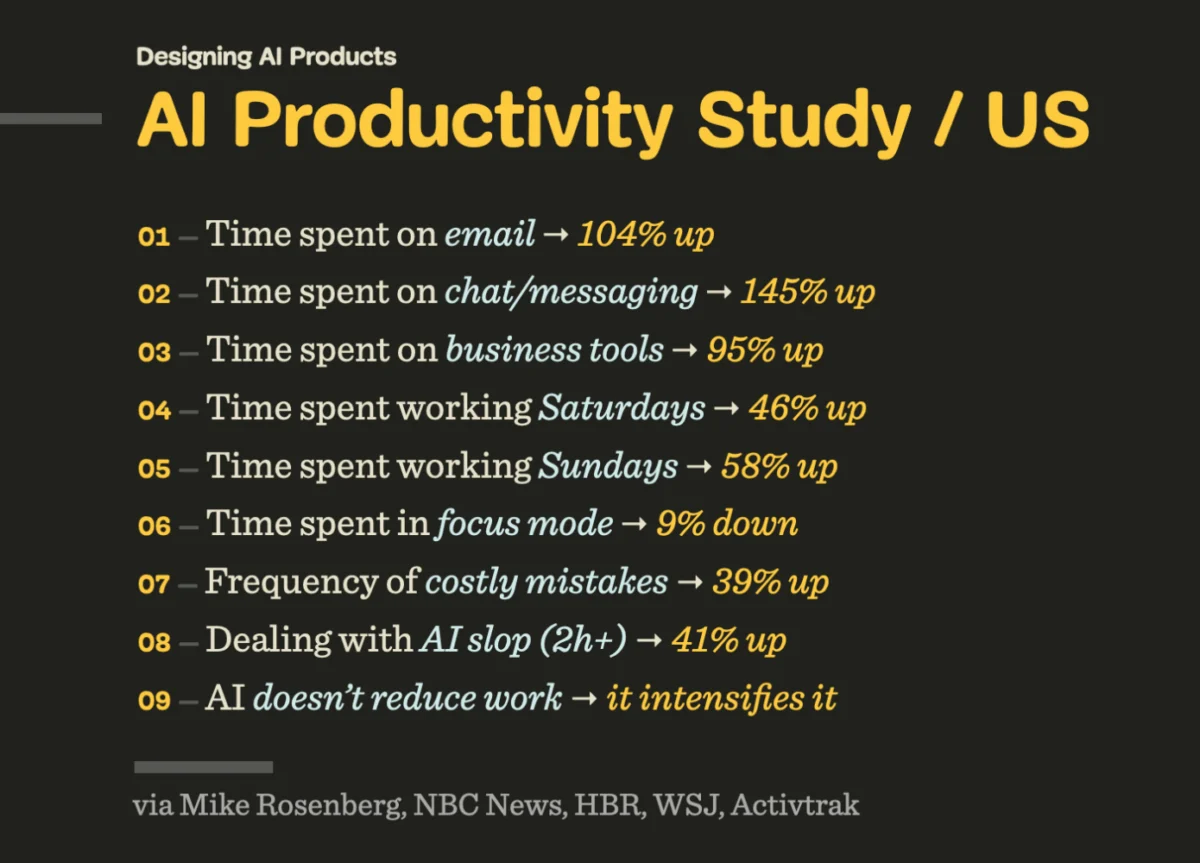
In most modern enterprises, daily labor already requires navigating a fragmented ecosystem of disconnected platforms. Introducing a new, standalone AI tool simply adds yet another system that workers must hop on and off throughout the day. Instead of streamlining operations, it frequently generates more work—and rarely the kind of rewarding, creative work that brings professional satisfaction.
Compounding this friction is the well-documented cost of identifying and fixing AI hallucinations. While prompting an algorithm to generate a response may initially feel faster than drafting content from scratch, it carries a hidden operational tax. Users must meticulously review, verify, and correct AI-generated output, turning what should be a labor-saving device into an exercise in quality control.

For many individuals, artificial intelligence is rarely a technology they can proactively choose and explore on their own terms. Instead, it arrives uninvited, forced upon them at an organizational pace they cannot control. When combined with widespread cultural anxieties regarding automation and job displacement, it is hardly surprising that the public perception of AI is rarely one of unbridled excitement. Instead, it breeds resistance to change and deep-seated anxiety about personal relevance in a rapidly shifting economy.
At best, new enterprise AI features are met with silent resignation or passive compliance. At worst, they trigger profound skepticism, operational caution, and genuine security concerns. Unlike traditional software features, artificial intelligence is inherently probabilistic rather than deterministic—it is neither fully predictable nor entirely reliable, turning it into a liability in mission-critical environments.
Consumers, meanwhile, are not waking up dreaming of artificial intelligence art museums, automated smart fridges, AI-driven hotel receptionists, or algorithmically narrated children’s books. They are not asking for romantic machine-learning partners, nor are they eager to actively manage and clean up after a swarm of autonomous AI agents roaming through their personal bank accounts. Most importantly, people do not fundamentally want to spend their days speaking or typing into a magical black box.

The AI People Actually Need
Discussions surrounding software reliability often lean on the argument that humans are imperfect too, suggesting that AI tools should be judged by a similar curve. However, everyday users do not compare software performance against human capabilities; they compare features against features. If a specific tool proves unreliable while a competing product functions flawlessly, users will consistently choose the reliable option. The preference is rarely philosophical about whether a system relies on AI; it is entirely practical, driven by what works consistently and what fails.
Much of the current corporate discourse surrounding artificial intelligence focuses excessively on the sheer speed of delivery. Yet, for many professionals, increasing output speed holds little inherent value if it compromises quality. People want the time and space to think critically, make sound decisions, and genuinely enjoy their daily work rather than simply shipping flawed products faster. That sense of professional reward and personal achievement risks evaporating one automated shortcut at a time.
Human nature changes slowly. After decades of technological shifts, people still desire features that are fast, accessible, reliable, predictable, and useful every single time they use them. Rather than tools that upend their entire workflow, users want enhancements that augment their existing habits, specifically targeting the most mundane, repetitive, and exhausting tasks they encounter.

Many modern professions are heavily exposed to automation, yet they retain deeply creative, nuanced components that require human taste, intuition, and a distinct point of view. When artificial intelligence successfully absorbs the tedious administrative burdens of a job, it creates a net advantage for everyone involved, boosting genuine productivity and restoring daily job satisfaction.
To achieve this, AI cannot feel like an awkward, bolted-on novelty. It must be deeply integrated into pre-existing workflows, aligning smoothly with mental models that workers have spent years or decades refining. Technology should adapt to how humans naturally think and make decisions, rather than forcing people to fundamentally restructure their cognitive habits to accommodate a machine.
Ultimately, whether these features are explicitly branded as "AI," "smart," or simple "automation" matters very little. What matters is that they solve real problems in ways that make sense to the end user. Tools that achieve this are rarely designed with an "AI-first" mindset. Instead, they operate under an "AI-second" philosophy—remaining subtle, humble, calm, and ambient, quietly supporting the background processes of work that would otherwise be remarkably dull.

As corporate strategist Bo Young Lee noted in widely shared industry commentary, everyday workers are not looking to replace human experiences with algorithmic substitutes. People want technology to shoulder the heavy physical and mental labor that drains their daily energy, leaving them free to engage with human-authored books, authentic art galleries, and meaningful interpersonal connections. The ultimate goal is technology that makes daily life simpler, rather than demanding that humans bend to fit the software.
Evaluating the broader landscape reveals a fundamental choice. While artificial intelligence can serve as a powerful assistant in numerous scenarios, so can human colleagues. Between the two, fostering genuine connections with people—with all their inherent complexities, stories, and emotions—remains an irreplaceable priority.
People do not need more artificial intelligence for its own sake; they need smart automation to clear away the bureaucratic and administrative friction of daily life, leaving them with the time and mental bandwidth to focus on what truly matters.