In the rapidly evolving landscape of enterprise artificial intelligence, the utility of an AI agent is often measured by its capacity to act as a seamless extension of a human workforce. However, a persistent technical hurdle has long plagued even the most sophisticated systems: the ability to maintain consistent, evolving memory over long periods. Salesforce AI Research has recently announced a significant milestone in addressing this challenge, revealing that it has effectively doubled the memory performance of its Agentforce platform by implementing a novel, rigorous evaluation framework that tracks exactly what an AI agent remembers throughout multi-session interactions.
The challenge of memory in AI agents is not merely a matter of data storage; it is a complex problem of context management and temporal awareness. Consider a scenario that reflects the daily friction faced by many modern enterprises: In March, a customer informs an agent that their primary office is located in Bangalore. Months later, in June, the customer updates this information, noting that their office has relocated to Pune. By July, when the customer submits a request that is inherently dependent on their physical location—such as scheduling a service or arranging logistics—the agent mistakenly relies on the outdated March data.
While the error seems trivial in isolation, it represents a profound failure of "memory continuity." In a business environment, these lapses can lead to inefficient workflows, redundant data entry, and, in more severe cases, costly operational errors, such as shipping supplies to an incorrect facility. The core issue, according to Salesforce researchers, is that the architecture of many modern AI agents fails to distinguish between stagnant facts and evolving truths. A reply generated based on an outdated fact often appears as syntactically correct and professional as one based on the latest information, making these "forgetfulness" errors notoriously difficult to detect through standard testing protocols.
A New Standard for Memory Evaluation
To bridge this gap, Salesforce AI Research developed an evaluation framework designed to answer the most fundamental question in the field: how much does an agent actually retain and utilize? Rather than relying on static, short-term benchmarks, the team’s approach involves generating extensive, multi-session conversations. These simulations are seeded with specific facts at various intervals to mimic the messy, non-linear nature of real-world business interactions.
By running these complex, long-form conversations through the live Agentforce system, the researchers can subject the AI to questions that specifically require the retrieval of those planted facts. This end-to-end testing—tracing the trajectory from the moment a user provides a piece of information to the moment the agent applies it—ensures that the memory performance is measured in a context that reflects actual usage. This methodology relies on data derived from ConvoMem, a public benchmark released by Salesforce in 2025 to encourage greater transparency and rigor in evaluating agentic memory across the industry.
This framework was instrumental in the refinement of Agentforce Memory, the capability that ensures agents remain current on customer information. Since its general availability in September, Agentforce Memory has become a critical component of the Salesforce ecosystem, and the recent research breakthroughs provide the technical validation required to scale its reliability for enterprise-grade applications.
Policy Overhauls Without Architecture Changes
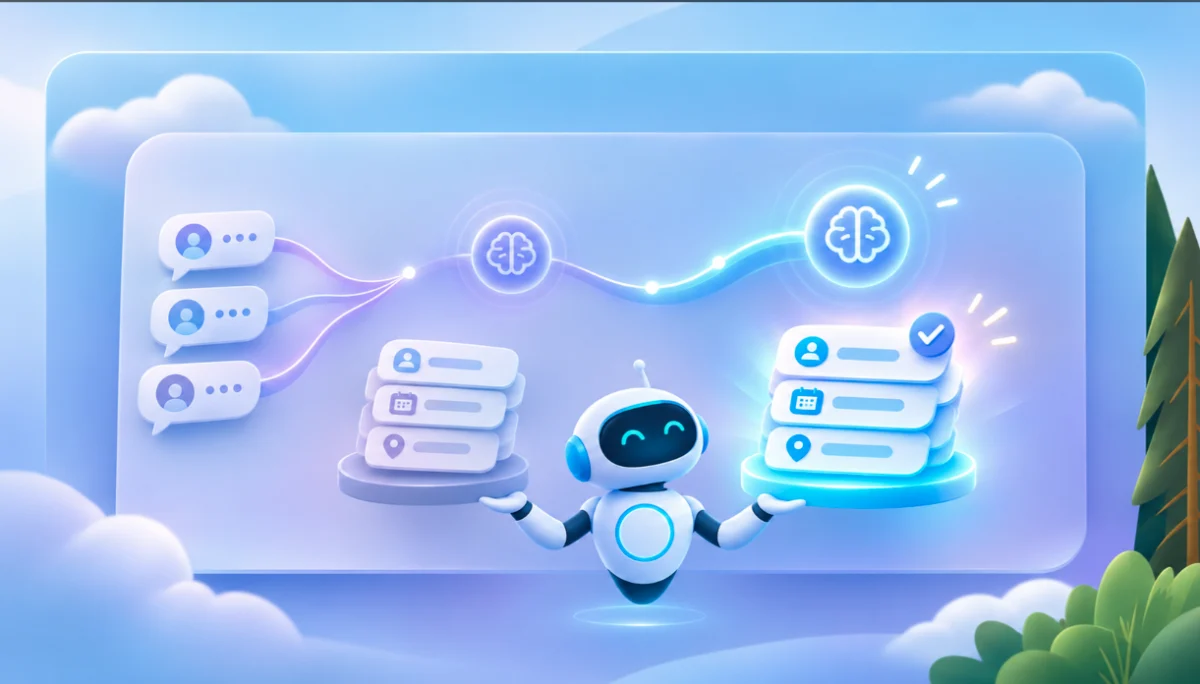
Perhaps the most compelling aspect of this development is that the performance gains were achieved without altering the underlying architecture of the Agentforce system. Instead, the research team focused on a fundamental overhaul of the "memory policy"—the set of governing rules that dictate what an agent prioritizes for retention and, crucially, how it handles contradictory updates to existing data.
Under the previous iteration, an agent might file a new piece of information alongside an old one, creating a cluttered data environment that led to retrieval conflicts. The updated policy, however, treats a new update as a deliberate correction to existing knowledge. This approach forces the system to re-evaluate and replace outdated facts rather than simply accumulating them. By refining these logical rules, Salesforce has demonstrated that significant AI performance improvements can be realized through better governance of existing models, rather than relying solely on the scaling of computational power or model size.
The results of this policy shift, as measured by the new evaluation framework on the live Agentforce system, are striking. The updated policy recalls 1.8 times as many facts stated outright by customers compared to the previous iteration. More impressively, the recall of facts that change over time—the most difficult metric to master—has improved by 2.2 times. When aggregated, these improvements effectively double the quality of the end-to-end conversation memory.
The Shift Toward Production-Grade AI
For the researchers at Salesforce, this work highlights a critical distinction between laboratory experimentation and product-level engineering. Erik Nijkamp, director of research at Salesforce AI Research, emphasizes that an agent’s output often masks the underlying cause of a failure; it is impossible to tell from a single response whether an agent failed to store a piece of information or simply failed to retrieve it correctly.
"Testing the whole path is what separates those, and once you can see which one is failing, you can improve it by changing a policy instead of rebuilding the system," Nijkamp explained. This philosophy underscores the necessity of testing in production environments, where the variables of real-time communication—varying time gaps between interactions, shifts in user intent, and live data streams—create the only environment where true "memory" can be measured.
Silvio Savarese, EVP and chief scientist at Salesforce, notes that this transition from a research-first to a product-first mindset is essential for the future of enterprise AI. "In a research lab, you choose a problem and then go find data for it," Savarese remarked. "In a product organization, the problem is already running, with customers on it, and the discipline is to measure it honestly before you change anything. That is what this work gives us, on a capability our customers depend on every day."
Enterprise Impact and Future Standardization
The real-world implications of these memory improvements are already being realized by Salesforce customers. For instance, a major travel platform recently deployed an Agentforce-powered agent to support its internal staff. The agent serves a variety of roles, including answering team-specific inquiries, summarizing ongoing case files, drafting professional correspondence, and updating CRM records.
With the improved Agentforce Memory, the agent is now able to carry essential context across multiple sessions, allowing sales and service representatives to receive personalized and relevant responses without the frustration of re-explaining background information. This continuity is a prerequisite for the next generation of enterprise automation, where agents are expected to handle complex, long-running tasks with the same level of reliability as a human colleague.
As the industry moves forward, it is becoming increasingly clear that AI memory will be held to the same rigorous performance standards as any other critical infrastructure. The ability to audit, measure, and improve how an agent remembers information across a full, sustained conversation is rapidly becoming the benchmark for success. By proving that such improvements can be achieved through disciplined policy-based engineering, Salesforce is helping to set the standard for how enterprise businesses should evaluate and trust their autonomous agents in the years to come.