Since 2023, OpenAI has aggressively built a vast web of content licensing partnerships, securing agreements with more than 20 major media publishers ranging from the Associated Press to Condé Nast. Under the standard framework of these agreements, publishers license their content directly to the artificial intelligence giant, allowing ChatGPT to present summaries, quotes, and direct links back to the original sources. This integration has quietly transformed these media outlets into some of the most prominent web entities within the conversational search ecosystem, raising important questions about visibility, public relations strategy, and the shifting dynamics of digital referral traffic.
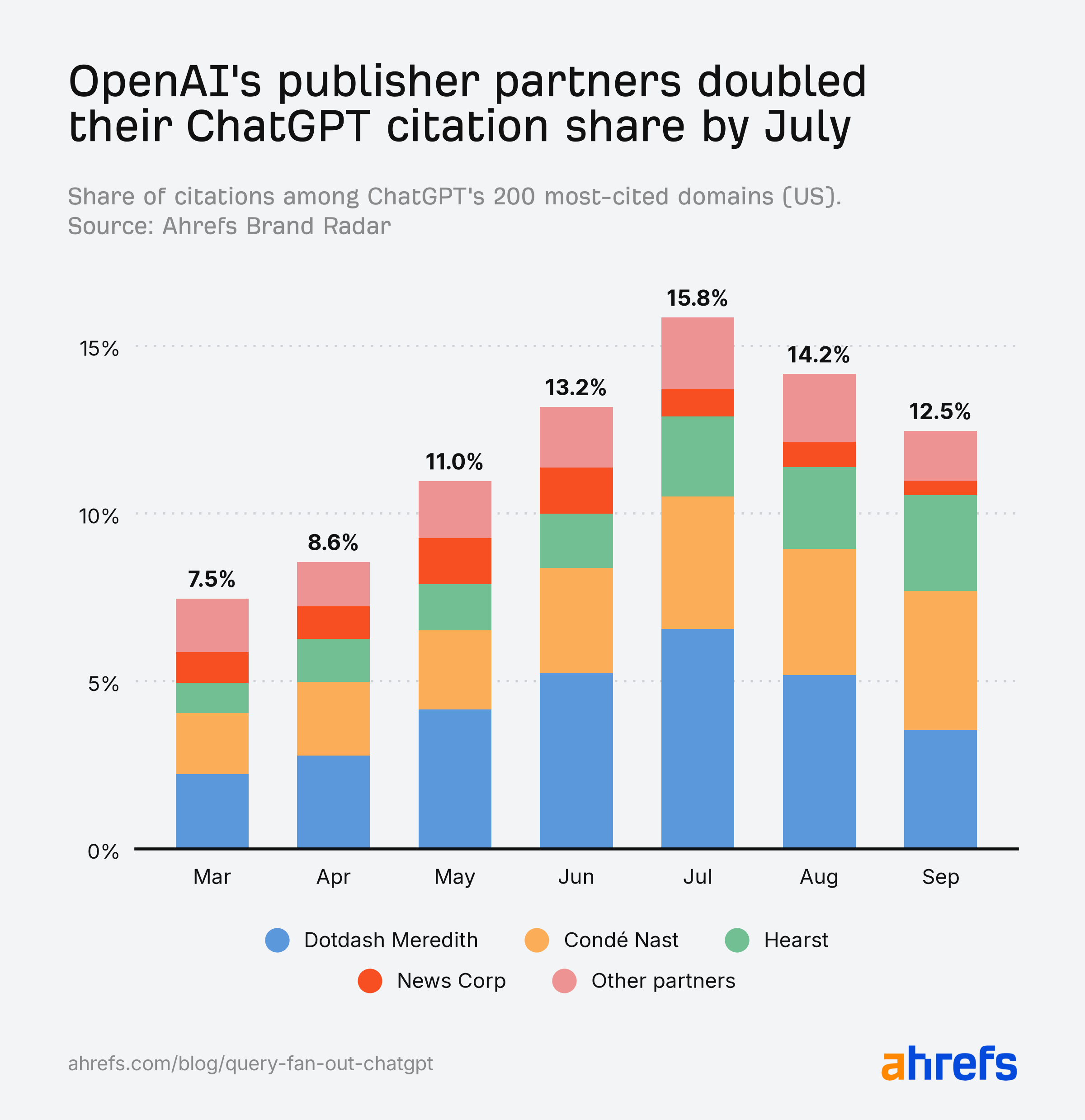
Recent data compiled by Ahrefs using Brand Radar highlights the profound impact these partnerships have on digital visibility. According to the research, partner sites accounted for 7.5 percent of all ChatGPT citations among its 200 most-cited domains in March 2026. By July of that year, that figure surged to 15.8 percent, stabilizing at 12.5 percent by late September. A granular analysis of 85 partner domains reveals that ten partner properties rank comfortably among the top 50 sites cited most frequently by ChatGPT in United States queries, with 47 securing positions within the top 500.
Interestingly, the most frequently cited partners are predominantly review and lifestyle publications rather than hard news organizations. Outlets such as Vogue, Car and Driver, Tom’s Guide, Good Housekeeping, and TechRadar each register more than 30,000 appearances in US ChatGPT answers. This trend underscores a fundamental reality of user behavior on conversational AI platforms: consumers frequently seek practical product reviews, buying advice, and lifestyle recommendations, areas where specialized publishers have built deep, authoritative content repositories.
How Citations Are Measured and Evaluated
The metrics governing AI citations are dynamic and subject to continuous flux. In the context of these evaluations, "ChatGPT citations" refer to the volume of US ChatGPT answers within a specific snapshot that successfully link back to a given domain, inclusive of its subdomains. Rankings reflect a domain’s standing among the 2,000 sites most frequently cited by ChatGPT across a diverse cross-section of queries. Because these datasets focus strictly on US-centric outputs, publishers operating primarily in languages other than English are inherently undercounted.
Furthermore, individual citations exhibit remarkable daily volatility. Tracking studies monitoring thousands of prompts over extended periods reveal that only about a quarter of the specific pages cited by ChatGPT for a given query on one day reappear in answers the following day. However, the most heavily cited major domains demonstrate significantly higher stability, fluctuating by only about 14 percent day-over-day. This relative consistency indicates that major publisher partnerships provide a stabilizing anchor for AI citation authority.
Future
Future, the prominent UK specialist publisher behind renowned brands like TechRadar, Tom’s Guide, PC Gamer, and Who What Wear, commands more ChatGPT citations than any other partner group in the analyzed data. When Future and OpenAI announced their partnership in December 2024, the agreement ensured that users would gain seamless access to content spanning Future’s extensive portfolio, complete with attribution and links to full original articles. Tom’s Guide stands as the 15th most-cited site in ChatGPT across the broader sample, while TechRadar holds the 24th position, capitalizing heavily on consumer demand for tech reviews and purchasing guidance.
Condé Nast
Condé Nast represents another heavyweight in the AI citation landscape, maintaining ownership over iconic titles including Vogue, Wired, GQ, The New Yorker, and Bon Appétit. Following their partnership announcement in August 2024 to integrate content across ChatGPT and the SearchGPT prototype, seven of the publisher’s nine primary properties secured spots within ChatGPT’s top 250 cited domains. Vogue leads the entire partner group as the single most-cited partner domain with more than 42,000 citations, while Wired claims the 34th position. Meanwhile, more prestigious literary and cultural publications within the stable, such as The New Yorker and Vanity Fair, garner approximately 3,000 citations each.
Hearst
The strategic content agreement established with Hearst encompasses more than 20 magazine brands and over 40 newspapers. However, a stark divergence exists in how these distinct formats perform within AI systems. Hearst’s lifestyle and automotive magazines vastly outperform its traditional newspaper holdings. Car and Driver and Good Housekeeping both secure positions within ChatGPT’s top 25 most-cited sites, accumulating tens of thousands of citations. In contrast, legacy newspaper properties under the Hearst umbrella, such as the San Francisco Chronicle and the Houston Chronicle, register significantly lower visibility, each pulling in fewer than 4,000 citations.

Dotdash Meredith (People Inc.)
Dotdash Meredith, operating under the name People Inc., brought a sprawling portfolio of more than 40 lifestyle, food, and finance brands to ChatGPT following an agreement announced in May 2024. Under the terms, OpenAI displays attributed content and direct links in relevant conversational responses. Food, home, and style properties such as Allrecipes, Food & Wine, The Spruce, InStyle, and Better Homes & Gardens successfully rank within ChatGPT’s top 150 cited sources. Interestingly, financial powerhouse Investopedia receives a relatively modest 3,217 citations, illustrating that corporate partnerships do not automatically guarantee uniform visibility across every brand in a sprawling media portfolio.
News Corp
News Corp secured a landmark multi-year global partnership granting OpenAI access to current and archived journalism from premier mastheads including The Wall Street Journal, the New York Post, The Times, and various Australian publications. The Wall Street Journal drives the vast majority of this visibility, accumulating nearly 19,000 ChatGPT citations. None of the remaining publications within the News Corp network approach the 6,000 citation threshold, demonstrating that specific financial and business verticals capture a distinct share of user inquiries handled by AI interfaces.
Vox Media
Vox Media’s content and product partnership covers a diverse digital stable including Vox, The Verge, Eater, New York Magazine, The Cut, Vulture, and SB Nation. Designed to inform ChatGPT’s massive user base while providing brand attribution and audience referrals, the collaboration has yielded notable results for food and technology verticals. Eater emerges as Vox Media’s most-cited property with upwards of 13,000 citations, outperforming technology publication The Verge, while general interest site Vox.com maintains a surprisingly modest citation count.
The Washington Post and The Guardian
Among single-site general news publications, The Washington Post and The Guardian occupy prominent positions following their respective partnership agreements in early 2025. The Washington Post’s agreement ensures that ChatGPT displays summaries, quotes, and links to original reporting, resulting in more than 25,000 citations and a spot in the overall top 50. Similarly, The Guardian’s partnership provides weekly global users with extended summaries of its reporting, yielding nearly 24,000 citations and cementing its status as a core source for AI-driven news discovery.
Axel Springer, Associated Press, and Financial Times
As the pioneer of these media pacts, Axel Springer brought Business Insider, Politico, Bild, and Welt into the OpenAI ecosystem in late 2023. Business Insider captures a substantial footprint with over 16,000 citations, while Politico records a minimal presence in current US datasets. Meanwhile, the Associated Press—OpenAI’s foundational publisher agreement, structured initially around mutual technology and content sharing—maintains steady visibility just outside the top 100 domains. The Financial Times also secures notable traction, generating over 7,500 citations despite operating behind a stringent paywall.
International and Niche Media Partners
OpenAI’s expansion into international markets has introduced numerous prominent regional publishers, though language restrictions in US-focused tracking snapshots often obscure their true reach. European and Latin American agreements—such as those with Spain’s PRISA Media, France’s Le Monde, Brazil’s Grupo Folha and Grupo UOL, and Nordic network Schibsted Media—are designed to supply localized news summaries and verified reporting. Similarly, major Indian publishers including The Times Group and the Indian Express Group signed comprehensive multi-language agreements in late 2026 to integrate their extensive archives and live journalism into AI discovery channels. Other specialized partners, including Axios, TIME, The Atlantic, and Canadian local news network Village Media, experience widely divergent citation volumes, proving that formal partnership status establishes eligibility rather than guaranteed prominence.
Reddit and Stack Overflow
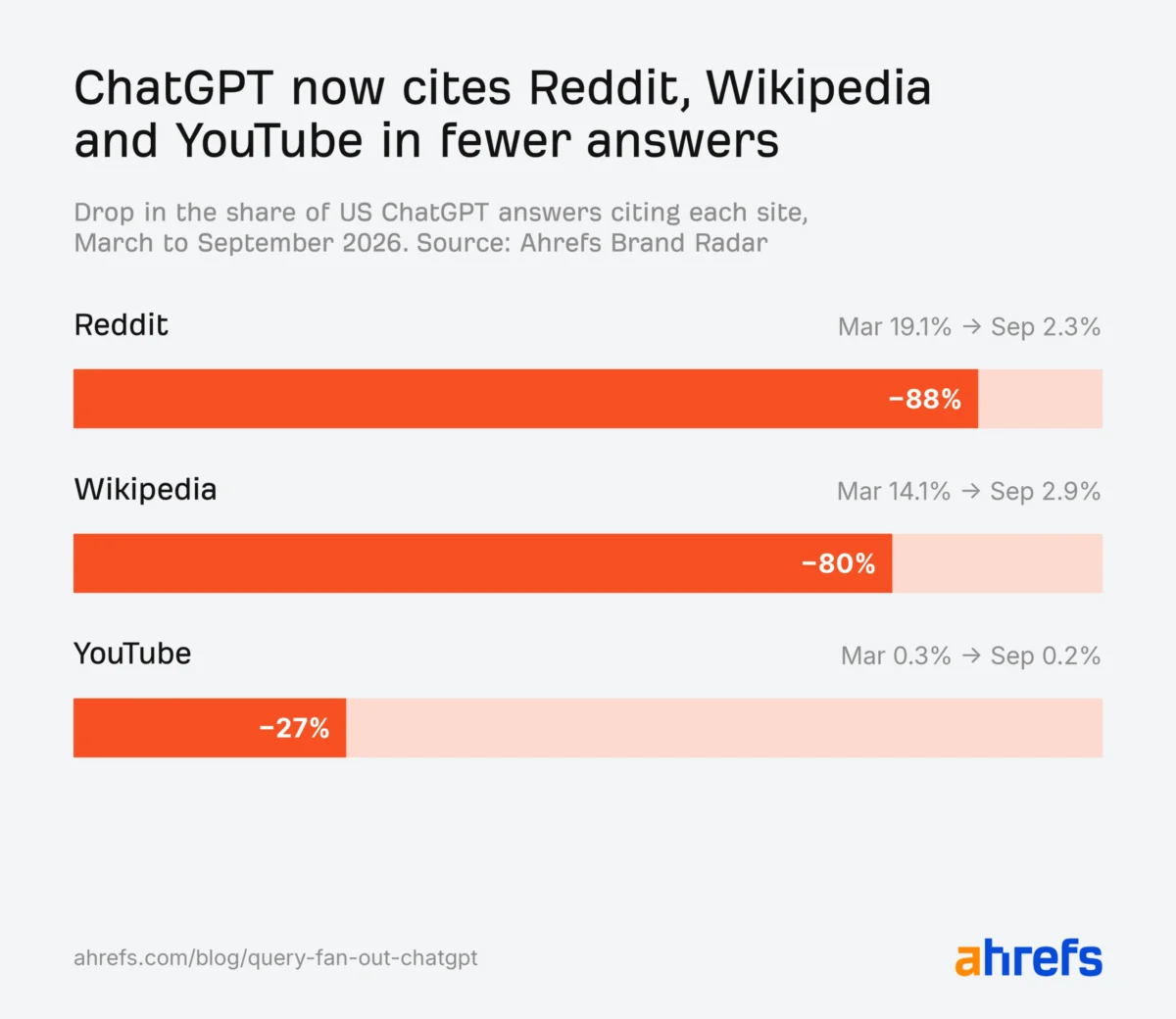
Beyond traditional journalism, OpenAI has forged high-profile data licensing deals with user-generated content platforms Reddit and Stack Overflow to secure robust API access to conversational knowledge and technical discussions. Reddit ranks as the second most-cited site in ChatGPT, trailing only Wikipedia. However, despite this deep integration, Reddit has experienced significant turbulence in traffic metrics. Data from fan-out studies show a sharp decline in the share of ChatGPT answers citing Reddit between March and September 2026, coinciding with broader challenges in search engine referrals stemming from the rise of AI-driven search overviews.
Ultimately, the evolving landscape of AI search visibility demonstrates that holding a content partnership with OpenAI serves as a vital baseline for eligibility, but it does not guarantee automatic prominence. For brands and publishers alike, securing visibility within conversational AI relies heavily on aligning content strategy with the specific informational niches that users consult AI to resolve.