As artificial intelligence continues to reshape the landscape of enterprise software, the complexity of the environments supporting these tools has grown exponentially. According to recent industry data, 79% of IT security leaders acknowledge that their current security and management practices must undergo a fundamental transformation to keep pace with the rapid adoption of AI. For many organizations, the Salesforce environments that were launched years ago bear little resemblance to their current states. Over time, these orgs have become dense ecosystems of added products, intricate custom fields, complex integrations, and layers of automation—each added to solve a specific business need at a specific moment in time.
This evolution, while necessary for growth, has created a secondary challenge: information overload. The diagnostic signals that describe how an org performs are now scattered across a fragmented array of monitoring tools, each flagging its own disparate list of issues. For IT leaders, the result is rarely a lack of information, but rather a paralyzing surplus of it. With no clear sense of what matters most to the health and security of the system, teams often find themselves reacting to noise rather than proactively managing their architecture.
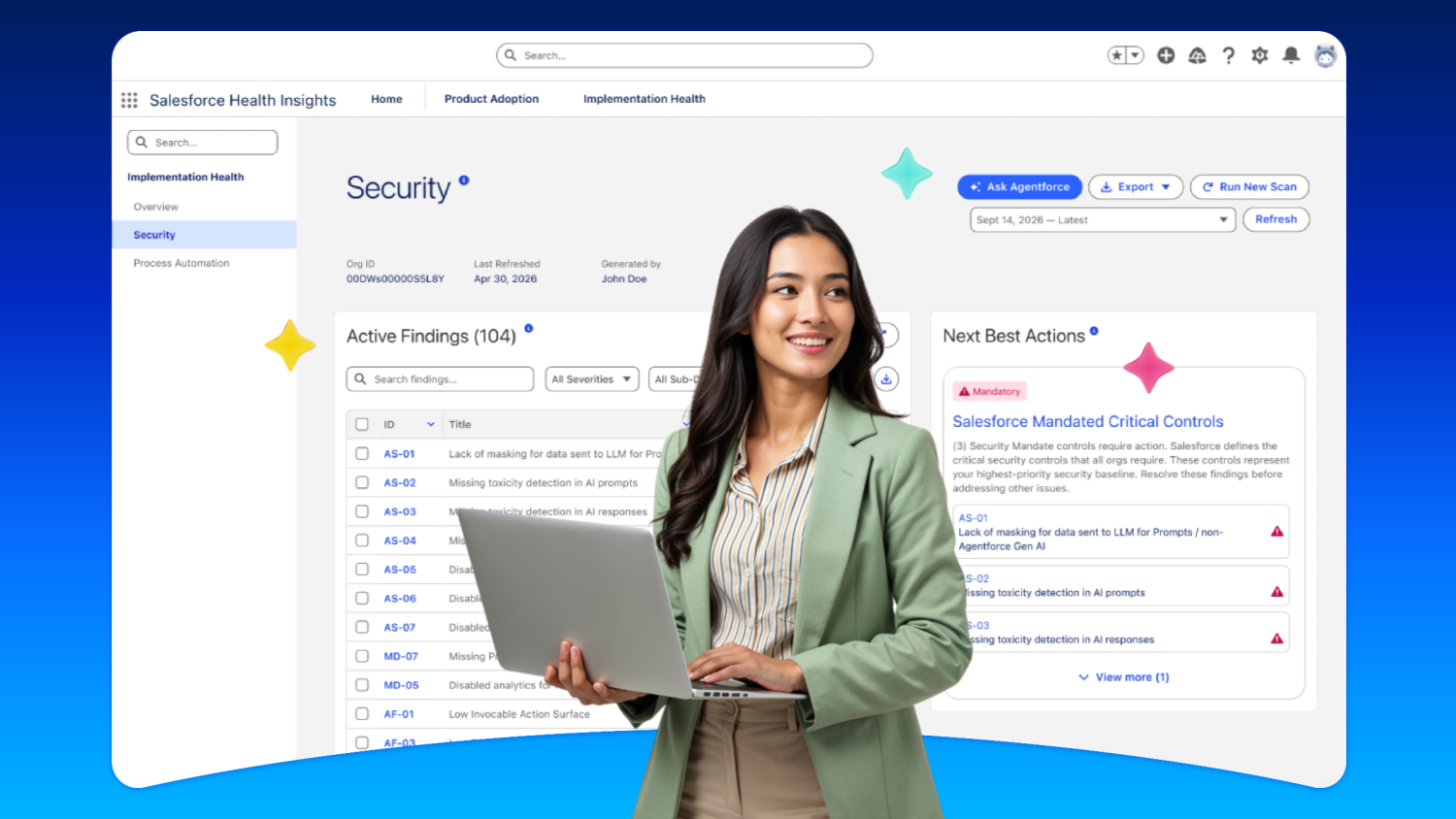
To address this, Salesforce has introduced Salesforce Health Insights, a native solution designed to cut through the clutter by continuously scanning an org, evaluating it against established benchmarks, and transforming raw data into prioritized, AI-powered "next best actions." By delivering these insights directly within the user’s workflow, the tool aims to replace the traditional, manual org health review—a process that can take up to three weeks to complete and is often obsolete by the time the final report is delivered—with a near real-time, on-demand assessment.
Why Salesforce Org Visibility Breaks Down as You Scale
The degradation of visibility within a Salesforce environment is often a symptom of organizational success. As an org grows, the number of stakeholders who rely on it increases, but each stakeholder typically views the system through a narrow lens. Admins focus on configuration and maintenance; security teams are preoccupied with access controls and compliance; architects are concerned with the integrity of the design; and business owners look primarily at license utilization and ROI.

Because each of these roles operates in a silo, no single person sees the complete picture. This lack of holistic visibility is exacerbated by the constant churn of a modern enterprise. Every time a new flow is shipped, a permission set is modified, or an integration is updated, the org’s underlying profile shifts. Without a shared source of truth, teams are left to define "health" based on their own specific tools and metrics. This fragmentation is precisely where visibility breaks down, leaving organizations with a collection of disparate data points rather than a coherent narrative of their system’s performance.
Every team that owns a Salesforce implementation is effectively trying to answer three fundamental questions: What products are currently in use? What areas of the system require immediate attention? And what should be done next to ensure optimal performance? However, because these questions are answered with different tools and varying definitions of success, the result is often a disconnect between technical maintenance and business outcomes. Organizations invest in Salesforce to achieve specific, measurable business results, but to realize that value, they must have a clear understanding of where they stand today and where they should focus their efforts tomorrow.

How Salesforce Health Insights Improves Org Health
Salesforce Health Insights addresses these challenges by acting as an intelligent layer that bridges the gap between raw telemetry and actionable intelligence. By moving away from manual assessments, the solution provides an on-demand, automated scan of the entire environment. Because it is native to the Salesforce ecosystem, there is no need for metadata uploads or complex scheduling. The system ranks findings from "Critical" to "Compliant," ensuring that the most urgent issues are addressed first.
The power of the tool lies in its ability to move beyond generic best-practice recommendations. Instead, the AI-driven engine generates advice based on the org’s specific configuration, its unique feature set, and its actual usage patterns. By connecting configuration metadata with runtime telemetry—such as request volumes and peak-business-hour traffic—the tool can identify which components are truly vital to the business. These recommendations are deeply rooted in Salesforce’s established "Well-Architected" principles, ensuring that fixes are not just temporary patches but long-term structural improvements.

Furthermore, the platform is designed to be "headless," meaning that these insights are not confined to a single, static dashboard. They can be surfaced through whichever interface or agent the team prefers. Within Salesforce, a conversational interface allows users to ask questions in plain language, with an AI agent guiding them from the initial identification of a problem through to the root cause analysis and step-by-step remediation. Outside of the core Salesforce platform, these insights can be accessed via tools like Slack, allowing users to check the health of their org without switching context. This transition represents a shift in how org health is managed: it is no longer an isolated, admin-only task, but a collaborative effort that is integrated into the daily flow of the entire team.
Getting Started with the New Standard of Visibility
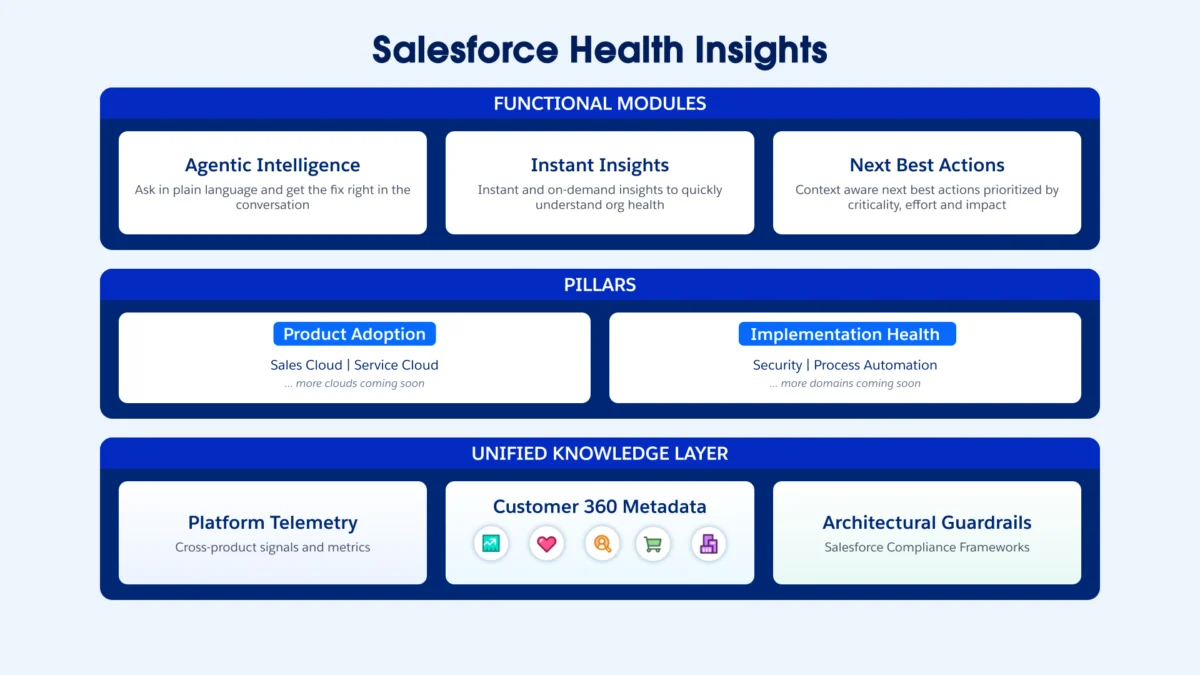
The architecture behind Salesforce Health Insights is designed to process petabytes of telemetry through a unified knowledge layer. By surfacing insights across multiple pillars and utilizing an agentic, in-app experience, the solution provides a comprehensive view of the environment that is as scalable as the businesses it supports. The focus is consistently on reducing the time spent reviewing logs and increasing the time spent on impactful, high-value work.

For customers looking to adopt this new standard of management, the solution is available starting with the Winter ’27 release. It is currently available to Signature Success Plan customers on Core products at no additional cost. Users can locate the feature directly within their instance by opening the App Launcher and searching for "Salesforce Health Insights." By providing a unified, intelligent, and accessible way to manage the complexities of modern Salesforce environments, the platform aims to ensure that as businesses continue to scale and integrate new AI capabilities, their technical foundation remains robust, secure, and fully aligned with their strategic objectives.