Shopify and Vercel have announced a strategic collaboration designed to reshape the landscape of digital commerce by building online stores optimized for both human shoppers and artificial intelligence agents. The initiative was unveiled on October 15 at Vercel’s Ship 26 conference in San Francisco, where Shopify CEO Tobi Lütke and Vercel CEO Guillermo Rauch took the stage together to discuss the emerging era of agentic ecommerce.
The joint announcement highlighted two major technological releases: Shopify’s completely rebuilt Hydrogen software development kit and Vercel’s new AI-enabled, open-source storefront template known as Vercel Shop. Together, these tools aim to solve some of the most complex integration challenges developers face when creating high-performance, customized ecommerce experiences.
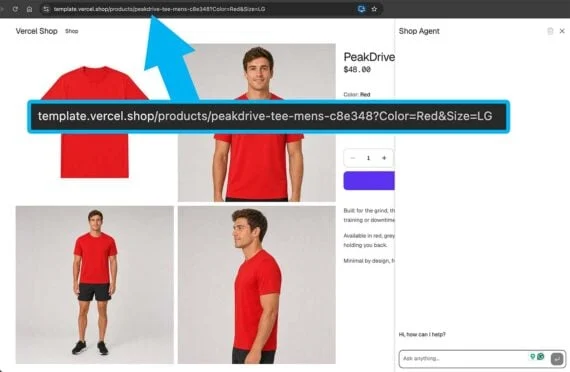
Hydrogen provides developers with a robust set of reusable tools for building Shopify storefronts across a wide array of JavaScript frameworks. Meanwhile, Vercel Shop translates those foundational tools into a fully customizable store template featuring agent-readable product information and sophisticated shopping utilities. Crucially, Vercel Shop also incorporates an optional conversational assistant designed to help human visitors navigate product catalogs and manage their shopping carts, while simultaneously allowing external AI agents to browse, evaluate products, and shop on behalf of human users.
Cooperation
The October unveiling marks the latest milestone in an ongoing partnership between the dominant ecommerce platform and the prominent application development provider. It builds directly upon a prior collaboration on June 30, when the two companies announced the initial rebuild of the Hydrogen SDK. That foundational update was engineered to allow developers to leverage Shopify’s powerful storefront tools seamlessly across various JavaScript frameworks and modern runtimes.
Through this cooperation, the rebuilt Hydrogen SDK organizes common ecommerce functions into shared, modular components. Developers can readily reuse these functions while maintaining complete creative control over how they design and implement the overarching shopper experience.
Custom Storefronts
Developing custom ecommerce storefronts has historically required extensive and delicate engineering integrations. Developers must successfully connect the front-end shopping experience to the complex back-end systems that actually process purchases and maintain business logic. Product pages require real-time catalog data, shopping carts demand accurate and up-to-date pricing and inventory availability, and checkout pages must securely retrieve and process the specific items selected by the shopper.
The newly rebuilt Hydrogen SDK and the Vercel Shop template work in tandem to streamline this demanding technical workflow by providing a reliable, pre-built foundation. Building custom checkout flows from scratch remains notoriously difficult, a reality that Shopify CEO Tobi Lütke emphasized during the conference discussion.
Reflecting on the philosophy behind the platform’s open architecture, Lütke explained that checkouts are notoriously hard to get right and represent the kind of software that genuinely requires years of iterative refinement. Noting that Shopify has always maintained an open approach, he invited developers to remix pieces of the company’s checkout system to suit their precise needs, effectively leveraging Shopify’s massive infrastructure to build whatever custom experiences they envision.

By utilizing this robust software foundation, developers are freed from reinventing core transactional plumbing. Instead, they can focus their creative energies entirely on how shoppers discover products, interact with the digital store, and experience the brand, while extending the base template with customized features as needed.
This underlying architecture is explicitly designed to support multiple, concurrent shopping paradigms. Human visitors can browse the visual storefront or converse directly with the store’s integrated AI assistant for personalized recommendations. At the same time, compatible external AI agents can programmatically access structured product information and execute shopping utilities directly on the merchant’s domain, bridging the gap between traditional web browsing and automated machine commerce.
External Agents
As artificial intelligence rapidly evolves, consumers are increasingly utilizing autonomous AI agents to manage routine tasks, including online shopping. An AI agent shopping on behalf of a human consumer needs efficient mechanisms to locate products, evaluate available options and variants, and eventually assemble a coherent shopping cart without the friction of traditional browsing. Vercel Shop is specifically engineered to support these automated tasks without requiring an AI agent to visually parse complex HyperText Markup Language or process screenshots of a web page.
To understand the practical advantage, consider a scenario where an AI agent is tasked with finding a specific black jacket in a particular size. Rather than forcing the artificial intelligence to interpret graphical elements or navigate labyrinthine menus, the underlying Vercel Shop template exposes product information in a clean, structured format that an AI model can effortlessly understand, parse, and act upon. This structured approach drastically reduces the computational overhead and error rates associated with automated web scraping, paving the way for seamless machine-to-merchant transactions.
Store Assistant
In addition to accommodating external AI agents, Vercel Shop introduces a secondary agentic experience built directly into the heart of the storefront itself. The optional, AI-powered shopping assistant functions similarly to consumer-facing retail helpers like Walmart’s Sparky or Amazon’s Alexa for Shopping. This integrated chat interface helps human shoppers discover products, navigate complicated product variants, inquire about store policies, and manage their active shopping carts entirely through conversational text.
A key technical achievement of the Vercel Shop template is its unified cart architecture. The AI shopping assistant utilizes the exact same underlying Shopify cart as the standard visual storefront. This means a human shopper can manually add a jacket to their cart while browsing visually, and then seamlessly pivot to the chat assistant to ask for a change in size or request recommendations for a matching hat. The shopping cart updates dynamically and accurately reflects any modifications, regardless of whether those changes are initiated by the human user browsing the site or by the AI assistant reacting to conversational prompts.
Throughout these interactions, Shopify remains the authoritative source of truth, rigorously confirming product prices, inventory availability, and permitted cart modifications. Crucially, the AI assistant is strictly confined to discovery and cart management; it is not permitted to independently place orders or process payments. When a human shopper is ready to finalize a purchase, they transition smoothly through a familiar, secure checkout flow.
To maintain developer flexibility, the store assistant is disabled by default within the Vercel Shop template. Developers must deliberately choose to enable the feature and configure the necessary access parameters to Vercel’s AI Gateway. This gives merchants complete control over how the assistant behaves, allowing them to customize the specific guidance it provides to customers and the aesthetic manner in which products are presented within the chat interface.
Vercel’s own corporate merchandise store serves as a live, working production example of the template and its integrated shopping assistant in action, demonstrating the practical viability of building ecommerce storefronts optimized for both human intuition and artificial intelligence.