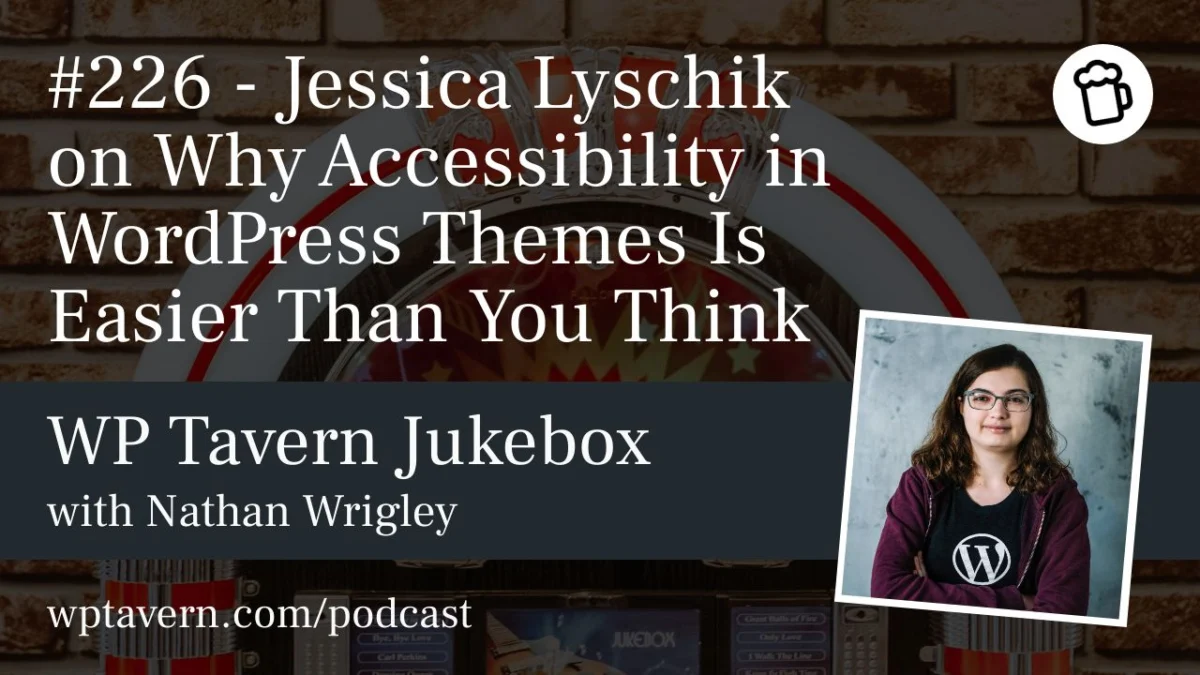
Accessibility in WordPress themes has long carried an intimidating reputation among developers, often viewed as a labyrinth of cryptic guidelines and burdensome technical requirements. However, according to longtime community member and web developer Jessica Lyschik, achieving an accessibility-ready status for both classic and block themes is far more straightforward than most creators imagine. Speaking from the media room at WordCamp Europe 2026, Lyschik sat down with Nathan Wrigley on the WP Tavern Jukebox Podcast to discuss her presentation, "Accessibility in Themes, Easier Than You Think," exploring how proper technical foundations, low-hanging fruit, and shifting industry pressures are transforming the way the WordPress ecosystem approaches inclusive design.
Lyschik, who has been working professionally in the WordPress ecosystem since 2015 and is currently with the agency Syde, has spent years studying and advocating for web accessibility. Her journey into the space was a gradual, moral awakening rather than an overnight shift. Working alongside community advocates and reviewing themes, she realized that many barriers on the web are entirely invisible to able-bodied developers. Unlike a physical barrier—such as a step outside a post office that instantly signals injustice—digital roadblocks remain hidden behind solitary screens, leaving the frustrations of blind, deaf, or motor-impaired users completely unheard.
Despite these historical oversights, interest in accessibility is surging. Lyschik noted that her session at WordCamp Europe drew a much larger and more enthusiastic crowd than expected, a clear sign that developers are increasingly recognizing the value of inclusive practices as they grow older and appreciate simpler, more navigable web experiences. Furthermore, a new technological driving force is entering the landscape: AI agents.
As artificial intelligence begins to interact with the web on behalf of users—such as navigating an online storefront to purchase specific items—it relies heavily on the underlying technical structure of a website. Google and other industry leaders are increasingly emphasizing that AI agents require the exact same semantic HTML, correct heading structures, and descriptive labeling as assistive technologies like screen readers. Lyschik pointed out that an AI agent essentially functions like a screen reader, meaning that building a structurally sound, accessible website naturally empowers automation tools to perform everyday tasks seamlessly for users.
Navigating WordPress theme requirements has traditionally been a point of friction for creators. The official theme repository on wordpress.org maintains 18 distinct accessibility-ready requirements. Lyschik explained that while these criteria can initially sound cryptic to newcomers, they essentially boil down to fundamental web standards, such as utilizing proper HTML5 landmarks like header, footer, and main tags, maintaining an unbroken heading hierarchy from H1 down to H3, and ensuring interactive elements include alternative text or proper ARIA labels.
Out of more than 14,700 themes currently available in the public repository, only about 270 carry the coveted accessibility-ready tag, accounting for roughly one and a half percent of the total ecosystem. Lyschik emphasized that while meeting these standards is not strictly mandatory for repository submission, bridging the gap requires better documentation and education rather than heavy-handed enforcement. By demystifying the rules and connecting theoretical guidelines to practical HTML implementation, developers can easily integrate accessibility into their standard workflows.
Fortunately, the transition toward block-based themes has made this integration significantly more intuitive. Unlike classic themes, which often demand manual interventions to configure complex structures or custom accessibility scripts, modern block themes handle much of the heavy lifting natively through core WordPress functionality. For instance, creating a compliant skip-to-content link or structuring a template part no longer requires bespoke custom code. By placing a content block inside a group and assigning the appropriate HTML tag within the editor interface, WordPress automatically manages the rest behind the scenes.
Similarly, common tasks like adding alternative text to images or ensuring form fields include proper labeling are already baked directly into the editing experience. Lyschik stressed that incorporating these practices from the very beginning of a project saves developers countless hours of remediation down the road. Fixing missing ARIA labels or misaligned heading structures across hundreds of pages after a site has already launched transforms a simple initial task into a frustrating chore. When accessibility becomes a natural habit built into the foundation of theme development, it ceases to be an afterthought and becomes standard professional practice.
Interdisciplinary awareness also plays a critical role in building truly inclusive websites. Accessibility is not solely the responsibility of the developer writing the code; it extends across design, content creation, and search engine optimization teams. Content writers and SEO specialists must understand how to maintain a logical heading hierarchy and structure information effectively, ensuring that every layer of a website contributes to a cohesive experience for both human users and automated systems.
While official guidelines remain relatively stable—drawing from established subsets of the Web Content Accessibility Guidelines (WCAG) that rarely undergo sudden, sweeping overhauls—the broader ecosystem continues to evolve. Resources from influential community leaders such as Joe Dolson, Rian Rietveld, Amber Hinds, and international developers like Sara Soueidan provide invaluable guidance for anyone looking to bridge the gap between dry regulatory text and practical implementation.
As the industry moves forward, the combination of native block theme capabilities, growing regulatory awareness, and the demands of emerging AI technologies is reshaping expectations around web design. By embracing simple, foundational habits early in the development cycle, WordPress creators can build better, more resilient digital spaces that function seamlessly for everyone.