By Sean Tinney
June 3, 2026
For years, digital marketers and small business owners have treated signup form templates as the ultimate shortcut. The process is a familiar routine: a user browses through a gallery, selects the template that looks closest to what they envision, and then settles in for an hour of tedious adjustments. Fields are added or removed, headlines are rewritten, color palettes are swapped, and layouts are dragged and rearranged until the final product vaguely resembles something that belongs to the business. In reality, starting with someone else’s form means spending half your time working backward, stripping away default settings, and trying to force a generic framework to fit a unique brand.
The landscape of digital list building is beginning to shift away from this backwards approach. Emerging tools like AWeber’s AI Signup Form Builder are changing the paradigm by replacing template galleries with conversational and visual generation. Instead of hunting through pre-made designs and generic copy, users can now describe what they need in plain language, upload a screenshot of an inspiring design from elsewhere on the web, or answer a handful of targeted prompts. The result is a form built specifically for a business and its unique offer from the very first click, eliminating the friction of manual customization.
What’s Wrong with Signup Form Templates
To understand why template-driven design has become a bottleneck for modern marketers, one must look at how templates are inherently constructed. Templates are built by necessity to appeal to as broad an audience as possible. They must be generic enough to suit a software-as-a-service startup, a local fitness coach, a freelance consultant, and an e-commerce storefront all at the same time. That broad appeal is precisely what makes them a poor fit for any single enterprise.
Every traditional template ships with a generic headline, a standard default field set, and a layout optimized for nobody in particular. A user frequently encounters the ubiquitous “Subscribe to our newsletter” placeholder when their actual offer might be a highly specific, five-day free email course on canine obedience training. They are handed three input fields when their lead magnet only requires an email address. They receive a complex, multi-column layout when their brand identity relies on clean, minimalist design principles.

Bridging the vast gap between a generic template and an operational, high-converting form requires a significant expenditure of labor. Copywriting must be overhauled, design decisions must be re-evaluated, and field logic must be configured. By the time the asset finally looks and functions correctly, the creator has often spent far more time forcing the template into submission than they would have spent starting from scratch with a blank slate and a clear creative vision.
Furthermore, traditional templates exert a subtle psychological constraint on the creator. By anchoring the user’s thinking to someone else’s structural decisions, templates dictate how the information should flow before the creator even considers the specific needs of their audience. Adapting around an existing structure is a fundamentally different creative process than designing an acquisition asset from the ground up to serve a specific audience and offer.
A Better Way: AI Signup Form Builders
In contrast to legacy methods, an AI-driven form builder starts the creative process with the user and their specific objectives rather than a pre-existing gallery of designs. Platforms like AWeber’s implementation illustrate this shift by offering three distinct entry points for form creation that eliminate the need for manual template hunting.
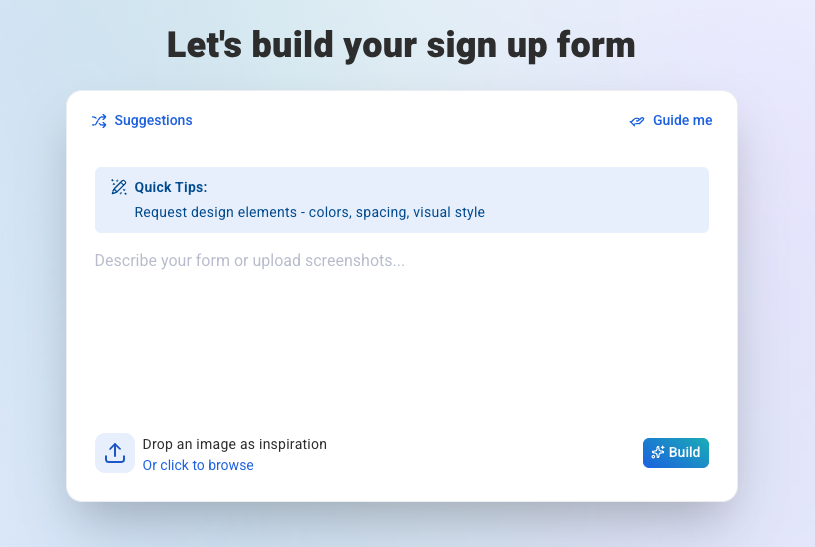
The first and most direct method involves natural language description. A user can type a straightforward sentence detailing their exact requirements, such as a request for a simple, single-field form designed to capture leads for a complimentary guide on meal planning for busy parents. The underlying artificial intelligence parses this description and instantly generates a corresponding form equipped with a relevant, contextual headline, appropriate input fields, and persuasive copy tailored directly to the specific offer.
The second method addresses the common practice of seeking visual inspiration across the web. When a marketer encounters a form design that catches their eye, they can simply capture a screenshot and upload it into the builder. The system analyzes the underlying design, drawing structural and layout cues from the uploaded image, and then synthesizes a brand-new version adapted to the user’s unique visual identity. This allows creators to leverage external design inspiration without resorting to manual rebuilding or direct imitation.
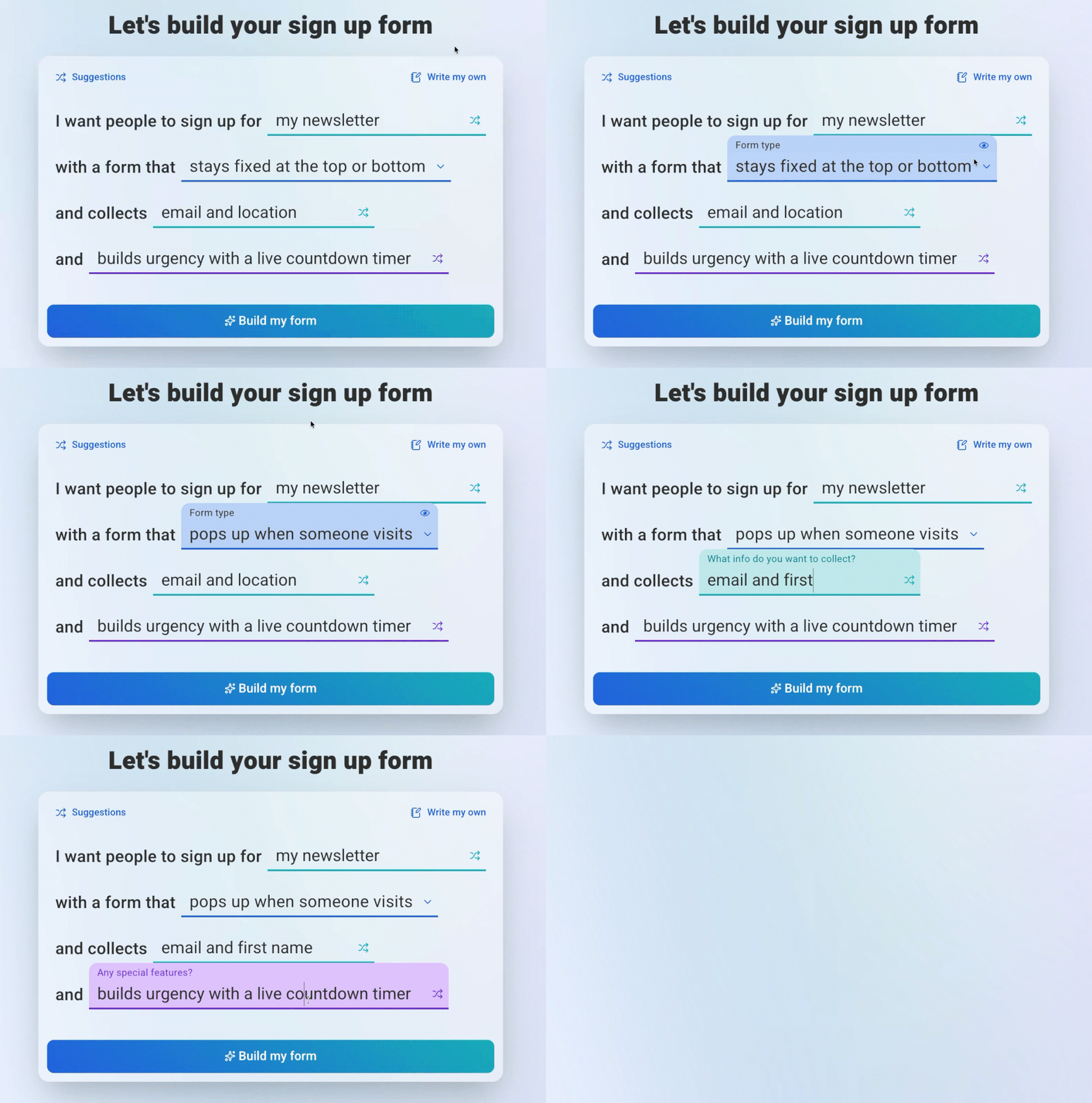
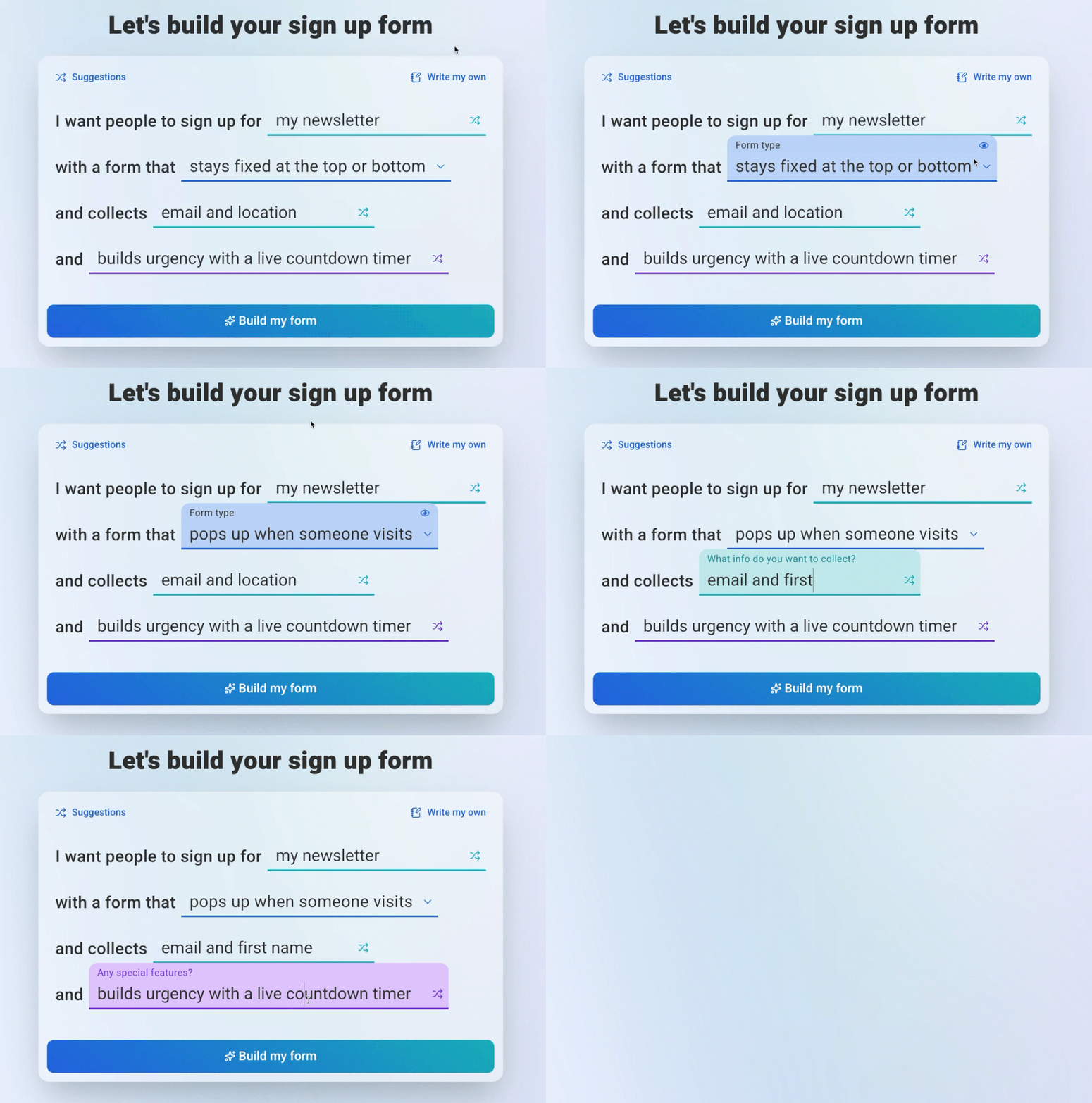
The third approach relies on guided prompts, where the builder asks the user a targeted sequence of questions regarding their specific audience, their lead magnet or offer, and their ultimate marketing goals. The system then assembles a cohesive form based entirely on those specific inputs, ensuring that the final output aligns closely with the user’s strategic intent.
Once the initial generation is complete, subsequent refinements occur through natural conversation rather than through complex settings panels and field editors. A marketer can instruct the tool to shorten a headline, integrate a new checkbox, or modify call-to-action button text using plain language. The form updates dynamically, streamlining a workflow that traditionally required navigating multiple layers of administrative menus.
What You Actually Get Versus a Template Gallery
The fundamental distinction between relying on a template gallery and utilizing an AI generation tool lies in the presence or absence of fixed constraints. When navigating a template gallery, a creator is perpetually confined to a finite set of pre-determined choices. If the exact form layout, messaging style, and field structure required by a specific brand do not happen to exist within that library, the user is forced into a compromise.
An AI builder removes these rigid boundaries by generating the form dynamically from individual inputs. This ensures that the generated headline speaks directly to the specific nuances of the offer, that the field count matches the exact level of friction appropriate for the audience, and that the accompanying copy reflects the authentic voice of the brand rather than reading like a generic software demonstration.
For instance, a specialized fitness coach requires an entirely different tone, visual cadence, and conversion strategy than a complex business-to-business software platform. In a traditional template gallery, both professionals might easily be funneled toward the same generic starting point, forcing them to spend valuable time stripping away irrelevant elements. An AI-driven builder bypasses this inefficiency by taking the creator’s exact description and building outward from there.
When a Template Can Still Be Useful
Despite the efficiency gains offered by modern AI tools, templates retain a distinct and valuable place in the digital marketing ecosystem, provided they are used for the right purpose: pure inspiration.
Every marketer encounters landing pages and signup modules that capture their attention mid-scroll. The layout, the phrasing of the call-to-action, or the clever arrangement of input fields can offer valuable insights into effective design. Recognizing what stopped the eye is a powerful learning tool, and those examples are worth preserving.
This is where the screenshot-based ingestion feature in modern form builders proves useful. By capturing an inspiring form design and uploading it into an AI builder alongside a description of their own business, creators can harness structural design cues from external sources while producing an asset that remains entirely original. This approach captures the essence of effective layout inspiration without falling into the trap of brand mismatch or manual imitation.
Build Your First Form in Minutes
The evolution of signup form technology represents a broader movement toward reducing friction in digital marketing workflows. By stepping away from restrictive template galleries and embracing descriptive, AI-assisted generation, businesses can deploy customized lead-capture assets in a fraction of the traditional time.
The process begins simply by opening a platform like AWeber, selecting the AI Signup Form Builder, and typing a single sentence describing the intended offer. With the need for template browsing, layout compromises, and extensive copywriting overhauls removed, marketers can focus on connecting with their audience and ensuring that every new subscriber transitions smoothly into an automated welcome sequence the moment they join the list.