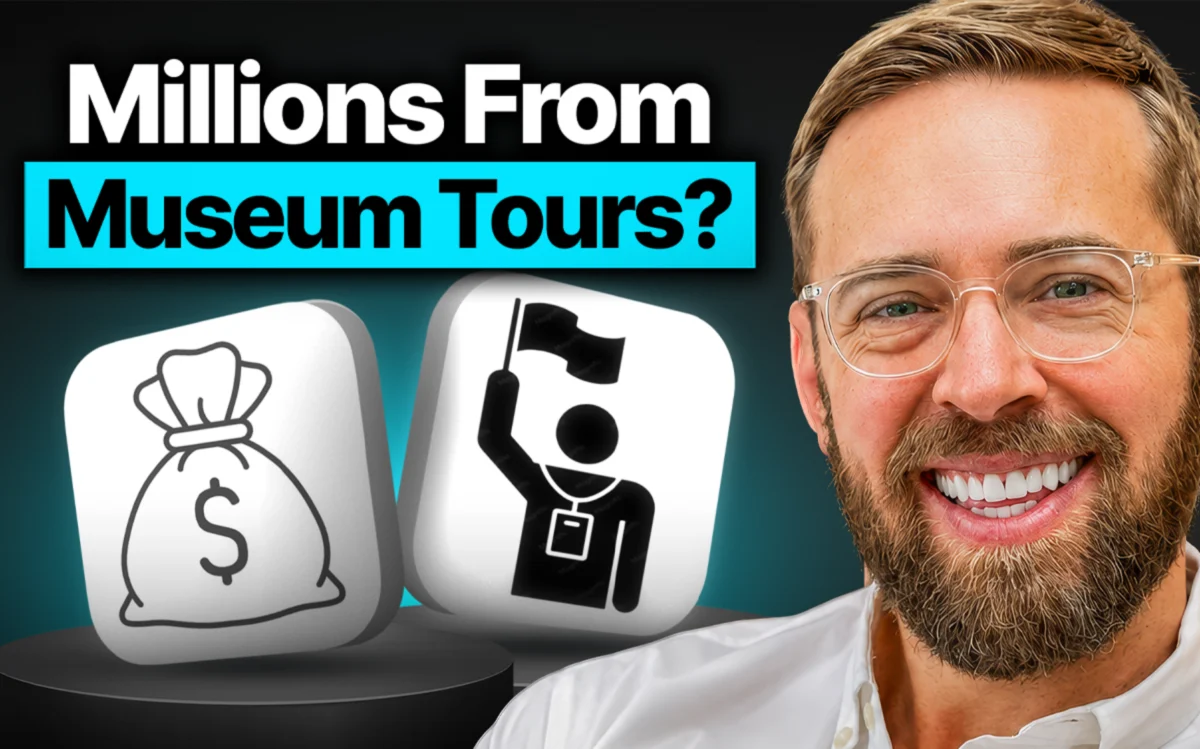
In a recent episode of the Niche Pursuits podcast, entrepreneur and author Nick Gray sat down with host Jared Bauman to discuss the journey of turning personal passions into profitable enterprises, the enduring trust-building power of books, and the evolving role of personal websites in search engine optimization (SEO) and online reputation management. Rather than following a standard marketing playbook, the wide-ranging interview explored unconventional paths to building authority, challenging conventional wisdom around scaling businesses, managing personal brands, and navigating the digital landscape.
The first half of the conversation traced Gray’s entrepreneurial roots, focusing on how he built Museum Hack from casual, informal museum tours for friends into a multi-million-dollar acquisition. The second half shifted into an analytical dialogue examining personal websites, entity clarity, digital authority, and what modern business owners often overlook when they concentrate solely on their corporate websites.
How a Hobby Became Museum Hack
Nick Gray did not set out to become a prominent museum entrepreneur. After moving to New York City, he began visiting the Metropolitan Museum of Art frequently and took it upon himself to show friends around for fun. Armed with curiosity and an outsider’s perspective, Gray was never trained in art history, nor had he ever worked as a professional tour guide. However, that lack of formal training quickly became his primary advantage.
Instead of designing tours tailored strictly for traditional art lovers, Gray built experiences explicitly for people who typically found museums boring. He focused on compelling stories, historical gossip, financial intrigue, romance, fierce rivalries, and the strange, quirky details that conventional docent-led tours frequently skipped.
As word spread, those initial tours for friends expanded. Friends began referring other friends, and eventually, a prominent blog featured his tours, praising them as one of the best things to do in New York City. Suddenly, more than 1,000 people expressed interest in joining. That surge in demand forced Gray to make a critical business decision: either continue treating the tours as a casual hobby or start charging money.
He initiated a modest pricing model, charging around $19 to $29 per person. Interestingly, on his very first paid tour, he felt so unaccustomed to the transaction that he refunded everyone their money simply because he enjoyed the experience so much. Despite this early hesitation, implementing a fee proved to be one of the best strategic decisions of his entrepreneurial career. Once attendees paid for the experience, they treated it with significantly higher respect, shifting the dynamic from a casual meetup to a professional product. Gray realized he was not merely selling access to a museum; he was selling an entertaining, highly engaging way to experience art and history.
Scaling Beyond the Founder and Working With Institutions
One of the most difficult challenges for any personality-driven business is successfully removing the founder from day-to-day operations and delivery. Gray faced this hurdle early on when a friend advised him that the business could never scale because Nick himself was the primary product. Refusing to accept that limitation, Gray began hiring individuals who could replicate the infectious energy of the tours. His hiring strategy was unconventional, prioritizing personality, charisma, and performance ability over traditional tour-guide credentials.
This staffing approach allowed Museum Hack to expand beyond a single guide in New York City, launching operations in Washington, D.C., due to its proximity and manageability. The cities that ultimately proved most successful shared two distinct traits: a high volume of visitor demand and a deep pool of freelance labor, such as actors, performers, and individuals with flexible schedules in major metropolitan areas like Los Angeles and San Francisco.
Initially, Museum Hack operated as an independent, renegade tour company without official sanction from the museums themselves, creating considerable institutional tension. Museums occasionally attempted to shut the tours down, requiring Gray and his team to navigate strict rules, operational uncertainty, and resistance. Over time, however, the relationship evolved into a cooperative partnership. Museum Hack structured its pricing so that a portion of every ticket directly covered the full museum admission price for each guest, clearly aligning financial incentives and demonstrating tangible value to the institutions.
The Eventual Exit and a Pivot During Crisis
Gray never anticipated selling Museum Hack. The business was labor-intensive, highly unconventional, and far removed from the clean software-as-a-service models favored by typical tech buyers. Although the company grew across multiple cities and generated millions in revenue, Gray noted that he worked intensely to push it into the $5 million to $10 million range, yet encountered a ceiling around $3 million in annual sales.
By that stage, Gray had successfully worked himself out of daily operations, allowing his leadership team to run the company autonomously. Eventually, that leadership team approached him with an acquisition offer. The deal utilized full seller financing, a structure where the buyers put down zero dollars upfront and paid Gray out of the company’s ongoing profits over time. This uncommon arrangement succeeded entirely because of mutual trust and transparency between Gray and his core team.
Gray sold the business in 2019. Shortly afterward, the COVID-19 pandemic struck, forcing museums worldwide to close indefinitely and reducing the company’s traditional tour revenue to zero. In response, the new owners pivoted the business toward remote team-building experiences. Gray later described that painful operational restart as a blessing in disguise, as it ultimately pushed the company toward healthier profit margins and a more resilient business model.
The Trust-Building Power of Books and the Rise of LLMs
Following his exit from Museum Hack, Gray launched a new venture in 2022 centered around his book, The 2-Hour Cocktail Party. While he initially pursued the project for branding and authority purposes, he wanted it to function as a tactical, workbook-style guide rather than a standard thought-leadership manifesto. Drawing on his expertise in hosting intimate gatherings for 15 to 25 people, the book provided a scalable way to teach his event-hosting formula.
Financially, the project required a significant investment, with Gray spending approximately $60,000 on high-end design, layout, and professional publishing support. While direct book sales presented a modest financial return, the asset served a much more valuable function: building deep, lasting trust. Much like podcasting, writing a book allows an audience to spend hours immersed in an author’s ideas, fostering a connection far stronger than a brief social media post or article can achieve.
During the podcast, Gray and Bauman also examined whether traditional business nonfiction books retain their historical value in the era of large language models (LLMs) and artificial intelligence. While books remain powerful tools for establishing authority and sharing structured frameworks, entrepreneurs today must weigh them against competing formats like newsletters, podcasts, video channels, and interactive digital content. Gray noted that while he was glad he wrote his book when he did, he might evaluate alternative formats differently if launching a similar project today.
Personal Websites as a Modern Business Asset
Gray’s latest entrepreneurial endeavor is PersonalWebsites.org, a service dedicated to building and managing professional personal websites for clients, priced at around $29 per month. This business stems directly from his own digital habits, having maintained a personal website for over two decades, which he credits with facilitating professional relationships, networking opportunities, and shaping his online presence.
The core premise behind the service is straightforward: when people or artificial intelligence engines search for an individual—whether they are a founder, service provider, corporate executive, or potential partner—they look for a definitive source of truth. A personal website provides a centralized platform to communicate an individual’s professional story, accomplishments, and background directly to the public. Rather than serving as a reactive tool to bury negative search results, a personal website functions as a proactive reputation management asset.
The conversation naturally transitioned into a live critique when Gray pulled up Jared Bauman’s personal website during the interview. Gray praised Bauman’s existing site for its strong visual imagery, speaker highlight reel, testimonials, and clear authority signals, while offering strategic suggestions to expand the site’s digital footprint. By creating additional content pages around professional interests, projects, and affiliations, individuals can provide search engines and AI systems with structured data regarding their professional identity.
Navigating SEO, GEO, and Entity Clarity
As the discussion turned toward modern search dynamics—encompassing SEO, generative engine optimization (GEO), and artificial intelligence optimization (AEO)—Gray emphasized the importance of distinguishing between a person and a corporate brand as distinct digital entities. For many business owners, particularly founders of small and mid-sized enterprises, the line between the individual and the company is heavily blurred, making it difficult for algorithms to accurately categorize who is who.
A well-structured personal website helps search engines and AI models clearly differentiate between the human entity and the commercial enterprise, clarifying professional roles, past projects, and industry expertise. Highlighting the technical infrastructure behind his new venture, Gray shared that his team successfully migrated approximately 80 personal websites from traditional platforms to a streamlined static setup using Payload CMS and Astro. This technical optimization resulted in dramatic performance gains, driving PageSpeed Insights scores from the high 80s up to near-perfect marks of 99.
Approaching its first full year of operation, PersonalWebsites.org supports around 80 clients and generates consistent monthly recurring revenue, mirroring the early, experimental phases of Museum Hack. As Gray continues to refine the service’s market focus, targeting entrepreneurs, consultants, and professionals, he faces the familiar entrepreneurial challenge of scaling a service-oriented business without compromising the quality and personalization that drives its core value.