The landscape of mobile communication is undergoing a fundamental shift as Rich Communication Services (RCS) emerges as the new standard for enterprise-to-consumer interaction. By bridging the gap between traditional SMS and the sophisticated requirements of modern marketing, RCS delivers a unified, interactive experience that functions seamlessly across both Apple and Android ecosystems. For organizations looking to move beyond the limitations of legacy text messaging, this evolution represents more than just a technical upgrade; it is a strategic expansion of how brands can deliver rich content, engage in meaningful two-way dialogues, and maintain personalized, data-driven relationships with customers regardless of their hardware preference.
At its core, RCS is designed to solve the fragmentation that has long plagued mobile marketing. Unlike the static nature of SMS and MMS, RCS allows for dynamic, branded, and high-fidelity messaging. For marketers, this means the ability to provide a vastly more creative and flexible environment. It allows for the deployment of rich media, interactive buttons, and real-time conversational flows that were previously only possible within proprietary mobile applications. By standardizing this experience across all major mobile platforms, RCS empowers businesses to reach their entire customer base with a consistent, high-impact message that no longer requires the user to leave their native messaging app.
Navigating the Configuration of Your RCS Agent
For enterprises preparing to integrate this technology into their stack, the transition requires a thoughtful approach to configuration. Success in the RCS space is rarely a matter of simple implementation; it is a deliberate architectural decision that begins with the creation of an "RCS Agent." This agent serves as the central identity and capability container for a brand’s presence within the RCS ecosystem. Before any messages are sent, organizations must map out four fundamental dimensions: use case, billing category, target market, and technical capabilities. These choices act as the foundation for all future activity, shaping how a brand scales its messaging strategy.
The selection of a "Use Case" is the primary determinant for compliance and operational structure. Salesforce simplifies this process by dynamically surfacing required fields based on the specific country and use case, ensuring that businesses remain compliant with local regulations. While many organizations opt for a "Multi-use" configuration—which allows for a blend of transactional and promotional messaging from a single brand—it is essential to note that this is not universally applicable. In specific regulatory environments such as Brazil and India, the infrastructure demands that companies provision separate agents for distinct use cases. This underscores the importance of a granular approach to international deployment.
Equally critical is the selection of a "Billing Category," which must be categorized as either "Conversational" or "Non-Conversational." Non-conversational billing is intended for one-way, trigger-based communications, such as standard shipping notifications, appointment reminders, or order confirmations. Conversely, conversational billing is triggered when a session incorporates inbound replies—whether from a human end-user or an automated AI interaction. Because the cost-model difference between these two categories is significant at an enterprise scale, marketing teams are encouraged to align their operational strategies with the available billing models in their specific markets early in the design phase.
The "Market" (or country) designation is a fixed, non-changeable parameter once an agent is provisioned. Because each country maintains unique carrier requirements, compliance standards, and sender regulations, organizations must confirm their target markets before moving forward. It is also vital to distinguish the agent’s market from the technical data-hosting environment. Data residency is managed separately through Google’s infrastructure, and companies should ensure that their internal legal and compliance departments are involved in both the market provisioning and data-hosting discussions to ensure full adherence to privacy mandates.
Finally, the configuration of "Capabilities" defines the operational boundaries of the agent. By choosing between "Flow Messaging" and "Conversational Messaging"—or opting for both—organizations determine how they will interact with their audience. Flow messaging unlocks rich media formats such as carousels, action buttons, and suggested replies, which are ideal for automated, journey-based communications. Conversational messaging, meanwhile, introduces the ability to handle inbound replies, effectively activating the Agentforce pathway for two-way, intelligent dialogue. For a robust, full-channel strategy, most enterprises find that enabling both capabilities provides the greatest flexibility.
Enterprise Scale and Strategic Implementation
The integration of RCS within the Salesforce environment is built upon a two-tier architecture designed for high-volume, reliable delivery. The first component is a direct partnership with Google, which ensures that Salesforce customers remain at the forefront of the evolving RCS ecosystem as the standard matures. The second component is a high-scale connection with messaging aggregators that manages the complexities of global carrier routing and inbound traffic. This dual-layer approach ensures that messages move reliably in both directions, even during periods of heavy, enterprise-grade traffic.
The utility of this technology is best understood through the lens of practical application. For one-way transactional messaging, RCS transforms standard notifications into high-value brand moments. Rather than sending a sterile text link to track a package, a company can now push a message containing a product photo, a live tracking button, and a branded header. By utilizing a "swipeable" carousel, businesses can even present related products for reorder, all within the native interface. This capability, powered by the "Send RCS Message" invocable action in Flow, allows data merge fields to populate personalized details—such as names or appointment times—directly from a unified data profile. Because this can be done on-demand, the media presented to the customer is always relevant to their specific transaction.
For more complex scenarios, such as flow-orchestrated customer journeys, RCS offers a sophisticated way to manage engagement through branching. A marketing campaign can now feature a carousel of products, with the system monitoring for a "Read" event. If a customer engages with the content, the journey continues accordingly; if they do not, the system can automatically trigger a follow-up with a secondary offer. If a message is delivered but remains unread for 24 hours, or if the recipient does not have an RCS-enabled device, the journey can intelligently trigger an SMS fallback. Because every engagement event is fed into Data 360 in real-time, these read rates and response behaviors become part of the customer’s permanent, unified profile, allowing for better audience segmentation and more precise future targeting.
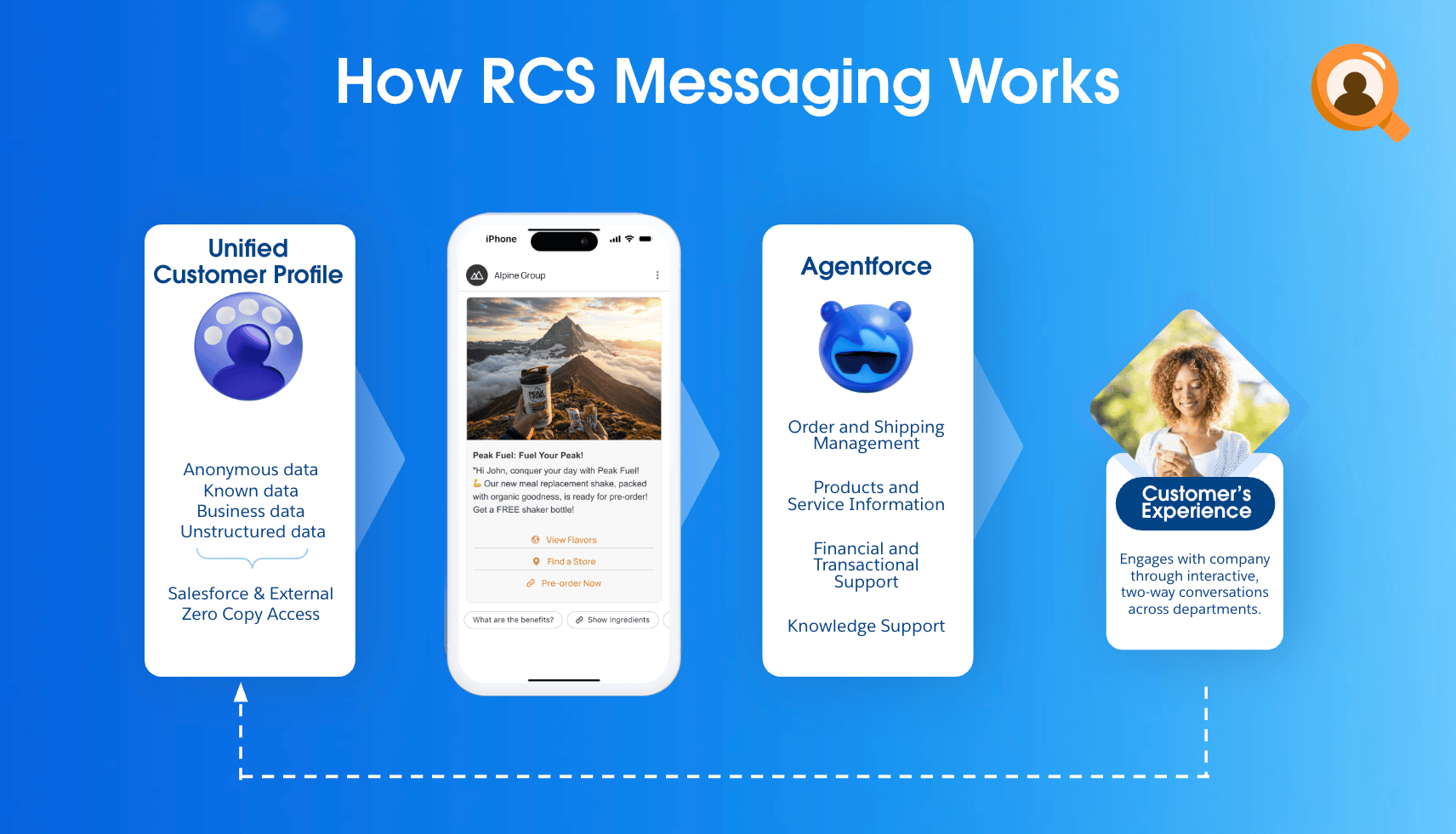
The third, and perhaps most transformative, use case involves two-way conversational AI. When a customer replies to an RCS message, the interaction is routed to the Agentforce Service Agent, which possesses full access to the customer’s history and the context of the current conversation. This allows the AI to provide highly intelligent, relevant assistance—such as handling a return, scheduling a callback, or answering questions about a recent purchase—without the customer ever leaving the messaging thread. Should the complexity of the inquiry exceed the AI’s capabilities, the system provides a seamless escalation path to a human agent, who receives the full conversation history to ensure the transition is smooth and efficient.
Measuring Success and Global Availability
The true value of moving to an RCS-based model is the quality of the analytics it provides. Unlike legacy channels that offer only limited delivery confirmation, RCS provides a comprehensive engagement stream. Tracking metrics like delivery, read receipts, failed sends, user responses, and subscription status allows for a far more nuanced understanding of customer intent. By integrating these metrics into Data 360, marketers can break down silos, ensuring that mobile messaging data is not isolated, but is instead used to drive cross-channel reporting and real-time automation triggers.
As of now, RCS on Salesforce is generally available in several key international markets, including the United States, Mexico, Brazil, France, Germany, the United Kingdom, and India. While the rollout continues, with countries such as Canada, Italy, Singapore, and various others slated for upcoming availability, the core configuration principles remain consistent. By establishing a strong, compliant foundation today, organizations can position themselves to scale their mobile messaging operations internationally as the ecosystem expands, ensuring they are ready to meet customers wherever they happen to be in the digital world.