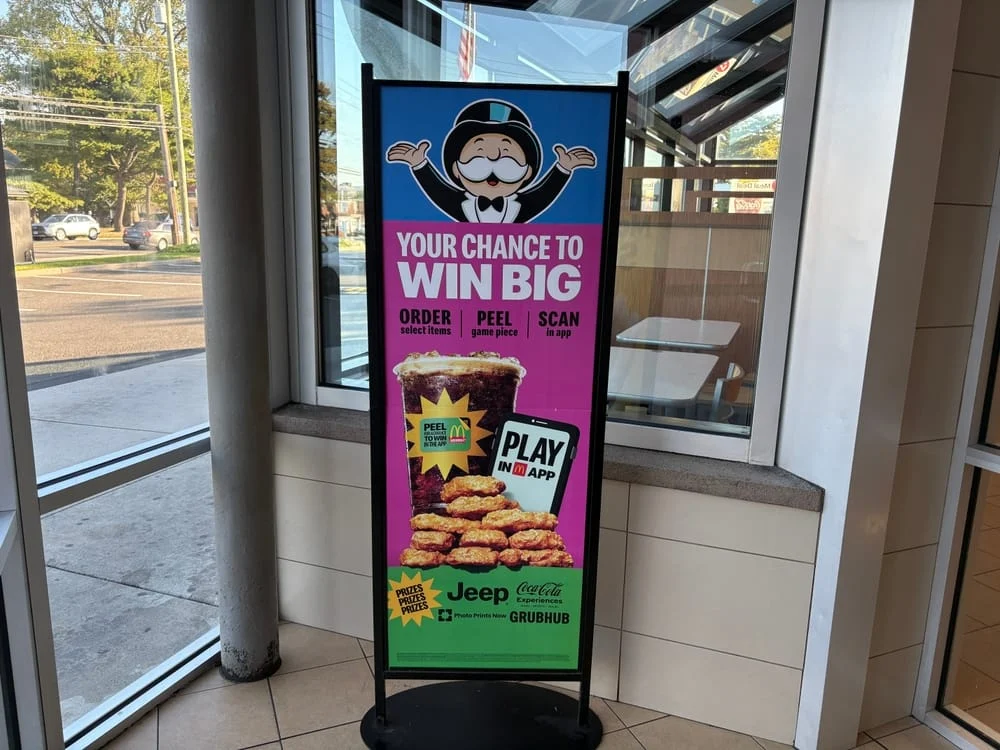
You peel the sticker off your McDonald’s fries, scan the digital code into your smartphone, and discover you’ve just collected yet another Monopoly property. Suddenly, that $100,000 cash prize or brand-new Jeep doesn’t seem completely out of reach. After all, someone has to win, right? But before you start ordering extra meals simply to collect more game pieces, it is worth understanding just how difficult winning the biggest prizes can truly be.
McDonald’s Monopoly officially returned to the United States in October, bringing back a wave of nostalgia alongside cash prizes, vacations, vehicles, free food, and loyalty rewards points. According to McDonald’s official promotion rules, the overall odds of winning any prize are approximately 1 in 5. However, the vast majority of those available prizes are relatively small rewards, such as French fries or soft drinks. This leaves many participants wondering: what are the actual chances of winning McDonald’s Monopoly when you are hoping for something substantially more life-changing than a free side order?
Your Overall Odds of Winning Are Approximately 1 in 5
At first glance, the advertised odds of winning McDonald’s Monopoly sound surprisingly generous to casual diners. The company’s official rules state that approximately one in every five game plays wins a prize, with the vast majority of those winners receiving food items or MyMcDonald’s Rewards points. That translates to roughly a 20% chance of winning something at the outset of the promotion, but it is important to note that this is not a 20% chance of collecting a major prize.
McDonald’s also cautions that available prizes diminish rapidly as they are claimed by participants, meaning the underlying odds can shift throughout the promotional period. Importantly, a one-in-five chance does not guarantee that you will win something after five distinct attempts, because individual outcomes are not distributed in a predictable or repeating sequence. Each game piece or scan represents an independent event with its own probability.
Winning Free Food Is Much Easier Than Winning Cash
The overwhelming majority of available McDonald’s Monopoly prizes consist of minor promotional rewards rather than substantial financial payouts. According to official prize information provided by the corporation, these rewards typically include items such as small French fries, baked apple pies, soft drinks, McChicken sandwiches, and various allocations of loyalty program points.
While these prizes can certainly be enjoyable—especially if you were already planning to purchase food from the restaurant anyway—a free menu item worth a few dollars is hardly financially equivalent to winning a major cash prize or an automobile. Even though both categories count toward the advertised overall winning odds of one in five, this distinction matters enormously when evaluating the true chances of winning something of high value, rather than simply asking whether a game piece might produce any reward at all.
The $1 Million Prize Is Exceptionally Difficult to Win
The headline-grabbing centerpiece for the promotion is a $1 million cash award available through the digital Chance Card Game. McDonald’s corporate announcements confirm that players can compete for the seven-figure prize alongside various vehicles, travel experiences, and secondary rewards.
Independent third-party analyses of the game’s complex prize structure estimate the odds of winning that specific $1 million award at approximately one in 801.6 million. Meanwhile, the official rules describe Chance Card winning odds as heavily dependent on the exact timing of play. That staggering estimate illustrates the enormous gulf between the overall chance of receiving any minor prize and the remote possibility of capturing the promotion’s largest cash payout. Treating the million-dollar prize as a realistic financial opportunity would clearly be a mistake, regardless of how exciting the marketing campaigns and advertisements make it appear.
Collecting Properties Doesn’t Mean You’re Close to Winning
The familiar Monopoly property-collection system creates another psychological reason why players frequently overestimate their actual chances of success. To win certain premier prizes, participants are required to collect complete property sets, such as matching colored streets or railroad properties.
The primary difficulty lies in the fact that some individual pieces are manufactured to be vastly scarcer than others. Consequently, collecting two properties in a standard three-piece set does not mean you are two-thirds of the way toward winning the prize. For example, McDonald’s offers major rewards through specific property combinations, but the total number of available winning pieces can be exceedingly limited compared with the massive volume of common pieces distributed. Before spending extra money chasing a missing property, participants should remember that the hardest piece to find is often the sole factor that determines whether the prize is obtainable.

The Game Features Several Different Ways to Win
The modern iteration of the McDonald’s Monopoly promotion successfully combines traditional physical game pieces with modern digital gameplay through the official McDonald’s mobile application. Participants register for the promotion, collect eligible pieces, and scan them to receive food rewards, loyalty points, properties, or opportunities to participate in the digital Chance Card Game.
Eligible purchases made directly through the app or using a Rewards code can also generate bonus Chance Card opportunities, provided the customer registers before placing their order. However, these additional opportunities to participate do not guarantee a prize, and the true probability of winning depends entirely on the specific game and prize category involved. Understanding these separate prize mechanisms is essential when comparing the chances of winning across different types of rewards.
You Don’t Actually Have to Buy McDonald’s to Play
One of the most frequently overlooked details about the nationwide promotion is that purchasing food is not actually a mandatory requirement to participate. The official rules explain that eligible participants can request game pieces by mail using a specified no-purchase entry procedure.
These requests must strictly follow published instructions, including the inclusion of required envelopes and postage, and must arrive by the established deadlines. McDonald’s also limits participants to a specific threshold of game-piece code entries and Chance Card Game plays per day, along with additional eligibility and registration requirements. Although mail-in participation involves minor postage costs, it offers a legitimate alternative for individuals who enjoy the entertainment value of the game without wanting to spend money on extra fast-food purchases.
Spending More Money Doesn’t Guarantee a Better Outcome
Suppose a customer decides to purchase an extra meal solely because they want another chance to win a major Monopoly prize. Even if they receive a small food reward, they may have ultimately spent considerably more money than the retail value of what they won.
Federal consumer protection agencies consistently encourage consumers to approach prize promotions carefully and to understand the difference between legitimate entertainment opportunities and promotional claims that inadvertently encourage unnecessary spending. McDonald’s itself explicitly states that no purchase is necessary and that purchasing additional food will not improve a participant’s statistical chances of winning under the promotion’s official terms. From a personal finance perspective, the smartest strategy is to treat Monopoly pieces as a modest bonus on food you already intended to buy rather than a justification for increasing your household restaurant budget.
Deadlines and Prize Restrictions Matter
Even winning a legitimate promotional prize does not necessarily mean that a participant can redeem it whenever they choose. Eligible food purchases and related bonus opportunities run through early November, while the digital Chance Card Game typically continues for an additional week.
General prize claim deadlines apply to all winners, although individual prizes often carry additional redemption requirements, restrictions, or verification procedures. Certain high-value awards—particularly vehicles, international vacations, and large cash prizes—may also involve applicable taxes, mandatory documentation, and other legal conditions clearly outlined in the official rules. Participants are advised to read the terms thoroughly before assuming that the advertised retail value of a prize represents the exact amount of cash or financial benefit they will ultimately receive.
Is McDonald’s Monopoly Worth Playing?
Ultimately, the answer depends heavily on whether an individual is participating purely for lighthearted entertainment or genuinely expecting to improve their financial standing. With overall winning odds hovering around one in five, there is a reasonable possibility of receiving a small, complimentary food reward, but major prizes remain exceptionally difficult to obtain.
Collecting properties and scanning game pieces can add an extra layer of fun to an ordinary restaurant visit, especially when customers are already purchasing eligible menu items. However, spending extra money to chase rare properties or high-value prizes is unlikely to be a sound financial strategy, and free-entry options deserve consideration for anyone who simply enjoys participating in the seasonal event. Understanding the actual mathematical odds behind McDonald’s Monopoly helps ensure that participants can enjoy the promotion as a fun marketing game rather than a realistic path to financial gain.