By
Kelly Forst | June 12, 2026
When launching an online small business, founders and creators are routinely met with a fundamental digital dilemma: Do I need a website, what should I use a landing page for, or do I need both? For anyone setting out to establish an online presence, carving out a digital home is a critical step toward building an audience. However, the modern internet offers more than one avenue to achieve this visibility, leaving many entrepreneurs weighing the operational costs and strategic advantages of different setups.
Understanding the similarities and differences between landing pages and websites can help business owners determine which digital tool aligns best with their current goals, resources, and long-term trajectory.
Landing Page vs. Website: Definitions
To make an informed decision, it helps to examine what each digital asset actually is and how it functions in a broader marketing strategy.
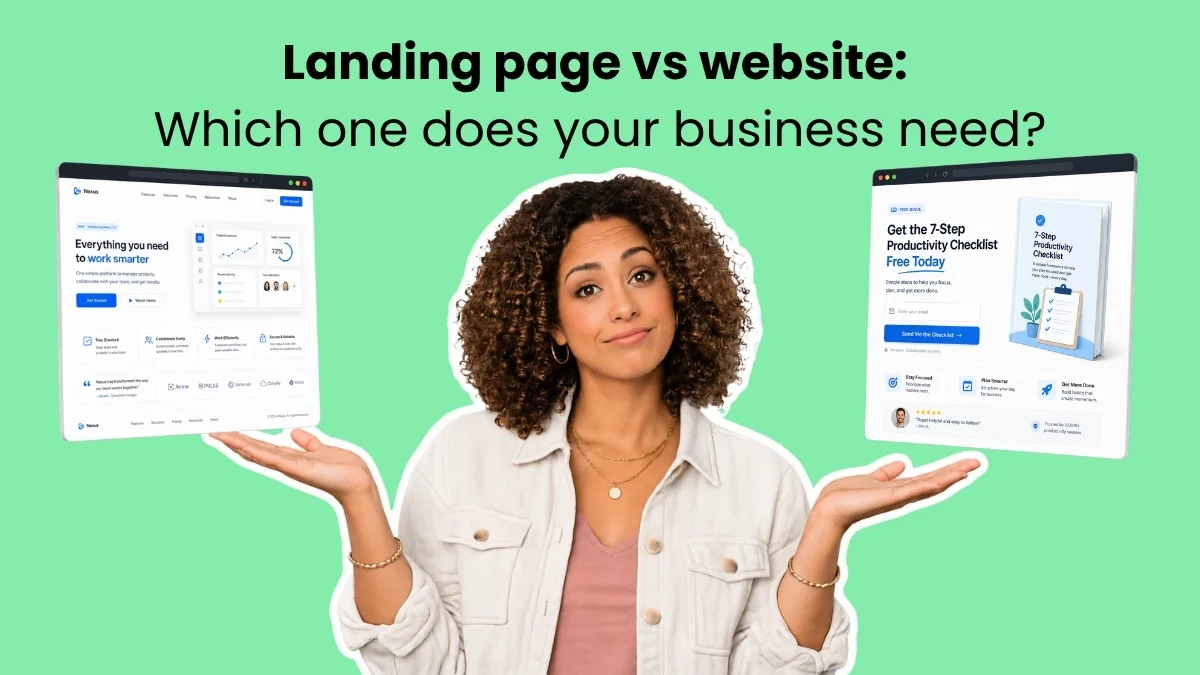
A traditional website is typically composed of five or more interconnected web pages. These often include a homepage, an about page, a contact page, a portfolio or services page, and a blog or resource section. The overarching goal of a website is exploration. Visitors browse freely, learn about the brand or individual behind it, find answers to various questions, and gradually build familiarity with the business over time.
A website serves as a comprehensive, one-stop shop for everything related to a business. But that level of completeness comes with trade-offs. Websites inherently demand more time, financial investment, and ongoing upkeep than a single, isolated web page.
For instance, consider the digital footprint of the podcast “Foodie Buddies.” Visitors to their main website can navigate across multiple tabs to learn about the show’s premise, listen to the latest audio episodes, and search through a collection of recipes.
By contrast, a landing page is a standalone web page engineered with a singular goal and a single call to action. Unlike a website, a landing page typically features no menu to click through and no secondary pages to wander off to. A visitor arrives, reads the content, and either takes the desired action or leaves the page entirely.
Common goals for landing pages include collecting email addresses through sign-up forms, registering participants for a webinar, registering for an event, or facilitating the direct purchase of a specific product or service. Because every element on the page is intentionally directed toward one specific action, landing pages generally achieve higher conversion rates than multi-page sites built for casual browsing. The visitor never has to deliberate over where to click next because the decision has already been made for them.
Returning to the “Foodie Buddies” podcast example, the creators utilize landing pages as a vital component of their broader marketing strategy. In their case, a landing page functions as a centralized link directory. This allows the podcasters to use a single link within their social media biographies, seamlessly directing followers to a clean hub of resources without overwhelming them with choices.
Side-by-Side Comparison of Structure and Function
The structural relationship between the two formats can be envisioned geographically. Think of a website as an expansive continent, complete with many interconnected regions, roads, and easy routes for travel between them. A landing page, meanwhile, is an isolated island off the coast. It stands entirely on its own, and every visitor who arrives there encounters one distinct destination.
When comparing them side by side, their operational differences become even clearer. A website consists of five or more pages, features full menu navigation connecting every corner of the site, is designed for exploration and education, hosts many calls to action spread across different sections, takes days or weeks to launch, involves higher costs for hosting, design, and maintenance, and is best suited for established businesses with extensive content to showcase.
Conversely, a landing page consists of a single page, features minimal or absent navigation, is built around one specific action, contains a single call to action, can be launched in minutes or hours, involves little to no extra cost—often being included directly with existing email marketing tools—and is best utilized for targeted campaigns, audience list growth, or selling a single product.
Ultimately, the fundamental difference between the two lies in user behavior. A landing page asks a visitor to perform one precise action, while a website invites them to look around and explore at their own pace.
When to Use a Landing Page
Choosing a landing page is ideal when a business requires absolute focus. When running a targeted digital advertisement, promoting a specific lead magnet, launching a singular product, or sharing a solitary link on social media platforms, a landing page ensures that the visitor remains strictly on task without distractions.
Landing pages also provide an efficient framework for testing new business concepts before committing significant capital. Entrepreneurs can build a dedicated page for a new product or service in an afternoon, direct traffic toward it, and quickly gauge whether there is genuine market demand before investing money into building out a full website.
For individuals who are just starting out, a landing page offers a fast track to getting online. It removes the immediate need for hiring a web designer or developer, eliminating complex setup hurdles and monthly hosting bills.
When to Use a Website
A full website becomes necessary when a business has grown to a scale where a single page can no longer contain its operations. This includes businesses with multiple product lines, extensive content libraries, professional portfolios, or staff directories. If visitors regularly require answers to a diverse range of questions, a website provides each topic with its own dedicated home.
Additionally, a website is essential for building long-term search engine visibility. A regularly updated blog filled with helpful, optimized content attracts organic visitors month after month—a feat that a single landing page rarely achieves on its own.
However, these two formats are not mutually exclusive; one is not a true replacement for the other. Even enterprises equipped with robust, multi-page websites continue to rely heavily on landing pages for conversion-driven tasks. Directing paid ad traffic and promotional email campaigns to focused landing pages yields better results than sending that traffic to a homepage, which inherently contains too many potential exits.
Determining Your Business Needs
Deciding which format to deploy requires evaluating a few practical questions regarding current objectives and resources.
Business owners must first consider what they want visitors to achieve. If the goal centers on one specific, immediate action, a landing page is the appropriate choice. If the goal is general brand exploration and education, a website is more suitable.
Next, entrepreneurs should evaluate their available time and budget. If resources are tight, starting with a landing page allows for an immediate launch, with the option to expand into a full website later as the business scales.

Evaluating whether an idea is in an experimental phase is another critical factor. Validating a concept with a landing page first prevents wasted effort, allowing founders to build out a comprehensive website only after the concept proves viable. Finally, business owners should assess whether they possess enough content to genuinely fill a five-page site. Padding pages merely to create volume indicates that a website may not yet be necessary.
Operating on Landing Pages Alone
Many modern content creators, independent coaches, and solo entrepreneurs successfully operate their businesses using landing pages exclusively. In this model, one page is dedicated to collecting email sign-ups, another to selling a digital product, and a third to serving as a link-in-bio hub.
Email marketing bridges the gap in this operational model. A landing page captures the initial subscriber, while automated email sequences handle the heavy lifting traditionally managed by a website—such as educating the audience, building trust, and delivering promotional offers. In this ecosystem, the email list becomes the core digital asset, with the landing page serving simply as the front door.
This front door can be constructed without maintaining a standalone website, paying for separate hosting, or writing code. Modern digital marketing platforms allow users to select pre-designed templates based on specific campaign goals, customize them using drag-and-drop editors, and publish them with hosting and secure connections included. Built-in content assistance and graphic design tools enable creators to draft copy and design visuals directly within the publishing interface, while integrated payment processing allows transactions to occur seamlessly on the page.
As visitors complete actions on these pages, their data flows directly into the connected email list, ensuring that automated communications, such as welcome sequences, are triggered instantly upon subscription.
Frequently Asked Questions
What is the exact difference between a landing page and a website? A landing page is a single, standalone web page engineered to drive a single action, such as an email subscription or a purchase. A website is a collection of interconnected pages designed for broad browsing and learning. Landing pages feature one primary call to action and little to no navigation, whereas websites utilize comprehensive menus and cater to multiple goals.
How does a microsite differ from a landing page? A microsite consists of a small cluster of pages—usually between two and five—built specifically for a temporary campaign, product launch, or event. It operates separately from a company’s main website and often utilizes its own distinct domain. A landing page is even more streamlined, consisting of a single page with a single conversion point. Microsites are used when campaigns require multiple pages of detailed content, while landing pages are preferred when a single, focused conversion point is required.
Is it necessary to have a website if you already use a landing page? No. A landing page functions entirely on its own. Businesses can successfully grow email lists, sell products, and manage operations using landing pages without ever developing a traditional website. Many enterprises begin with landing pages and introduce a website later as their content offerings expand.
Are landing pages more cost-effective than websites? In most instances, yes. Custom websites often require significant financial investments in design and development, alongside recurring hosting and maintenance fees. Landing pages, by contrast, are frequently included as a core feature within existing digital marketing and email tool subscriptions.
Can a landing page serve as a replacement for a homepage? For new or compact businesses, yes. When a business centers around a single offering, a landing page focused entirely on that offering often converts traffic more effectively than a traditional homepage. As businesses scale and visitors demand broader information, a navigation-enabled homepage becomes increasingly practical.