Welcome back to TechCrunch Mobility, your essential hub for exploring the future of transportation and the increasingly dominant role that artificial intelligence plays in reshaping how we move.
U.S. federal safety regulators are continuing to tackle the complex and fast-evolving problem of autonomous vehicles, this time with a proposal that could signal to the public—quite literally—when a vehicle is operating completely on its own. The National Highway Traffic Safety Administration (NHTSA) has proposed new lighting requirements for autonomous vehicles that include a strong suggestion to use cyan-colored lights to signal when a vehicle is operating autonomously without a human occupant actively monitoring the road.
While the agency is not imposing an absolute mandate for these blue-green lights, the proposed framework establishes clear equipment specifications. This includes where the lights must be mounted, the precise color they should emit, and how they are activated. Under the proposal, the NHTSA suggests that the lights be cyan, remain steadily illuminated rather than flash, and be clearly visible from the front, rear, and both sides of the vehicle. Importantly, the lights would be engaged exclusively when the autonomous vehicle is operating in fully autonomous mode.
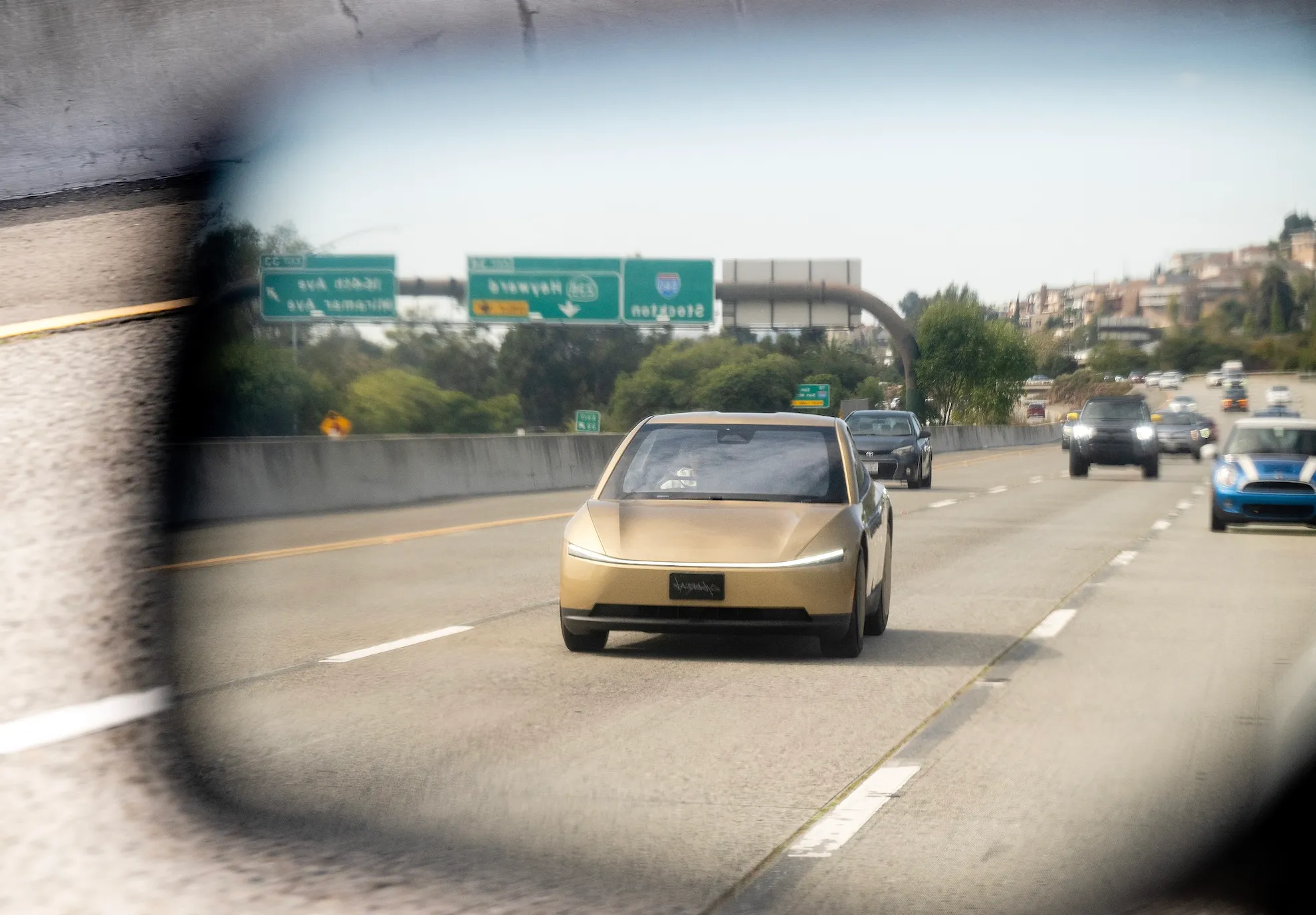
This latest regulatory move is part of a broader effort by federal authorities to update safety standards, aiming to speed up the safe adoption of autonomous vehicles across the country, according to NHTSA administrator Jonathan Morrison. The agency is actively working on a comprehensive federal automated vehicle framework and attempting to update Federal Motor Vehicle Safety Standards (FMVSS) to accommodate modern designs. Traditional FMVSS rules were never designed for futuristic vehicles like the Tesla Cybercab or the Zoox robotaxi, which lack standard federally required equipment such as pedals and steering wheels, as well as conventional design features like side mirrors and rearview mirrors.
While federal regulators wrestle with the logistics of governing the future of transportation, legacy automakers are aggressively staking their claims. General Motors recently laid out its strategic roadmap during its annual GM Forward event, demonstrating how it intends to compete globally, particularly against rising Chinese automakers. Building on its previous push into AI, GM announced a massive technological overhaul of the electrical and computational architecture inside its future vehicles.
The U.S. automaker’s strategy is designed to deliver faster software updates, more capable automated driving features, and a custom, conversational AI assistant that will completely modernize its 30-year-old OnStar service. This sweeping technological transformation is scheduled to debut in 2028 with the luxury Cadillac Escalade IQ. Alongside this hardware and software refresh, GM plans to roll out an advanced autonomous highway driving feature in 2028. This system will allow drivers to take their hands and eyes completely off the road without needing to remain ready to take over manual control. Furthermore, GM has integrated enterprise AI across its entire corporate structure to cut its traditional four- to five-year vehicle development timeline cleanly in half.

Deals and Industry Acquisitions
The intersection of artificial intelligence and transportation continues to drive intense consolidation and investment across the startup landscape. The latest example of this trend is Rivian’s acquisition of Third Dimension, a U.K.-based startup founded by veterans of the gaming and autonomous vehicle industries. Third Dimension specializes in utilizing artificial intelligence to transform flat images and videos into lifelike, interactive three-dimensional worlds.
For Rivian, this acquisition is entirely about simulation and closing the data gap between real-world driving environments and virtual scenarios—a challenge often referred to in the industry as closing the "sim-to-real gap." James Philbin, Rivian’s head of autonomy, emphasized that the company recognized it needed technology capable of bringing real-world driving data into virtual worlds that accurately mirror physical reality. While seasoned observers of the autonomous vehicle sector might note that simulation has been a staple of AV development for years, the underlying technology continues to evolve rapidly, making specialized startups like Third Dimension highly sought-after acquisition targets. Financial terms of the deal were not disclosed, though the startup previously raised a $7 million seed round and employs approximately 15 engineers.
Other notable deals are reshaping the global mobility landscape. Ride-hailing company inDrive, widely known for letting passengers and drivers directly negotiate fares, has partnered with Chinese autonomous driving firm Pony.ai and tech giant Nvidia to begin testing robotaxis in Kazakhstan by 2027. The companies have signed a memorandum of understanding to explore integrating Pony.ai’s autonomous vehicle technology directly into inDrive’s existing platform.
Meanwhile, Reliable Robotics, an aviation startup founded by SpaceX alumni that aims to commercialize autonomous flight technology capable of being installed on existing aircraft, has successfully raised $115 million. The funding round included $90 million in equity led by Nimble Partners and $25 million in debt financing from Silicon Valley Bank. This latest extension brings the startup’s total Series D funding to $275 million and pushes its corporate valuation past the coveted $1 billion mark.
Notable Reads and Industry Tidbits
The political and social friction surrounding autonomous vehicles continues to mount. Recent reporting by the Washington Post highlighted mysterious origins behind a political group actively campaigning to block robotaxis in Washington, D.C. This mirrors similar anti-robotaxi efforts observed earlier in the year, such as the Coalition for Accountability and Road Safety, which engaged in voter canvassing and social media campaigns. Investigative reporting previously revealed that the organization was registered to an employee of a New York lobbying firm with historical ties to labor unions and the New York Black Car Operators’ Injury Compensation Fund.
In manufacturing news, General Motors is closing a plant south of Detroit that previously assembled battery packs for Cadillac’s flagship electric vehicle, the Celestiq, as well as electric drive units and battery packs for the plug-in hybrid Chevrolet Corvette E-Ray. According to a GM spokesperson, the closure is unrelated to the automaker’s broader electric vehicle strategy and stems simply from the fact that the site’s commercial lease was nearing its expiration.

Tech giants are also pushing deeper into the in-vehicle AI space. Google announced upgrades to Gemini in vehicles, introducing a personal intelligence feature capable of drawing contextual data from Gmail, Google Calendar, YouTube, Maps, and Google Search history. The system is designed to understand user preferences, daily activities, and past experiences to provide a more tailored driving and passenger experience.
Rivian CEO RJ Scaringe recently shared his vision for how vehicle autonomy will eventually allow his company to design radically different types of vehicles compared to the R1S electric pickup truck and the R1S and R2 SUVs currently in production, turning industry speculation toward the anticipated R4 platform.
Meanwhile, Tesla and SpaceX reported their third-quarter earnings, with comments from CEO Elon Musk fueling intense speculation regarding a potential corporate merger. Musk disclosed that the boards of directors at both companies have established special committees specifically to review a potential combination.
Financially, SpaceX’s artificial intelligence business is booming, generating $7.5 billion in revenue and now accounting for 52% of the company’s total income. In contrast, Tesla reported flat revenue across its various segments alongside growing operational expenses, resulting in a 43% year-over-year drop in profits. Despite the financial squeeze, Musk remains intensely focused on Tesla’s AI and robotics future. The company has officially initiated production of its Optimus humanoid robot in California, reported strong growth in Full Self-Driving subscriptions despite delays to its "unsupervised version" pushed back to the second quarter of next year, and reiterated plans to begin selling its purpose-built Cybercab to customers before the end of the year.
On the robotaxi front, Waymo is aggressively expanding both domestically and internationally. The company announced plans to launch a commercial robotaxi service in Spain, starting with Madrid, with public rider access expected by 2027. Domestically, Waymo has officially commenced passenger operations servicing Harry Reid International Airport in Las Vegas.