In the current technological landscape, the raw power of large language models (LLMs) has increasingly become a commodity. As foundation models grow more accessible and sophisticated, the ability to generate a coherent response is no longer the primary differentiator for enterprises. Instead, the competitive frontier has shifted toward a more nuanced and proprietary asset: the context of the business itself.
Industry leaders are discovering that true competitive advantage lies in the deep, institutional knowledge that defines a company—the unique interplay of customer relationships, complex transaction histories, product usage patterns, and internal documents. This context is what transforms an AI from a mere content generator into a functional partner capable of understanding the business and executing tasks on its behalf. However, this intelligence is often trapped in a fragmented ecosystem of disparate platforms, including CRM systems like Salesforce, data warehouses like Snowflake, and a multitude of other enterprise applications.
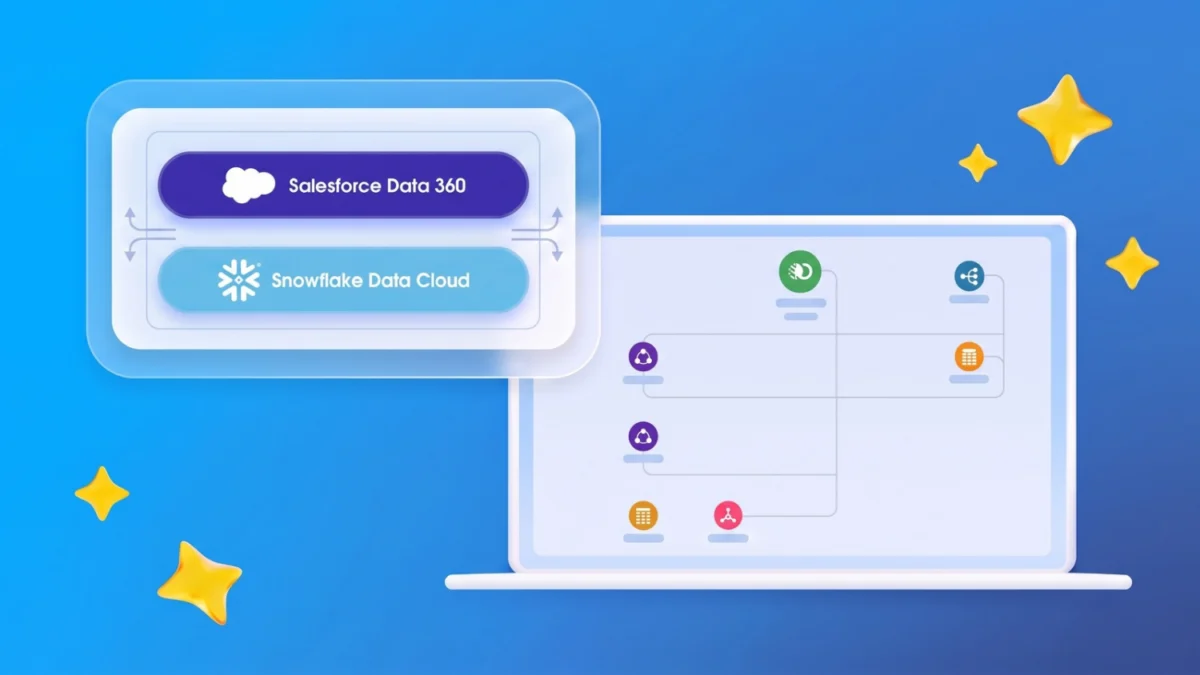
To address this challenge, Salesforce has championed its Data 360 initiative, further solidified by a deepened "Zero Copy" partnership with Snowflake. This collaboration is designed to dismantle the silos that prevent organizations from harnessing their enterprise context, allowing businesses to connect and utilize their data seamlessly without the burden of constant migration.
From Enterprise Data to Enterprise Context
At the recent Dreamforce event, Salesforce and Snowflake showcased how their combined architecture can bridge the gap between raw, distributed enterprise data and the actionable, trusted context required by human workers and autonomous AI agents. The core of this advancement is the evolution of data into intelligence, following a deliberate progression: data, semantics, context, and finally, action.
Data alone is insufficient for the modern "agentic" enterprise. For an AI agent to function effectively, it must grasp the semantic meaning of information, understand how various data points relate to one another, maintain a form of institutional memory, adhere to strict governance protocols, and discern which actions are safe to perform. The Data 360 framework, serving as the context engine, is designed to facilitate this journey.
Central to this architecture is the Agent Context Engine (ACE). ACE functions as a unifying layer that aggregates structured data, unstructured content, knowledge graphs, and agent memory. By doing so, it provides agents with real-time, relevant context in a format that allows them to reason more effectively across different channels and LLM providers. Crucially, the bidirectional Zero Copy access to Snowflake ensures that this context is grounded in governed enterprise data, eliminating the need to create redundant copies of data that already reside in Snowflake. This integration not only improves the accuracy of AI outputs but also addresses critical concerns regarding latency, governance, and operational efficiency.
Unlocking Trapped Data by Breaking Down Data Boundaries
The partnership between Salesforce and Snowflake is built on a shared philosophical foundation: companies should not be forced to choose between the openness of their data architecture and the intelligence of their AI systems. For years, the industry has been plagued by the "ETL tax," where massive datasets must be moved between platforms through complex extract, transform, and load (ETL) pipelines just to make them useful for analytics or AI. This not only consumes time and resources but also leads to data fragmentation and governance risks.
By leveraging Zero Copy technology, Salesforce Data 360 can securely access Snowflake data directly where it resides. This approach allows organizations to preserve their existing technology investments, governance models, and data architectures while simultaneously unlocking that data to power customer experiences, employee workflows, and sophisticated AI agents.
The success of this strategy is evidenced by the scale of its adoption. At Dreamforce, Snowflake was recognized as the "2026 System of Context Partner of the Year," a testament to the growth of the collaboration. Currently, more than 1,000 joint customers are leveraging this native Zero Copy integration, with a staggering 71 trillion rows of data now connected across the two platforms—a fourfold increase compared to the previous year.
Saptarshi Mukherjee, Senior Director of Product Management, emphasized the necessity of this shift. He noted that without governed context and clear business semantics, agents are prone to producing "hallucinations" or confident answers built upon incorrect assumptions and inconsistent definitions. The collaboration between Salesforce and Snowflake is effectively solving this bottleneck by ensuring that agents are tightly grounded in trusted, existing data.
Taking Zero Copy Further
The evolution of the Zero Copy architecture is moving beyond the simple elimination of data movement. Both companies are now extending this foundation across open table formats, cloud environments, and governance frameworks to provide a more robust and flexible context layer for global enterprises.
For customers, this means the new v2 Zero Copy connector removes significant friction. Teams building AI solutions on Snowflake using Cortex AI can now access fresh Salesforce data directly, without relying on cumbersome ETL processes. Data 360 objects are now rendered as native Iceberg-backed tables within a customer’s Snowflake account, making them immediately queryable with standard SQL and compatible with advanced tools like Streams and Dynamic Tables for real-time change data capture.
Early adopters of these integrated workflows report transformative results. Mike Doll, VP of Data at Guitar Center, described the bidirectional Zero Copy integration as a significant leap forward, noting that it has fundamentally changed how the company serves its customers. Similarly, Ranjith Ramesh, a Senior Engineering Manager at Indeed, highlighted that the ability to build a live, connected data layer has been instrumental in powering everything from demand routing to their internal AI platform. As they scale their agentic workflows, the convergence of Salesforce and Snowflake continues to serve as a critical infrastructure backbone.
Bridging Enterprise Data and AI
As the industry moves toward an agentic future, the ability to connect data is merely the starting point. The true challenge lies in ensuring that context can move securely and consistently across agents, applications, and workflows while retaining its precise meaning.
This is the next frontier for enterprise AI: not simply the aggregation of larger volumes of data, but the creation of a common, governed understanding of the business that is accessible to both humans and machines. By fostering an ecosystem where context travels seamlessly across platforms, Salesforce and Snowflake are providing the scaffolding for a new generation of intelligent enterprise applications.
This development represents a departure from the "black box" approach to AI. By prioritizing transparent, governed, and highly contextual data layers, enterprises can finally realize the potential of AI as a reliable, scalable, and deeply informed partner in business operations. As the integration between Salesforce Data 360 and Snowflake continues to deepen, the focus remains on the ultimate goal: empowering every agent and every employee with the trusted context necessary to act with precision and confidence.