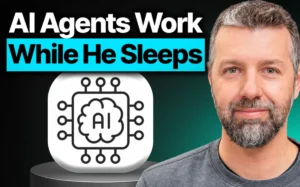
For small e-commerce businesses, providing live telephone customer support has long been an expensive and often unattainable luxury. Limited staff and tight operating budgets mean that customer service inquiries are typically funneled through email, web forms, or chat interfaces. However, recent advancements in artificial intelligence are beginning to bridge that gap. Eric Bandholz, the founder of the grooming brand Beardbrand, recently demonstrated how accessible this technology has become by creating a fully functional, custom-voiced customer service agent in roughly a single day without any professional software development experience.
Bandholz built the synthetic voice agent utilizing Grok Bot, the agent platform from xAI, alongside the Grok Voice API provided by SpaceXAI. For Beardbrand, a lean direct-to-consumer enterprise operating with a core team of just 10 employees, the financial and logistical burden of staffing a dedicated call center has always been out of reach. Synthetic voices generated by AI agents represent a practical solution to this long-standing operational challenge.
The successful deployment marks a continuation of Bandholz’s growing reliance on the Grok ecosystem. Over the past year, he has integrated the platform into various aspects of his daily business operations, utilizing it to generate imagery for his blog posts and to pull complex data from Shopify reports. By feeding these analytical numbers directly into Excel spreadsheets through Shopify’s integration with Grok Bot, Bandholz has streamlined internal workflows well beyond customer-facing tasks.
The inspiration to tackle voice AI specifically came after speaking with Will Roman of Chisos Boots, another direct-to-consumer brand that successfully implemented AI-agent voice calls for customer support. After reviewing an actual recorded interaction between the Chisos AI agent and a live customer, Bandholz decided to explore whether a similar system could be tailored to address Beardbrand’s specific product catalog and customer advisory needs.
What makes the development notable is Bandholz’s self-assessed technical background. Positioning himself on a skill scale from one to ten—where a ten represents a seasoned software developer—Bandholz places himself at around a four. While he is comfortable navigating APIs, updating DNS settings, and manipulating WordPress templates for his Shopify-backed store, he emphasizes that he does not know how to write code. Despite these technical limitations, modern low-code and agentic platforms allowed him to complete the functional aspects of the voice agent in a single day.
Conversation
To demonstrate the capabilities of the newly minted agent, Bandholz shared a transcript of a test conversation where he acted as a hypothetical Beardbrand customer seeking personalized grooming advice.
The interaction begins with the automated voice greeting the caller on a recorded line, immediately establishing the purpose of the call. When Bandholz explains that he is trying to decide which products would suit his two-month-old beard, the bot responds conversationally, asking clarifying questions about the length, texture, and current maintenance routine of the facial hair.
As the conversation progresses, the bot notes that an inch-long beard is at a stage where styling becomes possible and inquires about scent preferences. Bandholz describes his ideal fragrance profile as resinous, dark, and mellow. Drawing directly from Beardbrand’s product line, the AI agent immediately suggests suitable matches, highlighting "Temple Smoke" for its deep, warm resins combined with palo santo, frankincense, and patchouli, as well as "Norse Winter" for its pine and sacred resin notes.
When Bandholz asks which of the two options is more popular, the bot accesses relevant product data to explain that Norse Winter recently won a major community poll for a permanent fragrance with over 5,000 votes and boasts thousands of positive reviews. The agent recommends the 1.7-ounce bottle of Norse Winter Beard Oil priced at $29, noting its expected longevity.
Addressing security and practical constraints, the bot explains that it cannot process payments directly over the phone. Instead, it offers to generate a draft order within Shopify and email the checkout link directly to the customer. After confirming Bandholz’s email address, the agent successfully queues the draft order, concluding the interaction smoothly and efficiently.
Serve Customers
The dialogue illustrates how synthetic voice agents can move beyond rigid, tree-based automated phone menus to deliver genuine, context-aware information to consumers. Building the agent required Bandholz to utilize the X Premium Plus plan, which costs $40 per month. Looking ahead, he plans to further optimize the bot for Cloudflare hosting and integrate text messaging capabilities, such as Twilio, to handle broader communication channels.
To ensure the system is ready for real-world application, Bandholz plans to have members of his private community, the Alliance, test the agent by placing actual trial orders. Expressing enthusiasm for the underlying technology, Bandholz credits platforms from Grok and SpaceX, alongside other e-commerce utilities, with enabling small teams to elevate their customer service standards to levels previously reserved for much larger corporations.