When online retailers analyze their traffic sources, traditional metrics often tell a familiar story dominated by search engines, social media platforms, direct visits, and paid advertising campaigns. However, as generative artificial intelligence tools increasingly shape consumer behavior and product discovery, many businesses are finding that standard analytics tools fail to capture the full picture of how customers actually arrive at a digital storefront. For one family-owned florist in Spain, looking beyond surface-level traffic reports revealed a surprising and highly lucrative shift in consumer behavior: artificial intelligence was quietly driving a massive share of their online revenue.
José Pérez Sánchez, operating out of Spain as part of the family-run business Persa Flores, discovered this unexpected growth channel after closely tracking customer acquisition data. Prompted by ongoing industry discussions regarding the complexities of measuring AI-driven ecommerce traffic, Pérez Sánchez investigated his own company’s sales records. What he found was remarkable: beginning in September, a staggering one in every five online orders placed with the florist originated from customers who had discovered the business through ChatGPT.
The findings, which Pérez Sánchez later published on the company’s website, highlight a growing blind spot in modern ecommerce analytics. According to the florist, AI-referred shoppers can be remarkably difficult to identify without conducting a granular review of order-level attribution. While digital storefront platforms meticulously log the customer journey, standard analytics configurations frequently obscure the true origin of traffic generated by conversational artificial intelligence systems.
No Referrer
Understanding how these orders materialized required looking past conventional reporting categories. When examining how businesses track which channels successfully lead to sales, platforms like Shopify record comprehensive details regarding a customer’s first and last visits before completing a purchase. This data typically includes the referring site, the specific landing page with its full URL, and the exact timestamp of the interaction.
For Persa Flores, an order was classified as originating from ChatGPT whenever either the initial or concluding visit to the site stemmed directly from ChatGPT or OpenAI. Every single one of these transactions arrived bearing a specific tracking parameter, namely a link tagged with utm_source=chatgpt.com, which ChatGPT automatically appends to outbound links. Despite this automated tagging, only about one in eight of these transactions also displayed ChatGPT as the traditional referrer in standard web analytics. Consequently, any digital storefront that relies solely on checking standard HTTP referrers will inevitably miss the vast majority of this valuable traffic.
This discrepancy stems from technical definitions and privacy protocols. In technical parlance, the term "referrer" is traditionally spelled as "referer," denoting the exact URL a visitor was viewing immediately prior to arriving at a target website. Web browsers typically pass this referrer information within the HTTP header, allowing various analytics tools to read and categorize the visitor’s origin.
However, web analytics tools can frequently miss a referrer due to a wide variety of factors, including strict browser privacy policies, user security settings, or a protocol downgrade from a secure HTTPS connection to a standard HTTP connection. When this data is lost, analytics programs routinely mislabel the incoming traffic as "direct" or "unknown." In the case of Persa Flores, these default classification labels had been effectively hiding a rapidly growing stream of high-intent visits from conversational AI.

A Flourishing Channel
Once the marketing team at Persa Flores successfully implemented order-level attribution to properly identify ChatGPT-driven transactions, the true impact of the channel became unmistakably clear. The data revealed a steady, accelerating climb in both order volume and revenue generation over the course of several months, demonstrating that conversational AI was rapidly transforming from a negligible curiosity into a primary engine of commercial growth.
The upward trajectory began in July, when ChatGPT accounted for just 4 percent of the florist’s online orders. By August, that figure tripled to 12 percent, before nearly doubling again in September to reach 21 percent. As the autumn season progressed, the momentum continued, with ChatGPT responsible for 23 percent of all online orders through October 27. The financial impact mirrored this volume growth. In July, AI-driven traffic accounted for a modest 2 percent of total online revenue. That share jumped to 11 percent in August, climbed to 18 percent in September, and reached 26 percent by late October. Across the combined months of September and October, ChatGPT consistently accounted for 22 percent of both total orders and total revenue. Looking at the broader four-month period from July through October, the channel accounted for 16 percent of total online orders and 15 percent of overall revenue.
While Pérez Sánchez chose not to disclose the company’s exact raw order counts, he emphasized that total online orders for the business were also growing during this exact timeframe. This means ChatGPT was not merely filling a void in a stagnant market; rather, it was actively gaining market share while the overall ecommerce operation was expanding.
Significantly, the vast majority of this remarkable growth occurred entirely organically, preceding any deliberate, strategic effort by the company to improve its visibility within ChatGPT. Pérez Sánchez noted that the family business did not implement specific optimization tactics tailored for the chatbot until mid-October, well after the surge in traffic and sales had already established itself as a major sales channel.
Follow the Order
Successfully identifying ChatGPT as a traffic and sales source was merely the first step. To better understand the phenomenon, Pérez Sánchez analyzed the behavior of these specific shoppers to determine how they interacted with the digital storefront.
The data revealed that every single ChatGPT-attributed order came from a brand-new customer. Shopify’s account and email history records showed no prior interactions or previous purchases from any of these specific buyers. Furthermore, the timeline of conversion was notably swift; the vast majority of these newly acquired customers completed their purchases within a single day of their initial recorded visit to the site.
Geographically, the customer base proved unique as well. Approximately half of the buyers utilizing this path paid from locations outside of Spain, typically utilizing the service to send floral arrangements to recipients located within the country. While the average order value for these AI-driven transactions remained roughly comparable to other online channels, Pérez Sánchez noted that the company does not track conversion rates by source with enough granular precision to make a direct, side-by-side comparison between ChatGPT and traditional traffic sources like Google. Nonetheless, the transactional data provided a clear and undeniable benefit that standard traffic reports routinely fail to capture: ChatGPT was consistently bringing in fresh customers and introducing entirely new pathways to purchase.
City Pages
A deeper dive into the navigation paths of these customers revealed a striking pattern regarding how they landed on the site. A remarkable 84 percent of ChatGPT-driven customers first arrived on a specific city landing page. By comparison, only about one-third of customers originating from Google search traffic landed on these same local pages.
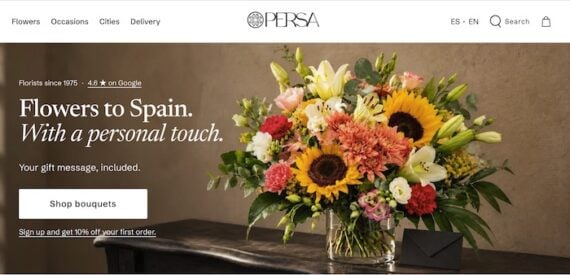
Persa Flores maintains a series of dedicated city pages specifically designed to facilitate sending flowers to various municipalities across Spain, including major destinations like Madrid, Marbella, Alicante, Gijón, Segovia, and A Coruña. Available in both Spanish and English, these pages provide detailed information about the florist alongside available bouquets, pricing structures, and local delivery options.
According to Pérez Sánchez, when a user asks a conversational artificial intelligence tool how to arrange a floral delivery to a specific town or city, a dedicated landing page tailored precisely to that exact query provides an ideal, direct answer for the model to reference and recommend.
While the creation of location-specific and intent-focused landing pages is far from a revolutionary concept in digital marketing—search engine optimizers have long utilized localized pages to align closely with specific user queries rather than relying solely on generic category or home pages—the fundamental difference in this context lies in the intermediary. Instead of a traditional search engine displaying a list of blue links, ChatGPT actively matches a user’s conversational question directly to a specific webpage containing the exact answer they are seeking.
Crucially, Persa Flores did not build or structure these city pages with artificial intelligence in mind. The pages were already fully established and operational long before the recent growth in AI-referred traffic, strongly suggesting that traditional, well-established search engine optimization practices can naturally translate into enhanced visibility and success within AI-driven shopping environments.
AI Attribution
For a family-owned business like Persa Flores, ignoring or failing to properly track ChatGPT traffic would have meant overlooking one of their most vital modern sales channels. As conversational artificial intelligence continues to reshape how consumers discover products and make purchasing decisions, the experience of the Spanish florist suggests that accurately identifying AI-driven sales requires merchants to look far beyond standard traffic reports and delve deeply into order-level attribution data.