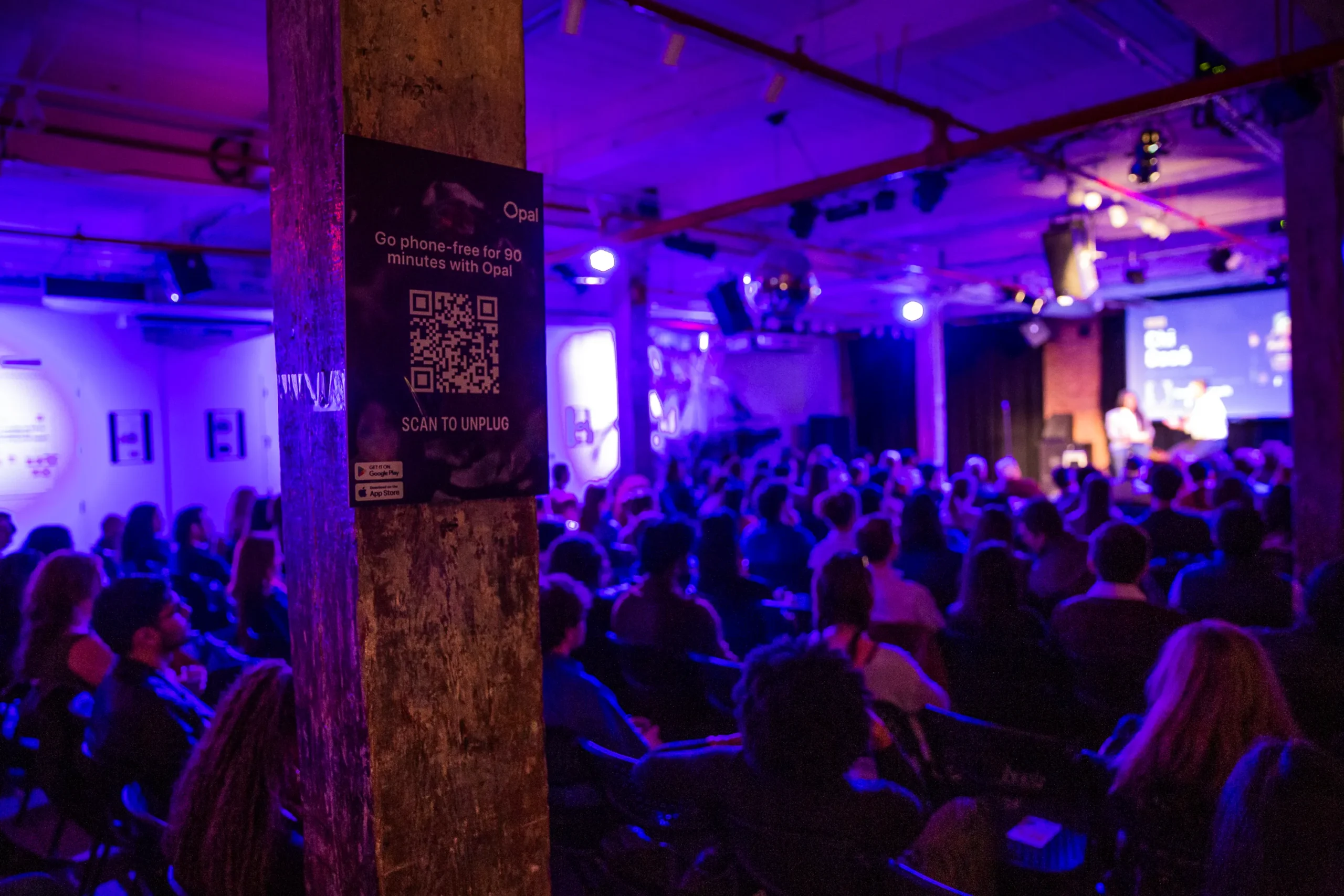
It was Thursday evening, and the dress code at the dimly blue-lit Brooklyn warehouse was unapologetically New York. Stepping out in neon yellow heels and a floral mini dress, the setting was a familiar haunt for media types, techies, and policy advocates. Hosted by Newsreel—the media startup founded by former Forbes and Newsweek reporter Jack Brewster—the event was billed as a high-minded gathering to discuss the impending midterm elections just days away. The lineup featured notable figures: Kenneth Schlenker, co-founder of the focus app Opal, sitting down for a fireside chat on “the state of attention,” and Aryan Banjan, creator of campaign software Barza, delivering a midterm forecast.
The stated goal of the evening, according to Brewster, was simple: to get people to put their phones away and talk about the election with less than a week left before voters headed to the polls. But as the evening progressed, a singular, dominating topic hijacked nearly every conversation on and off the stage, cutting through the standard political banter. AI, the infrastructure of data centers, and a deep-seated backlash against a rapidly advancing technocracy overshadowed traditional election handicapping.
For a tech reporter immersed in the industry daily, the friction can be easy to overlook. Spending hours talking to founders and developers who see only the undeniable benefits and boundless promise of artificial intelligence creates a sort of cognitive echo chamber. It is remarkably easy to forget how jarring, intimidating, and ugly that rapid expansion appears to those outside the tech bubble. But outside that insular world, data centers and AI have rapidly morphed into intense ballot-box issues—contentious local fights that political analysts say could sway several competitive midterm races.

Recent data underscores the scale of the friction. A report from Data Center Watch revealed that nearly $200 billion worth of data center projects were delayed, stalled, or blocked in the first half of the year due to intense political pushback and community opposition. At the same time, states like Pennsylvania, Georgia, Texas, New York, and Virginia are scrambling to implement stricter guardrails and transparency measures around the breakneck development. In Virginia, already widely known as the data center capital of the world, hundreds of new facilities are proposed, sparking local friction that defies traditional partisan lines.
The night’s tone was set early during a fireside chat with New York City Council member Chi Ossé. When the conversation inevitably turned toward AI near the end of his session, Ossé admitted he rarely uses the technology. He positioned himself neither as an evangelist nor a doomsayer, instead focusing his critique on corporate accountability and wealth inequality, suggesting that trillionaires like Elon Musk should be taxed more heavily. Describing himself as a “law and order” democratic socialist, Ossé argued that when corporate executives promote a technology capable of profound societal disruption, they should be summoned to testify directly before Congress.
That sense of institutional skepticism carried directly into the panel on data centers, which featured Maia Woluchem, a technology and human rights researcher, and Hilary Flint, an environmental and public health advocate. Stepping onto the stage, an opening poll of the room set the baseline: asking who in the audience was pro-AI data center was met with immediate, unmistakable boos.
The ensuing discussion touched on a wide array of public frustrations. Chief among them is the growing anger over major technology companies allegedly cutting secret, non-disclosed deals with local officials to fast-track billion-dollar infrastructure projects. In many municipalities, arcane zoning laws mean residents have little to no visibility into what is being constructed in their backyards until it is far too late to mount an effective protest.

At a time when everyday citizens are grappling with the rising cost of living and struggling to preserve their vision of the American Dream, hearing tech leaders casually discuss automation replacing human labor—or even human existence—creates a profound sense of alienation. Communities feel stripped of self-determination, left to worry about massive energy consumption, environmental degradation, and health risks. Panelists agreed that these sprawling, windowless server farms have become the physical manifestation of deep public anxiety and anger directed at the tech class.
“What is a life worth?” Flint asked the room when the discussion turned toward the economic sweeteners and temporary financial benefits that tech companies often dangle before cash-strapped local governments. Residents continue to organize protests, she noted, because they value their health and local ecosystems far more than a temporary corporate check.
The subsequent panel, ostensibly dedicated to the future of the Democratic Party, featured NewsNation host Batya Ungar-Sargon, political strategist Morris Katz, and Vox’s Astead Herndon. Yet, true to the evening’s overriding theme, the conversation quickly veered back to infrastructure and industry footprint. Ungar-Sargon pointed out that some labor unions support data center developments because of the initial wave of high-paying construction jobs they promise. However, industry studies consistently show that while construction phases are lucrative, the permanent operational jobs left behind are remarkably few.
Drawing a parallel to historical industry shifts, Ungar-Sargon noted that past generations took immense pride in heavy industrial architecture in regions like the Rust Belt because those massive, imposing buildings guaranteed stability and prosperity. Those structures symbolized a tangible stake in the American Dream.

Herndon referenced a similar dynamic playing out in the Midwest, noting that Republican figures like Vivek Ramaswamy had faced hostile receptions in places like Ohio when attempting to champion tech expansion. Herndon emphasized a core theme of the backlash: a profound lack of local consent. Katz echoed the sentiment, framing the current wave of tech expansion through the lens of historical economic displacement. He argued that the same institutional powers that oversaw the decline of traditional manufacturing and union labor are now returning to consume whatever local stability remains.
Along the perimeter of the warehouse, interactive displays invited attendees to pin sticky notes addressing pressing political questions. One prominent prompt asked whether big money would ever be successfully purged from politics. A handwritten response taped nearby captured the prevailing mood of the room: “God, I hope so.”
As the panels concluded and the warehouse transitioned into a networking hour underscored by thumping techno music, attendees clustered in tight circles to continue debating the societal impact of AI and data centers. Reflecting on the evening, Brewster expressed little surprise at how thoroughly the technology dominated the discourse. He noted that infrastructure and AI were mentioned on every single stage and ranked as the second most common topic submitted by RSVPs prior to the event.
Even in an urban center like New York, where massive data centers are largely out of sight, AI has solidified its place as a genuine election issue for everyday voters. In rural regions, the backlash stems from a profound fear of economic replacement and displacement, whereas in metropolitan hubs like Brooklyn, the anxiety centers around questions of accountability and equitable wealth distribution.

Conversations lingering near the exit touched on the broader cultural fatigue surrounding generative technology. Several attendees pointed to the rapid proliferation of low-quality deepfakes and AI-generated art, noting that synthetic media is increasingly associated with cheapness and lack of authenticity. That cultural pivot may explain why high-end luxury brands are deliberately moving in the opposite direction; recent campaigns from fashion houses like Prada have leaned heavily into hand-drawn illustrations, while Hermès has amplified the handmade work of traditional artists across social media.
For one software engineer heading out into the night, the cultural saturation of tech was inescapable, recalling an anecdote about a Halloween manicure mistakenly interpreted by peers as a subtle tribute to an enterprise tech IPO. Another attendee noted that data centers are quietly proliferating in her Southern California hometown, emerging within immigrant neighborhoods where residents have begun posting yard signs depicting stylized dragons choking server towers—imagery that has required translation into multiple local languages to accommodate the affected community.
Stepping back out into the New York night, the contrast between the insular optimism of Silicon Valley and the grassroots anxiety rippling across America felt sharper than ever, proving that the future of technology is no longer just a boardroom debate—it is a frontline political issue.